
1.2.19 Przejścia poziomowe
Oto najważniejsze zasady dotyczące przejazdów kolejowych, szlabanów, migających świateł, krzyży Andrzejkowych i pierwszeństwa pociągu w łatwy i zapadający w pamięć sposób.
🧠 Zasady szybkiej pamięci
🚦 Czerwone migające światło
Zatrzymaj się bezpośrednio przed Krzyż św. Andrzeja.
🚧Opuszczanie Bariery
Nigdy nie przejeżdżaj, gdy bariery zaczną się obniżać.
🚂 Priorytet pociągu
Pojazdy szynowe zawsze mają pierwszeństwo.
⚠ Niebezpieczeństwo korka
Nigdy nie wchodź na przejazd, jeśli możesz zatrzymać się na szynach.
🛑 Kiedy MUSISZ się zatrzymać
🚫 Natychmiast zatrzymaj się
- Pojawiają się czerwone migające światła
- Bariery zaczynają się obniżać
- Bariery są zamknięte
- Pracownik kolei macha flagą
- Pracownik kolei przejeżdża na czerwonym świetle
⚠ Dlaczego to jest ważne
- Pociągi jeżdżą bardzo szybko
- Pociągi potrzebują długiej drogi hamowania
- Bariery zamykają się szybko
- Pojazdy mogą zostać uwięzione
✖ Regulamin Krzyża Św. Andrzeja
| Znak / Sytuacja | Oznaczający | Co musisz zrobić |
|---|---|---|
| Krzyż św. Andrzeja | Pociąg ma pierwszeństwo | Poczekaj, jeśli nadjedzie pociąg |
| Czerwone migające światło | Przejście zablokowane | Natychmiast przestań |
| Strzałka migająca | Dotyczy ruchu skręcającego | Skręcające pojazdy muszą się zatrzymać |
| Symbol błyskawicy | Elektryczna linia napowietrzna | Ważne w przypadku wysokich pojazdów |
✅Jak bezpiecznie przejść przez jezdnię
🚗 Bezpieczne zachowanie podczas jazdy
- Zmniejsz prędkość przed przejściem
- Przyjrzyj się uważnie w obie strony
- Słuchaj zbliżających się pociągów
- Przejdź szybko i bezpiecznie
- Zachowaj czujność nawet przy otwartych barierach
❌Niebezpieczne zachowanie
- Jazda wokół barier
- Zatrzymanie na szynach
- Śledzenie na ślepo innych samochodów
- Ignorując migające światła
- Przejazd w czasie korków
⭐ Sytuacje specjalne
🚛 Ciężarówki powyżej 7,5 t
Poza terenem zabudowanym pojazdy ciężkie i pojazdy z przyczepami często muszą czekać za 80-metrowym znacznikiem.
🏭 Tereny przemysłowe i leśne
Spodziewaj się niezabezpieczonych przejazdów kolejowych bez szlabanów i migających świateł.
🚨 System uszkodzonych barier
Nigdy nie przechodź, jeśli system szlabanu wydaje się uszkodzony. Natychmiast powiadom policję.
🚩 Sygnały personelu kolei
🚩 Flaga biało-czerwono-biała
Przejście jest zablokowane. Musisz się zatrzymać i poczekać w bezpiecznej odległości.
🔴 Czerwone światło przez personel kolei
Tory są niedostępne, a pierwszeństwo mają pociągi. Nie przekraczaj.
🎯 Łatwe wskazówki dotyczące egzaminu
- Pociąg zawsze ma pierwszeństwo
- Zatrzymaj się na migających czerwonych światłach
- Nigdy nie zatrzymuj się na szynach
- Otwarta bariera NIE oznacza automatycznie bezpieczeństwa
- Przejazd w czasie korków
- Jazda wokół barier
- Ignorowanie pracowników kolei
- Zbyt wczesne podążanie za innymi pojazdami
Practice Questions (19)
-
Question 1 of 19
Kiedy musi Pani/Pan czekać przed przejazdem kolejowym?
1.2.19-0023 PunktówWyjaśnienie
All road users are required to stop and wait immediately before a level crossing in the following situations: when the signal system's red flashing light comes on, when the barriers start to lower, when the barriers are closed, when a staff member waves a white-red-white flag , You must wait until the blockage is released again.
-
Question 2 of 19
Pracownik kolei powiewa czerwoną latarnią na przejeździe kolejowym. Co to oznacza?
1.2.19-0043 PunktówWyjaśnienie
All car drivers and other road users must wait at a safe distance before the crossing if a member of the railway staff secures a low-traffic level crossing with a red light. Waving the red light means that the tracks are inaccessible and trains have priority.
-
Question 3 of 19
Przy wjeździe na teren przemysłowy ustawiony jest krzyż św. Andrzeja z dodatkową tabliczką "Teren przemysłowy. Pojazdy szynowe mają pierwszeństwo". Czego należy przestrzegać?
1.2.19-0083 PunktówWyjaśnienie
Even if there are no barriers and no diagonal crosses at the level crossings in the entire industrial area, motor vehicle drivers must give priority to all rail vehicles. Always expect a train to come, observe the railway lines accurately and approach the tracks only with moderate speed.
-
Question 4 of 19
Położenie szlabanów kolejowych nie zmieniło się od dłuższego czasu. Jaki jest właściwy sposób zachowania się?
1.2.19-0094 Punktów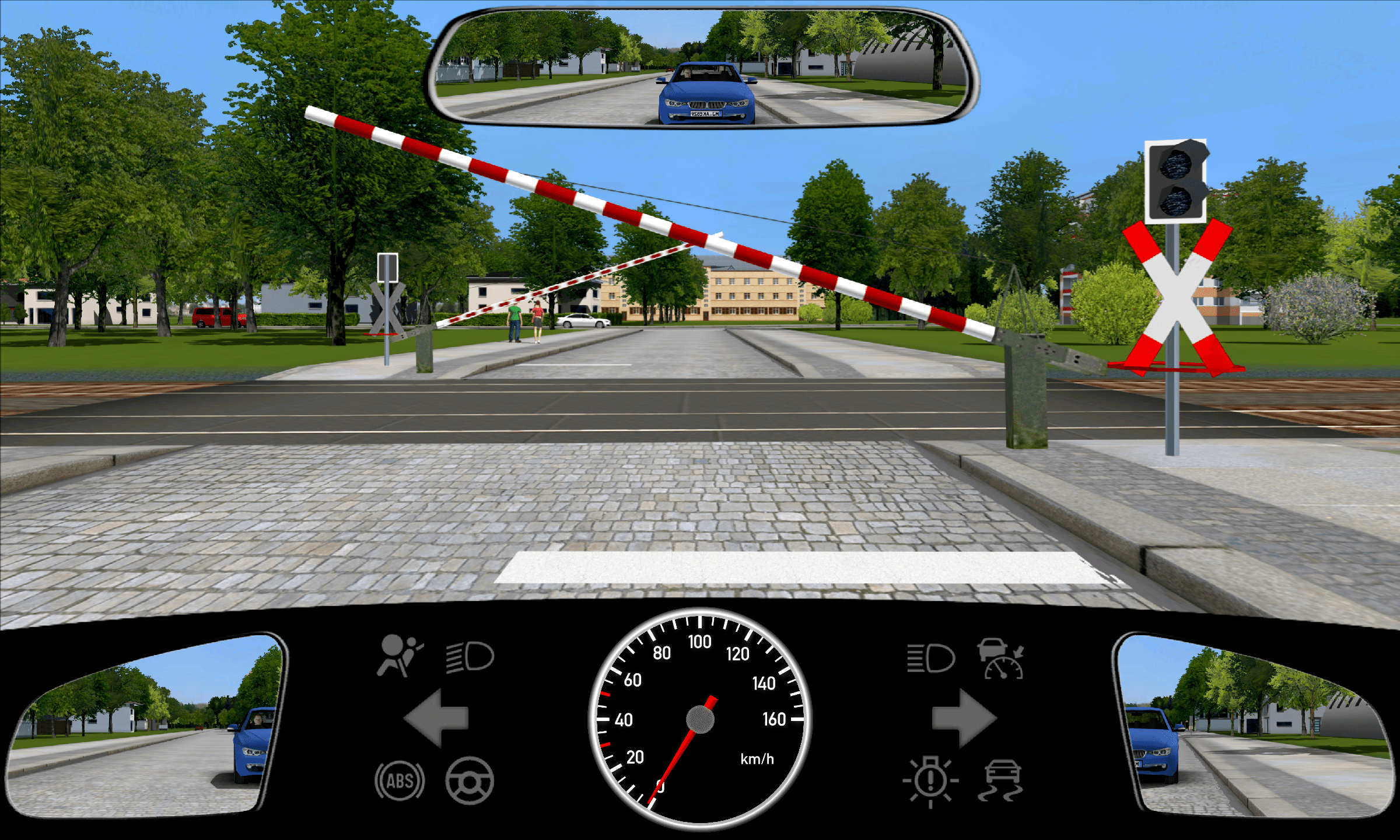
Wyjaśnienie
Apparently there is a fault with the railway barrier. It is therefore not safe to use the railway crossing. Do not cross the railway crossing under any circumstances; if a train is approaching, there is an acute danger to your life and there is also a risk that you will not be able to get through under the barriers and get stuck. Inform the police about the fault at the railway crossing so that the problem can be fixed.
-
Question 5 of 19
Jedzie Pani/Pan drogą leśną i zbliża się do przejazdu kolejowego bez krzyża św. Andrzeja. Jak się Pani/Pan zachowa?
1.2.19-1013 PunktówWyjaśnienie
Even without the diagonal cross, a car driver must always give priority to a rail vehicle on field and forest paths. Approach the railroad crossing at moderate speed and listen for a train approaching. Observe the track and stop, if necessary, to let the rail vehicle pass.
-
Question 6 of 19
Jak zachowuje się Pani/Pan na przejeździe kolejowym z zamkniętymi zaporami?
1.2.19-1023 PunktówWyjaśnienie
At a level crossing with closed gates, all car drivers have to wait in front of the diagonal cross. If there is no traffic sign, a safe distance to the rails must be observed. Be careful not to block intersections or T-junctions when waiting. In the dark, lighting must be switched on, parking light is sufficient.
-
Question 7 of 19
Kiedy można przejeżdżać przez przejazd kolejowy z migającą sygnalizacją świetlną i bez zapór po przejechaniu pociągu?
1.2.19-1043 PunktówWyjaśnienie
You may only cross the level crossing after the red flashing light turns off, as another train could follow. Do not be fooled by oncoming traffic to drive on if the car driver waiting on the opposite site already starts driving too early after the train has passed through.
-
Question 8 of 19
Zbliża się Pani/Pan do przejazdu kolejowego z zaporami. Gdzie należy czekać, jeżeli ze względu na zator drogowy musiałaby Pani (musiałby Pan) zatrzymać się na przejeździe kolejowym?
1.2.19-1053 PunktówWyjaśnienie
If you are unable to pass the railroad crossing quickly due to slow traffic, then stop in front of the diagonal cross. Waiting directly in front of the rails or at the level of the barriers is prohibited, because at these positions you may be hit by the dynamic pressure of the train, by the train itself or trapped by the barriers.
-
Question 9 of 19
Na przejeździe kolejowym na terenie zabudowanym zamknięta jest zapora. Gdzie musi Pani/Pan czekać?
1.2.19-1073 PunktówWyjaśnienie
Trucks and vehicles with trailers (vehicles over 7.5 t permissible total mass) are only required to wait outside of built-up areas behind the level crossing (80 m) ahead marker. Inside a built-up area they have to wait in front of the diagonal crosses.
-
Question 10 of 19
Co oznacza ten znak drogowy?
1.2.19-1093 Punktów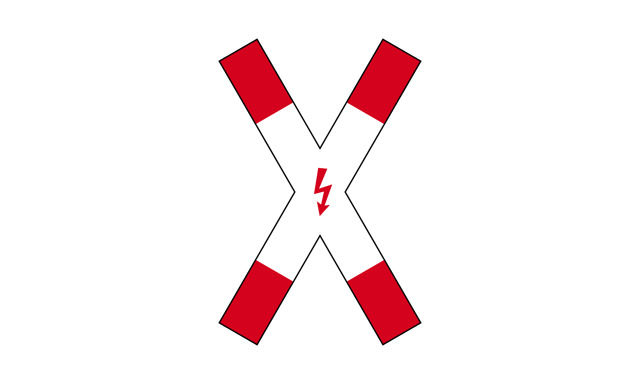
Wyjaśnienie
The diagonal crosses indicate that rail transport has priority here. As a car driver you need to wait when a rail vehicle is approaching. A lightning bolt in the diagonal cross is an indication of an electrical overhead line, which is important for special transports with a big height.
-
Question 11 of 19
Przed przejazdem kolejowym przy ulicy, dochodzącej z prawej strony, znajduje się czerwony, świecący sygnał świetlny bez krzyża św. Andrzeja. Gdzie musi Pani/Pan czekać?
1.2.19-1103 Punktów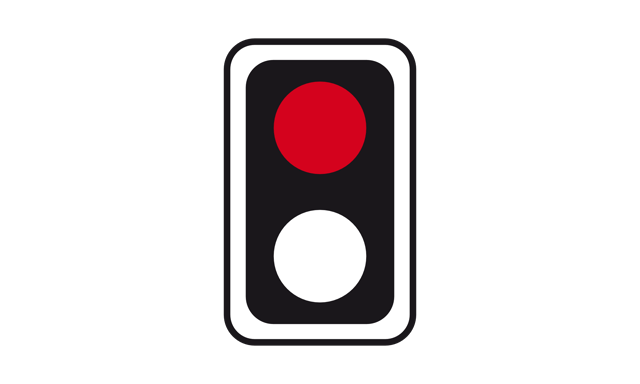
Wyjaśnienie
In the event of a red light, the car driver must stop in any case. In order not to block the traffic from the road going to the right, the red light is located several meters from the actual railroad crossing. Wait at the stop line or at the light sign if no line is available.
-
Question 12 of 19
Jak muszą się Państwo zachować w tej sytuacji?
1.2.19-1113 Punktów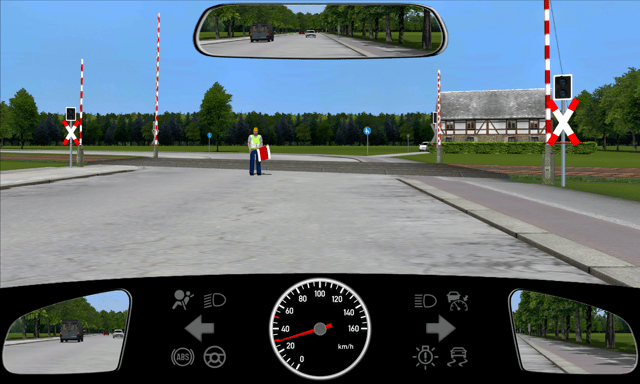
Wyjaśnienie
The railway employee secures the level crossing and therefore you should stop before the St. Andrew's cross.
-
Question 13 of 19
Kto musi czekać przy krzyżu św. Andrzeja z czerwonym migającym światłem w kształcie strzałki w prawo?
1.2.19-1123 PunktówWyjaśnienie
A diagonal cross with a red flashing light in the form of an arrow to the right can be found behind an intersection or T-junction after a railroad crossing. The right arrow indicates that the car drivers who turn right must wait.
-
Question 14 of 19
Na co wskazuje niniejsze zestawienie znaków drogowych?
1.2.19-1134 Punktów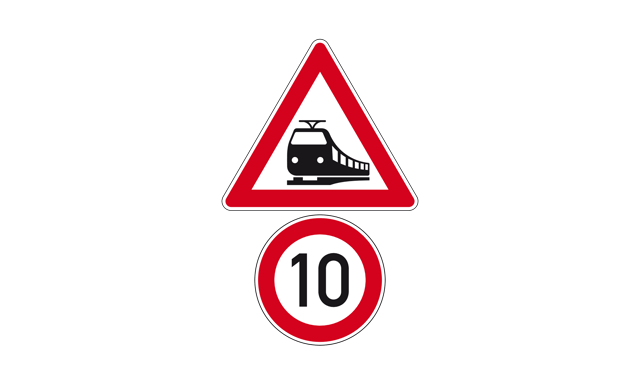
Wyjaśnienie
The traffic sign combination shows you a level crossing. The car driver may approach the level crossing only at 10 km/h and cross it at that speed.
-
Question 15 of 19
Jak należy zachować się teraz prawidłowo?
1.2.19-1144 PunktówWyjaśnienie
If there is a risk that you might come to a stop on the rails due to a traffic jam situation or stagnant traffic, stop in front of the diagonal cross and wait until you can safely and quickly cross the level crossing. Fatal accidents occur when a car standing on the rails cannot avoid the approaching train.
-
Question 16 of 19
Zbliżają się Państwo do przejazdu kolejowego. Szlaban zaczyna się obniżać. Jak należy się zachować?
1.2.19-1153 PunktówWyjaśnienie
When a driver approaches a gate that lowers, he/she must wait in front of the level crossing. This also applies if no rail vehicle is yet to be seen. Switching on the hazard light is not required.
-
Question 17 of 19
Gdzie muszą się Państwo liczyć z technicznie niezabezpieczonym przejazdami kolejowymi?
1.2.19-1163 PunktówWyjaśnienie
In industrial and port areas, on field and forest paths, as well as on roads with little traffic, you should expect a railway crossing without a barrier or traffic light (technically unprotected).
-
Question 18 of 19
Chcesz przejechać przez przejazd kolejowy z otwartymi szlabanami. Co musisz zrobić?
1.2.19-1173 PunktówWyjaśnienie
Even when the barriers are open, you must always approach level crossings with caution and at a moderate speed. This gives you enough time to react to possible bumps and dangerous situations. Moderate speed in this context does not mean walking speed, because you can also drive faster than walking speed. In this way you can prevent possible dangerous situations with approaching trains or lowering barriers.
-
Question 19 of 19
Jak należy postąpić teraz?
1.2.19-1183 PunktówWyjaśnienie
Level crossings may not be crossed when the flashing lights above the St. Andrew's Cross are on or the barriers are lowered.