
2.2.18 Autostrady i autostrady
Szybko i łatwo naucz się najważniejszych przepisów ruchu drogowego, aby przygotować się do egzaminu z teorii prawa jazdy z języka niemieckiego. Skoncentruj się na bezpieczeństwie, dyscyplinie na pasie ruchu, zachowaniu w sytuacjach awaryjnych i przepisach dotyczących opłat drogowych.
🚗 Zasady wyprzedzania i pasa ruchu
Bezpieczne wyprzedzanie
- Zachowaj bezpieczną odległość, gdy inny pojazd zmienia pas ruchu.
- Bądź przygotowany na wolniejsze pojazdy, nawet jeśli przyspieszają.
- W razie potrzeby zwolnij.
- Nie wolno nigdy agresywnie trąbić ani migać światłami tylnej klapy.
Wykorzystanie lewego pasa
- Lewy pas służy głównie do wyprzedzania.
- Jeśli to możliwe, trzymaj się prawej strony.
- Jeżeli jeden samochód wyprzedza, samochód jadący z tyłu również może go wyprzedzić.
🛣️ Wjazd i zjazd z autostrady
Pas przyspieszania
- Pasem przyspieszania możesz jechać szybciej.
- Przyspiesz odpowiednio przed połączeniem.
- Ruch główny ma pierwszeństwo.
- Zachowaj bezpieczną odległość.
Zjazd z autostrady
- Sygnalizacja co najmniej 300 m przed zjazdem.
- Skorzystaj z pasa wyjazdowego, aby zwolnić.
- Jeśli wyjście jest zablokowane, przejdź do następnego zjazdu.
- Nigdy nie zatrzymuj się ani nie cofaj.
⛔ Surowo wzbroniony na autostradzie
- Cofanie
- Odwracając się
- Zatrzymanie na jezdni
- Jazda tyłem do utraconego zjazdu
- Jazda po poboczu bez sytuacji awaryjnej
Pamiętać
Na autostradzie można jechać do przodu tylko w jednym kierunku. Naruszenie tych zasad jest niezwykle niebezpieczne.
🚑 Pas ratunkowy (Rettungsgasse)
Gdy ruch zatrzymuje się lub porusza się powoli:
- Utworzenie pasa ratunkowego dla policji i pojazdów uprzywilejowanych.
- Z 2 pasami → uformuj go pomiędzy lewym i prawym pasem.
- Z 3 pasami → uformuj go pomiędzy lewym i środkowym pasem.
- NIE używaj twardego ramienia.
Motocykle w korkach:
- Muszą zachowywać się jak samochody.
- Nie można jeździć pomiędzy pojazdami.
- Nie można używać twardego ramienia.
⚠️Światła ostrzegawcze o zagrożeniu
- Skorzystaj z nich, zbliżając się do korka.
- Ostrzegaj odpowiednio wcześnie o ruchu drogowym.
- Używaj ich podczas holowania.
- Przydatne podczas wypadków lub niebezpiecznych sytuacji.
Zasada holowania
Holowanie na autostradzie jest dozwolone tylko do następnego zjazdu. Obydwa pojazdy muszą używać świateł awaryjnych.
🏎️ Zasady prędkości
Minimalna prędkość
Z autostrady mogą korzystać wyłącznie pojazdy rozwijające prędkość większą niż 60 km/h.
Zalecana prędkość
Zalecana prędkość na niemieckich autostradach wynosi 130 km/h.
Nocna jazda
Nigdy nie jedź szybciej, niż pozwalają na to światła mijania.
🚨 Kierowca jadący pod prąd
- Jedź jak najdalej w prawo.
- Ostrzeż innych użytkowników drogi.
- Natychmiast powiadom policję.
💶 Zasady opłat drogowych (opłata LKW)
- Opłata dotyczy samochodów ciężarowych i zestawów powyżej 7,5 t.
- Odpowiedzialność ponoszą zarówno kierowca, jak i właściciel.
- Należy poprawnie wprowadzić klasę wagową i osie.
Ważny
Przed wjazdem na drogi płatne należy zawsze sprawdzić ustawienia OBU i liczbę osi.
📚 Krótkie fakty z egzaminu
Motocykle muszą przestrzegać tych samych przepisów drogowych, co samochody.
Wiadomości drogowe pomagają unikać korków, wypadków i kierowców jadących pod prąd.
Asystent zmiany pasa ruchu jedynie ostrzega — nie kieruje automatycznie.
Nie blokuj pojazdów wjeżdżających ze zjazdów, jeśli możesz bezpiecznie pomóc.
Jazda środkowym pasem jest dozwolona, gdy ruch prawym pasem byłby utrudniony.
Światła awaryjne w ciężarówkach często ostrzegają o korkach na przodzie.
🧠 Łatwe wskazówki dotyczące pamięci
W lewo = wyprzedzenie → w przeciwnym razie pozostań przy swoim.
Brak odwrotu. Bez zatrzymania. Bez zwrotu.
Korek = pas ratunkowy.
Przegapiłeś wyjście? → Weź następny.
Światła awaryjne = Niebezpieczeństwo przed nami.
Practice Questions (21)
-
Question 1 of 21
Jaka zalecana szybkość obowiązuje na autostradach dla samochodów osobowych i motocykli?
2.2.18-0032 PunktówPoprawnie: 130
Wyjaśnienie
On motorways cars and motorcycles have to keep an advisory speed limit of 130 km/h. In addition, driving on a freeway is only permitted to vehicles exceeding 60 km/h.
-
Question 2 of 21
Zbliża się Pani/Pan lewym z dwóch pasów ruchu do innego pojazdu, który właśnie wychyla się do wyprzedzania. Jak się Pani/Pan zachowa?
2.2.18-0064 PunktówWyjaśnienie
You allow this vehicle to overtake by maintaining a safety distance. As the vehicle changes from the right, be prepared that its speed is lower than yours despite acceleration. Slow your pace down, if necessary. Never tailgate, honk or flash.
-
Question 3 of 21
Jedzie Pani/Pan autostradą przy małym ruchu. Jak długo może Pani/Pan używać lewego pasa ruchu?
2.2.18-0073 PunktówWyjaśnienie
The left lane may generally only be used for the purpose of overtaking. If the preceding vehicle overtakes, it can be assumed that the following car driver will also overtake. Therefore, it is allowed here to use the left lane. In all other cases, you have to drive on the right.
-
Question 4 of 21
Co obowiązuje na drogach samochodowych (drogach szybkiego ruchu)?
2.2.18-0094 PunktówWyjaśnienie
You may only enter at intersections or T-junctions on motorways. Turning on motorways is prohibited. The regulations regarding speed differ from those that apply on the freeway. On highways you must not drive faster than the range of the low beam allows.
-
Question 5 of 21
Na autostradzie o trzech pasach ruchu utworzył się korek. Gdzie należy utworzyć "uliczkę" dla pojazdów ratunkowych?
2.2.18-0114 PunktówWyjaśnienie
When traffic stops on freeways or on roads outside of built-up areas with at least two lanes in one direction, vehicles must form a free lane for the passage of police and support vehicles. If a road has three lanes into one direction, then the middle is considered to be between the left and the middle lane.
-
Question 6 of 21
Jak należy się teraz zachować?
2.2.18-0134 PunktówWyjaśnienie
You approach the end of a traffic jam on the freeway. Turn on the hazard light. Form an alley in the middle of the lane for the passage of police and helping vehicles: on roads with three lanes for one direction, form an alley between the left and middle lane. Therefore, you have to drive far to the right. This rule applies outside built-up areas and on freeways.
-
Question 7 of 21
Jak należy się teraz zachować?
2.2.18-0144 PunktówWyjaśnienie
They want to leave the freeway. You can see that traffic is stalling in your intended exit. Since you are not allowed to drive on the hard shoulder and wait on the lane, you behave correctly if you continue driving and use the next exit in order to exit the freeway.
-
Question 8 of 21
Co należy zrobić w przypadku korków na tej drodze?
2.2.18-0154 Punktów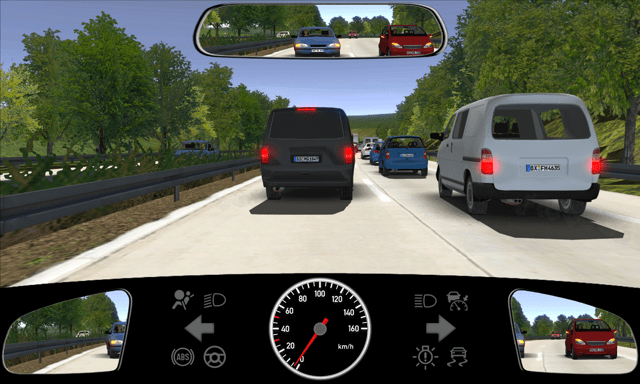
Wyjaśnienie
Any car driver must cooperate in forming an alley in the middle of the road for the passage of police and support vehicles in case of congestion on freeways and on out-of-town roads with more than one lane. Do not drive on the side strip, this is prohibited.
-
Question 9 of 21
Jak powinni się Państwo teraz właściwie zachować?
2.2.18-0164 PunktówWyjaśnienie
You meet a wrong-way driver on the freeway exit. By driving as far to the right as possible, you can best counteract a collision with the wrong-way driver. Now other road users must be warned of this acute danger. For this reason, you must inform the police.
-
Question 10 of 21
Jak powinni się Państwo teraz zachować?
2.2.18-0173 PunktówWyjaśnienie
They have already passed the truck on the acceleration lane on the right-hand side of the freeway. If you continue to accelerate, you can drive onto the main lane before the end of the lane. You should do that.
-
Question 11 of 21
Chcą Państwo zjechać z autostrady. Jak powinni się Państwo właściwie zachować w takiej sytuacji?
2.2.18-0183 Punktów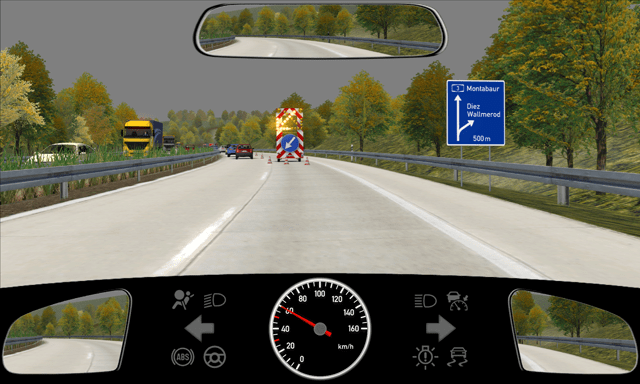
Wyjaśnienie
You flash and leave the freeway at the exit. The route to the turn of the exit is used to decelerate. Drive quickly off the highway, then reduce your pace. Drive into the corner at a moderately reduced speed.
-
Question 12 of 21
Jak muszą się Panstwo zachować w korku na autostradzie i na drogach ekspresowych z dwoma pasami w jednym kierunku?
2.2.18-0194 PunktówWyjaśnienie
If vehicles stand or drive at walking speed on freeways or on roads outside of built-up areas with at least two lanes for one direction, the following applies: You, as a car driver, must participate in forming a free lane between the leftmost and rightmost lane for the passage of police and support vehicles.
-
Question 13 of 21
Jak zachowają się Państwo teraz właściwie?
2.2.18-0214 PunktówWyjaśnienie
You must stay in the middle lane because there are vehicles in the left and right lanes that you would obstruct. In the right lane, a motorbike is coming onto the motorway from the slip road. In the left lane is the car that just overtook you.
-
Question 14 of 21
Chcą Państwo opuścić autostradę przy najbliższym zjeździe. Jakie zachowanie będzie właściwe w tej sytuacji?
2.2.18-0224 PunktówWyjaśnienie
When leaving the motorway, you should set the indicator at least 300 m before the exit. Always keep a close eye on the traffic behind you when driving on the motorway. Especially when exiting the motorway, make sure that nobody tries to overtake you on the right.
-
Question 15 of 21
Jak należy się teraz zachować?
2.2.18-0234 PunktówWyjaśnienie
Reduce your speed and allow the blue car to join the motorway while keeping a safe distance.
-
Question 16 of 21
Z czym musisz się teraz liczyć?
2.2.18-0244 PunktówWyjaśnienie
You should expect the truck in front of you to slow down because the other truck in the right lane is already slowing down and has its hazard lights on. You also have to expect that the truck will stay in the middle lane because it doesn't have enough space to get into the right lane. If a dangerous situation is identified on the motorway, the hazard warning lights may be switched on in order to warn all following vehicles in good time. Dangerous situations usually include accidents, traffic jams or slow traffic.
-
Question 17 of 21
Pani/Pana samochód zepsuł się na autostradzie. O czym należy pamiętać przy jego ściąganiu?
2.2.18-1013 PunktówWyjaśnienie
When towing on the freeway, the towing vehicle and the towed vehicle must have their hazard lights switched on. It's only allowed to tow on the freeway until the next exit. Then, the freeway must be left.
-
Question 18 of 21
Jadą Państwo autostradą i przegapili Państwo zjazd. Jak powinni się Państwo właściwie zachować?
2.2.18-1034 PunktówWyjaśnienie
Continue until the next exit and leave the freeway there. Now you can drive back to the missed exit on the other side of the freeway. You must not stop or drive backwards.
-
Question 19 of 21
Jakie wsparcie może dać w tej sytuacji asystent zmiany pasa ruchu bez ingerencji kierownicy?
2.2.18-1044 Punktów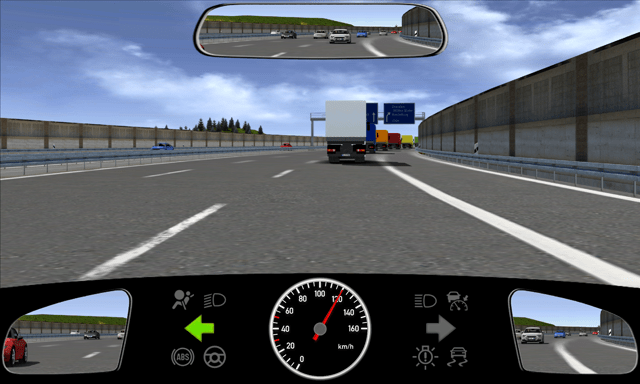
Wyjaśnienie
Lane Change Assist recognises the vehicle in the middle lane as a hazard and warns you not to change to that lane. To change lanes on your own would require steering intervention. Lane Change Assist does not interfere with your speed.
-
Question 20 of 21
Co jest zabronione przy korzystaniu z autostrad?
2.2.18-1053 PunktówWyjaśnienie
According to the StVO § 18 motorways and motor drivers: (7) Turning and reversing are prohibited. (8) hold, also on the side stripes, is forbidden.
-
Question 21 of 21
Dlaczego podczas jazdy na autostradzie radio drogowe powinno być uruchomione?
2.2.18-2153 PunktówWyjaśnienie
Drivers are not required to listen to traffic news, but traffic news are indispensable for a smooth journey. Traffic news inform about traffic jams, traffic accidents and construction sites. Warnings about wrong-way drivers have already prevented a lot of serious accidents.