
1.2.11 Situações de trânsito especiais
🚦 Regras de ouro para lembrar
Mantenha as encruzilhadas livres
Nunca bloqueie cruzamentos, passadeiras ou passagens ferroviárias durante engarrafamentos.
Veículos de emergência primeiro
Deixe espaço suficiente para policiais, ambulâncias e caminhões de bombeiros.
Os ciclistas precisam de espaço
Mantenha uma distância de segurança de 1,5–2 metros. Não ultrapasse em estradas estreitas.
Luz Verde ≠ Sempre Dirija
Mesmo com sinal verde, espere se a estrada à frente estiver bloqueada.
Polícia anula sinais
As instruções da polícia são mais fortes do que semáforos e sinais.
Espere por veículos grandes
Caminhões e bondes podem precisar de espaço extra ao fazer curvas.
🚧 Mantenha áreas importantes livres
- NÃO bloqueie cruzamentos.
- NÃO bloqueie cruzamentos ferroviários.
- NÃO bloqueie as passagens de pedestres.
- Entre em um cruzamento apenas se puder sair rapidamente.
- As paradas de ônibus são uma exceção.
“Se você não pode sair, não entre.”
⛔ Prioridade ao tráfego que se aproxima
Um sinal de seta vermelha significa que o tráfego em sentido contrário tem prioridade.
❌ Nunca
Dirija para a calçada.
✅ Sempre
Espere até que a estrada esteja limpa.
🚶 As travessias de zebra devem permanecer gratuitas
As travessias de pedestres são para uma travessia segura. Nunca pare neles.
🚴 Associações Fechadas
Grupos de ciclistas, pedestres ou veículos que viajam juntos são chamados de associações fechadas.
- Não interrompa o grupo.
- Espere até que todos os membros passem.
- Permaneça atrás da linha de parada, se necessário.
🚲 Nunca ultrapasse sem segurança
- Estreitamento da estrada = o ciclista pode mover-se para a esquerda.
- Tráfego em sentido contrário = espere atrás do ciclista.
- Mantenha uma distância de 1,5–2 metros.
⚠ Observe os ciclistas com atenção
Os ciclistas podem mudar repentinamente de direção sem sinais manuais.
🚋 Trilhos do bonde
Ao virar à esquerda nos trilhos do bonde:
- Pare antes dos trilhos.
- Mantenha distância suficiente.
- Espere o bonde passar.
- Vire à esquerda com segurança depois.
🟢 Verde NÃO significa “Vá sempre”
Se o trânsito estiver bloqueado, espere antes de entrar no cruzamento.
👮 As instruções da polícia vêm em primeiro lugar
Comandos policiais anulam semáforos e sinais de trânsito.
🚑 Veículos de emergência
Mantenha os cruzamentos livres para ambulâncias, policiais e caminhões de bombeiros.
🚛 Caminhões precisam de mais espaço
Veículos grandes podem balançar ao virar.
✋ Sinal manual versus luzes piscantes
- Sinal manual = isenção de prioridade válida.
- Luzes piscantes por si só NÃO são suficientes.
↪ Caminhão virando à direita
Espere até que o caminhão termine de virar completamente antes de continuar.
🧠 Revisão rápida do exame
| Situação | O que fazer |
|---|---|
| Engarrafamento | Mantenha cruzamentos e cruzamentos livres |
| Ciclista à frente | Mantenha distância e espere se não for seguro |
| Semáforo Verde | Dirija apenas se a saída estiver livre |
| Direções da Polícia | Sempre siga a polícia primeiro |
| Caminhão giratório | Espere até que a curva seja concluída |
| Travessia de bonde | Espere antes das faixas |
✅ Dica do exame final
Na teoria de direção alemã, muitas questões testam uma ideia principal: Não bloqueie ou coloque outras pessoas em perigo. Pense sempre em:
Perguntas de Prática (11)
-
Pergunta 1 de 11
Which are the areas you must not drive into when there is traffic congestion?
1.2.11-0034 PontosExplicação
In the case of stagnant traffic, the following areas must be kept free for example for emergency vehicles: intersections, level crossings and cross-walks. For residential exits, this rule does not apply. If you notice that someone wants to drive off his property onto the road, you should give the driver the opportunity to enter the road.
-
Pergunta 2 de 11
During traffic congestion, what parts of the road infrastructure must be kept clear?
1.2.11-0064 PontosExplicação
The pedestrian crossing (“zebra crossing”) is intended to enable pedestrians to cross the road safely and without danger. For this reason, you must leave pedestrian crossings free under all circumstances. If you drive into a junction (or crossing) in slow-moving traffic, there is a risk that you will block oncoming cross traffic or that oncoming traffic turning left will have to wait unnecessarily long. The junction or crossing would thus become even more clogged and traffic would be obstructed more than necessary.
-
Pergunta 3 de 11
You want to continue driving straight ahead. What is correct in this situation?
1.2.11-0074 Pontos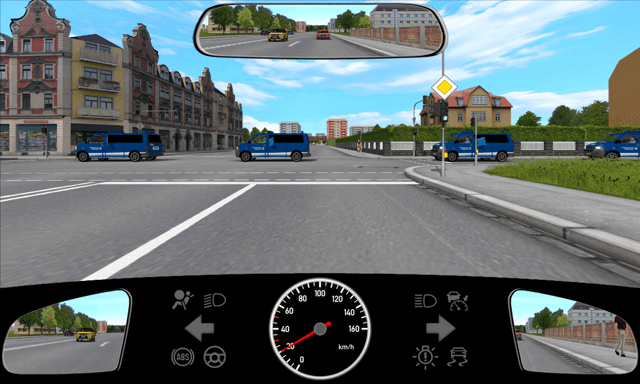
Explicação
A group of pedestrians, cyclists or motor vehicles, which is traveling together in road traffic, is called a closed association. Closed associations must be clearly marked and must not be interrupted. So you have to wait until all vehicles drove past you and as long as you have to wait at the stop line.
-
Pergunta 4 de 11
You want to continue driving straight ahead. What is the right course of action?
1.2.11-1034 Pontos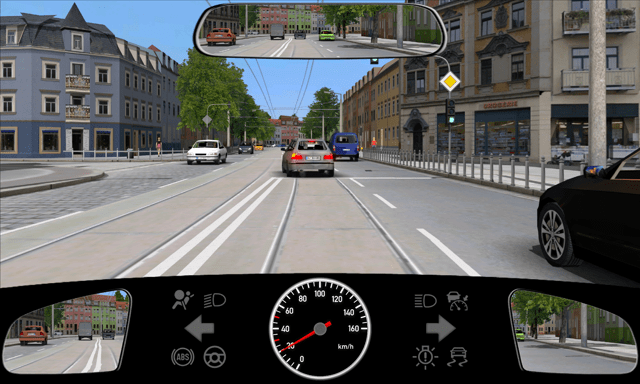
Explicação
The car ahead blocks you in your lane. Nevertheless, you should not overtake on the right before the intersection, as this would be too dangerous. Keep your distance, reduce the speed and stop if necessary. Continue straight ahead when the free lane is free and the traffic light turns green. You can only change on the right lane if there is a sufficiently large traffic gap.
-
Pergunta 5 de 11
What should you do?
1.2.11-1045 PontosExplicação
If tram rails lead through the left turn lane and you want to turn left when the tram approaches, it is important to wait with sufficient distance in front of the tram rails. When the tram passed, you can turn left.
-
Pergunta 6 de 11
What is the right course of action?
1.2.11-1055 PontosExplicação
If a cyclist who moves to the left drives in front of you, you must not overtake him if the road is narrowed at this point and there is oncoming traffic. A safety distance of 1.5 to 2 meters could not be maintained here.
-
Pergunta 7 de 11
In which situations are you not allowed to enter a junction even though the traffic light is green?
1.2.11-1084 PontosExplicação
In the following cases, you must not enter a crossroad, even though the traffic light shows "green": with slow-moving traffic, as crossings, for example, must remain free for emergency vehicles. Secondly, when police officers regulate traffic and give instructions that deviate from the meanings of the colors of the traffic lights. In general, a green traffic light tells you that you are allowed to drive and overrules other traffic signs that regulate the right of way. Policeman orders have the highest rank and override traffic lights.
-
Pergunta 8 de 11
Why must you slow down here and be ready to brake?
1.2.11-1105 PontosExplicação
You don't have to slow down because of pedestrians. He is far enough away from the constriction. The red vehicle is standing and is therefore no reason to slow down as well. However, reduce the speed because of the cyclist. He could change lanes without a hand signal and bring about a dangerous situation.
-
Pergunta 9 de 11
Why do you have to continue to brake?
1.2.11-1114 PontosExplicação
A garbage truck comes towards the blue truck and forces him to stop. Since the garbage truck could swing out and get on your lane as it turns, you'll need to wait for the vehicle to be properly merged. The cyclist is no reason for braking.
-
Pergunta 10 de 11
You want to drive straight ahead. What should you do?
1.2.11-1124 PontosExplicação
In case of halting traffic, you are not allowed to block any intersection or T-junction despite the green traffic light or right of way. You may need to wait at the stop line and cannot close up until the front vehicles are far enough away.
-
Pergunta 11 de 11
When may you take the turn?
1.2.11-1143 PontosExplicação
As you want to turn left, oncoming traffic has priority. Only when the lorry driver gives up his right of way with a clear hand signal can you pass with due regard for oncoming traffic. Flashing your lights is not sufficient here.