
2.2.37 Sinais de luz variáveis e constantes
Os sinais luminosos amarelo, vermelho, verde e de seta indicam se você deve parar, continuar, usar uma faixa ou sair dela. O segredo é reagir com antecedência e segurança com base na velocidade, distância e no sinal mostrado.
🚦 Semáforo Amarelo
Um sinal amarelo significa que você deve parar antes da travessia se ainda for possível com segurança.
A 40 km/h: a distância de parada é aproximadamente 28 metros.
Se você estiver longe o suficiente da linha de parada, pare com segurança.
⚠️ Quando você deve continuar
Se estiver demasiado perto do semáforo, uma travagem brusca pode ser perigosa.
Exemplo: Em 40 km/h, se você estiver apenas prestes 10 metros antes do semáforo, mesmo a frenagem de emergência pode não pará-lo a tempo.
Reação correta: continue dirigindo para evitar uma colisão traseira.
✅ Quando você deve parar
Se a distância até a linha de parada for grande o suficiente, a reação correta é parar.
No 40 km/h, lembre-se da regra prática:
Distância de parada ≈ 28 metros
🛣️ Sinais de controle de pista
❌
Barras cruzadas vermelhas
Você não deve dirigir nesta faixa.
⬇️
Seta verde para baixo
Você pode dirigir nesta faixa.
↘️
Seta diagonal amarela piscando
Você deve mudar de faixa na direção da seta.
🧠 Regra de memória fácil
❌
Cruz vermelha
Não use pista
⬇️
Arqueiro Verde
A pista está aberta
↘️
Seta Amarela
Saia da pista
Perguntas de Prática (4)
-
Pergunta 1 de 4
You are travelling at a speed of approximately 40 km/h. The lights change from "green" to "amber" when you are 10 m away. What do you do?
2.2.37-0024 PontosExplicação
At 40 km/h, the braking distance according to the rule of thumb is 28 meters. Even with emergency braking, a car driver can barely come to a halt 10 meters in front of a traffic light. To prevent a possible rear-end collision, you should therefore continue driving.
-
Pergunta 2 de 4
You are travelling at a speed of approximately 40 km/h. The lights change from "green" to "amber" when you are 40 m away. What do you do?
2.2.37-0034 PontosExplicação
According to the rule of thumb, at a speed of 40 km/h your car comes to a stand after 28 meters. The only correct reaction is to stop.
-
Pergunta 3 de 4
What is true of permanently illuminated signs?
2.2.37-0072 Pontos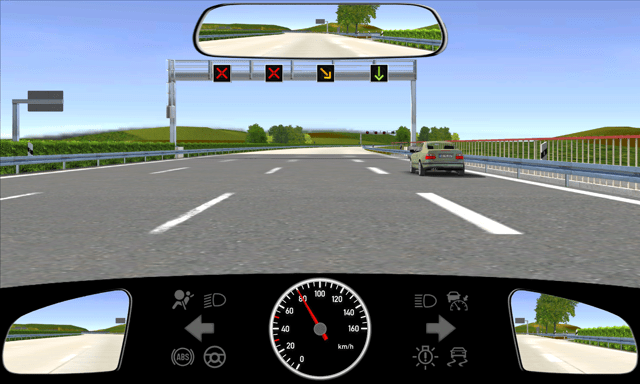
Explicação
If there are crossed red diagonal beams, drivers on the lane must neither drive nor hold in front of them. A green arrow looking down means: You can drive on the lane. A yellow blinking, obliquely downward looking arrow, you must change the lane in the direction of the arrow.
-
Pergunta 4 de 4
What do these permanently illuminated signs mean?
2.2.37-0084 Pontos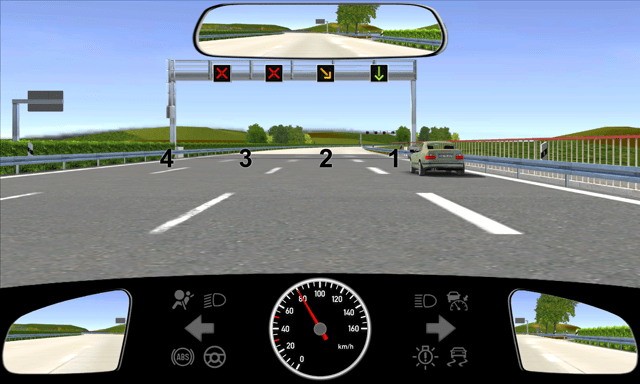
Explicação
Continuous light signals above a lane inform you as a car driver whether this lane is passable or locked or if you need to leave it. Red crossed bars mean: The lane must not be used. A green arrow looking down means: You can drive on the lane. A yellow blinking, obliquely downward looking arrow, you must change the lane in the direction of the arrow.