
2.2.37 Variable and steady light signals
Yellow, red, green and arrow light signals tell you whether to stop, continue, use a lane, or leave it. The key is to react early and safely based on your speed, distance, and the signal shown.
🚦 Yellow Traffic Light
A yellow light means you must stop before the crossing if it is still safely possible.
At 40 km/h: stopping distance is about 28 meters.
If you are far enough from the stop line, you should stop safely.
⚠️ When You Should Continue
If you are too close to the traffic light, sudden braking may be dangerous.
Example: At 40 km/h, if you are only about 10 meters before the traffic light, even emergency braking may not stop you in time.
Correct reaction: continue driving to avoid a rear-end collision.
✅ When You Should Stop
If your distance to the stop line is large enough, the correct reaction is to stop.
At 40 km/h, remember the rule of thumb:
Stopping distance ≈ 28 meters
🛣️ Lane Control Signals
❌
Red crossed bars
You must not drive in this lane.
⬇️
Green downward arrow
You may drive in this lane.
↘️
Yellow flashing diagonal arrow
You must change lanes in the direction of the arrow.
🧠 Easy Memory Rule
❌
Red Cross
Do not use lane
⬇️
Green Arrow
Lane is open
↘️
Yellow Arrow
Leave the lane
Practice Questions (4)
-
Question 1 of 4
You are travelling at a speed of approximately 40 km/h. The lights change from "green" to "amber" when you are 10 m away. What do you do?
2.2.37-0024 PointsExplanation
At 40 km/h, the braking distance according to the rule of thumb is 28 meters. Even with emergency braking, a car driver can barely come to a halt 10 meters in front of a traffic light. To prevent a possible rear-end collision, you should therefore continue driving.
-
Question 2 of 4
You are travelling at a speed of approximately 40 km/h. The lights change from "green" to "amber" when you are 40 m away. What do you do?
2.2.37-0034 PointsExplanation
According to the rule of thumb, at a speed of 40 km/h your car comes to a stand after 28 meters. The only correct reaction is to stop.
-
Question 3 of 4
What is true of permanently illuminated signs?
2.2.37-0072 Points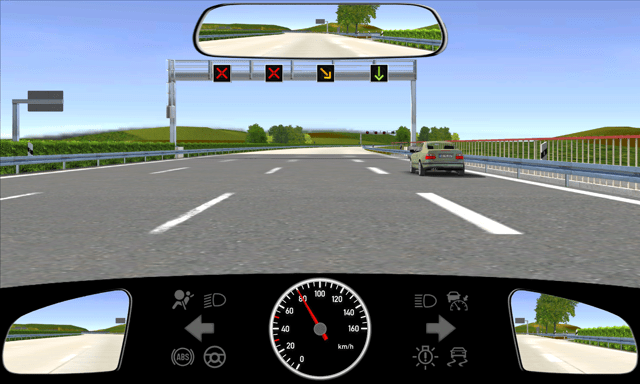
Explanation
If there are crossed red diagonal beams, drivers on the lane must neither drive nor hold in front of them. A green arrow looking down means: You can drive on the lane. A yellow blinking, obliquely downward looking arrow, you must change the lane in the direction of the arrow.
-
Question 4 of 4
What do these permanently illuminated signs mean?
2.2.37-0084 Points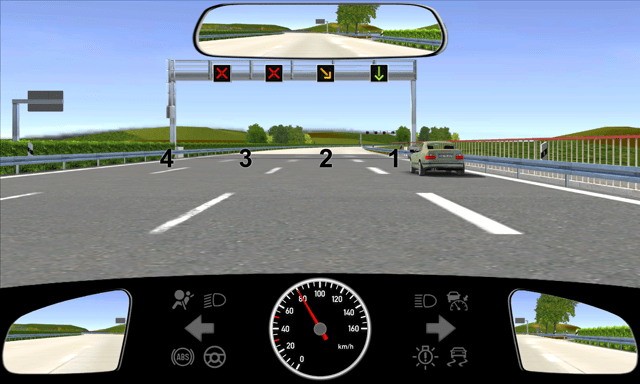
Explanation
Continuous light signals above a lane inform you as a car driver whether this lane is passable or locked or if you need to leave it. Red crossed bars mean: The lane must not be used. A green arrow looking down means: You can drive on the lane. A yellow blinking, obliquely downward looking arrow, you must change the lane in the direction of the arrow.