
1.2.02 Road use
1. Using the right-hand hard shoulder

The hard shoulder (Standstreifen) is strictly reserved for emergencies. It is not an extra lane for driving, stopping, or parking unless explicitly signed.
Correct Actions
Use only if your vehicle breaks down.
Use when traffic signs explicitly permit it (e.g., during heavy congestion).
Forbidden Actions
Do not use it to overtake slower vehicles.
Do not stop for a break or to make a phone call.
2. Wrong lane – what to do?

Realizing you are in a turn-only lane when you intended to go straight can be stressful. However, safety takes priority over your route.
thumb_up Do
Continue in the direction of the lane arrows.
Find a safe place to turn around later.
thumb_down Don't
Do not stop abruptly in traffic.
Do not try to switch lanes across solid lines.
Never reverse in a live lane.
3. Complex Situations
directions_car Narrow streets with parked cars
When driving past parked vehicles, you must maintain a safe distance to account for opening doors.
- Keep at least 1.0 meter side distance.
- Oncoming traffic has priority if the obstruction is on your side.
- Wait in a gap if the street is too narrow for two cars.
agriculture Encountering horse-drawn carriages
Horses can be unpredictable. Noise and proximity can spook them.
- Overtake with a wide berth and low engine noise.
- Do not rev your engine or honk.
4. Right of Way & Speed
Fundamental rules for intersections and high-speed roads.
Right before Left
Applies at all intersections without traffic lights or priority signs.
Yield to vehicles coming from your right.
Autobahn Requirements
Your vehicle must be mechanically capable of certain speeds.
Design speed > 60 km/h required.
Recommended speed (Richtgeschwindigkeit) is 130 km/h.
Ultra-short exam summary
Hard shoulder is for emergencies only.
Wrong lane? Follow it, then turn around safely.
Pass horses slowly and quietly.
Right before Left applies if no signs exist.
Autobahn entry requires vehicle capability of > 60 km/h.
Practice Questions (8)
-
Question 1 of 8
When may you use the right-hand hard shoulder?
1.2.02-1013 Points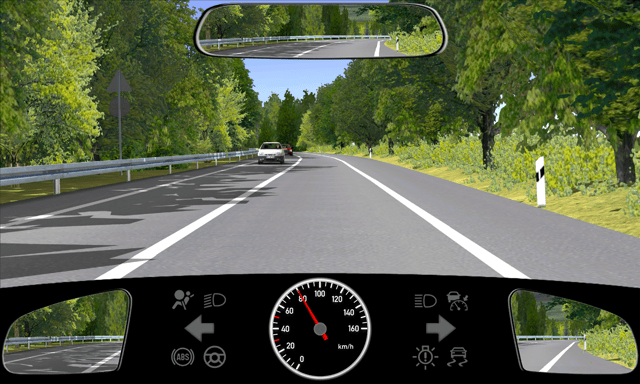
Explanation
The right side strip may be used in the following cases: 1. for holding and parking, 2. for slow moving vehicles such as mopeds or agricultural tractors and machinery. These should use the right side strip to avoid traffic obstructions and traffic jams. The side strip must be attached and have a sufficient width. It is forbidden in any case to use the side strip for overtaking.
-
Question 2 of 8
You have manoeuvred into the left lane by mistake, but would like to take a right turn. What is the right course of action?
1.2.02-1044 Points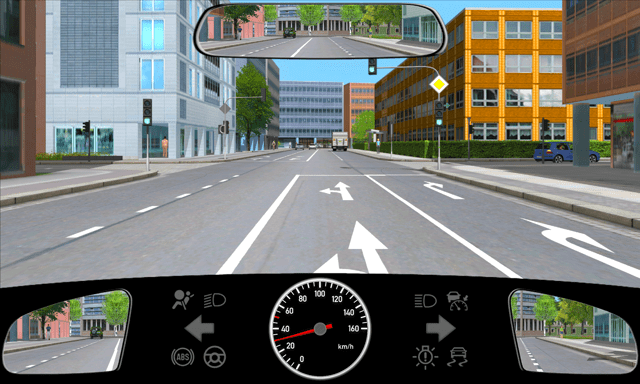
Explanation
With a solid line as a road edge marking, you must under no circumstances turn right. Rather, you must stay in your lane and continue straight or turn left.
-
Question 3 of 8
When driving on main roads, which vehicles must use the hard shoulders where possible?
1.2.02-1063 PointsExplanation
Slow-moving vehicles such as tractors, mopeds must use the hard shoulder. Other vehicles that go faster than 45km/h need to remain on the road
-
Question 4 of 8
What should you do in this situation?
1.2.02-1073 PointsExplanation
In a street where vehicles park on both sides, the range of movement is limited. With only one lane, vehicles are equally important in both directions. Nevertheless, you should drive into a gap here to let an oncoming vehicle pass.
-
Question 5 of 8
A horse-drawn carriage is coming towards you. What should you do?
1.2.02-1083 PointsExplanation
Drive as far to the right as possible when you encounter a horse-drawn carriage. Do not honk and do not drive at high motor speed. The animals could be sensitive to noise and be frightened. It might happen that they break out and run on your side of the road.
-
Question 6 of 8
What is correct in this situation?
1.2.02-1092 Points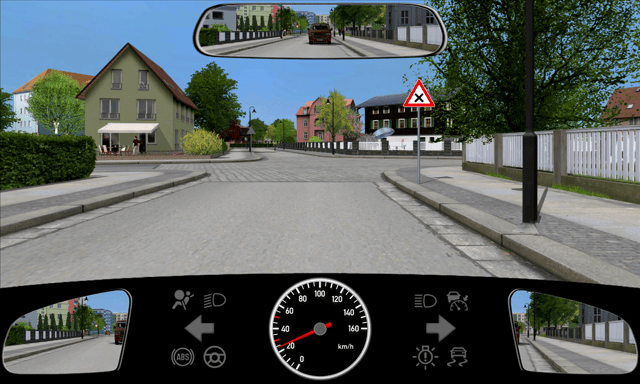
Explanation
At the traffic sign "Intersection or junction with right-of-way", you must follow the right-of-way rule "right before left". This applies to the nearest intersection.
-
Question 7 of 8
What do you have to watch out for, when crossing a priority road?
1.2.02-1102 PointsExplanation
When crossing a priority road, you must keep in mind: 1. the width of the priority road, 2. the distance and speed of oncoming traffic, 3. the weather conditions. These are all the influences that are important for crossing the priority road. The weather influences the condition of the road and the visibility. Along with the road width, it determines how long you need to cross the priority road. By estimating the distance and the speed of oncoming traffic you can assess how much time you have available.
-
Question 8 of 8
You want to use an autobahn. To allow you to do so, what type-specific maximum speed must be entered in Part I of the registration certificate or in the operating licence?
1.2.02-1113 PointsCorrect: 60
Explanation
According to the German Road Traffic Regulations (Straßenverkehrsordnung - StVO), motorways may only be used by vehicles with a maximum design speed of more than 60 km / h.