
2.1.08 Motorway
Learn the most important Autobahn rules for the German driving exam in an easy and visual way. This guide helps you understand merging, exits, traffic jams, overtaking, and safe motorway driving.
🚗 Golden Rules
- Keep right whenever possible
- Use mirrors before lane changes
- Maintain safe distance
- Do not brake suddenly
- Always indicate early
⚠ Important
- Build rescue lanes in traffic jams
- Use hazard lights at jam ends
- Acceleration lane allows faster speed
- Never overtake on the right
❌ Avoid
- Cutting lanes suddenly
- Driving too fast into exits
- Braking before deceleration lane
- Pressuring drivers with headlights
🔀 Zip Merging Principle
When a lane ends, vehicles must merge smoothly like a zipper.
Drivers already on the lane must allow cars from the ending lane to merge safely.
🛣 Leaving the Motorway
Correct Steps
- Finish overtaking early
- Move to right lane
- Indicate
- Enter deceleration lane
- Brake only inside deceleration lane
Important Tip
Drivers often underestimate speed after driving fast for a long time. Always check your speedometer before entering an exit curve.
🚨 Traffic Jam & Rescue Lane
When Approaching a Jam
- Reduce speed immediately
- Turn on hazard lights
- Warn drivers behind you
Rescue Lane
Form a rescue lane for emergency vehicles. Drive as far right as possible.
🚧 Construction Zones
- Lanes are narrower
- Vehicles may cross yellow markings
- Risk of accidents increases
- Overtaking usually saves no time
↩ Dangerous Curves
Possible Dangers
- Traffic jam
- Broken vehicles
- Narrowing lane
- Unexpected obstacles
Correct Behavior
- Slow down before the curve
- Stay alert
- Be ready to stop
🚙 Overtaking Rules
Allowed
- Overtake on the left only
- Return to right lane after overtaking
Forbidden
- Overtaking on the right
- Flashing headlights to force others away
🏎 Acceleration Lane
Vehicles entering the motorway use the acceleration lane to match the speed of motorway traffic.
- You may drive faster here than traffic on the motorway
- Stay in your lane
- Do not cut boundary lines
⚡ Speed & Safety Distance
Higher Speed Means
- Longer reaction distance
- Longer braking distance
- Higher accident risk
Safe Driving
- Keep larger safety distance
- Drive smoothly
- Match traffic flow speed
✅ Exam Tips to Remember
- ✔ Build rescue lanes
- ✔ Use mirrors frequently
- ✔ Keep right after overtaking
- ✔ Brake only in deceleration lane
- ✔ Never overtake on the right
- ✔ Slow down before curves
- ✔ Watch for trucks changing lanes
- ✔ Always signal lane changes
Practice Questions (21)
-
Question 1 of 21
What must you reckon with here?
2.1.08-0053 Points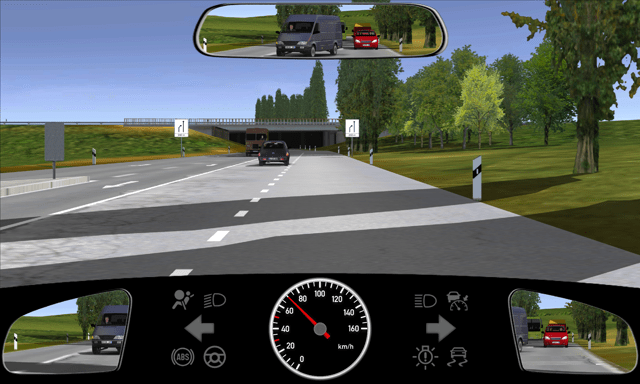
Explanation
The sign announces the end of the left lane. The traffic flow will condense from two lanes to a single lane. Halting traffic might occur. The vehicle in the left lane will change the lane. You have to allow the vehicles on the left side of the lane to change over to your lane according to the zip merging principle.
-
Question 2 of 21
A traffic jam is building up here. What is the correct procedure?
2.1.08-0084 Points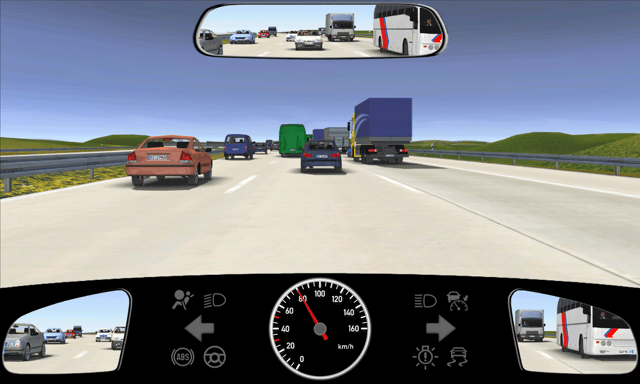
Explanation
If you drive towards a traffic jam, turn on your hazard lights to alert other road users. It is important to build a rescue lane for any approaching rescue vehicles. In this case, drive as far to the right as possible.
-
Question 3 of 21
What must you anticipate with inclines on motorways?
2.1.08-0104 PointsExplanation
When driving uphill on motorways, you should expect slow-moving trucks in the right lane, sudden overtaking manoeuvres by other road users and large speed differences between vehicles. All 3 answers are correct.
-
Question 4 of 21
What must you do?
2.1.08-0114 PointsExplanation
Since you are currently being overtaken by a car on the left-hand side, you must maintain the lane and reduce the speed until the truck in front of you has completed its overtaking maneuver and changes to the right-hand lane.
-
Question 5 of 21
What must you be aware of when joining the motorway?
2.1.08-0135 PointsExplanation
On the freeway, the continuous traffic always has the right of way and does not have to allow entrance. On the acceleration lane the driver may drive faster than the rest of the vehicles.
-
Question 6 of 21
You are driving at the recommended speed on the motorway and want to leave it at the next exit. What should you do?
2.1.08-0144 PointsExplanation
Finish overtaking in good time and get on the right lane. Before changing to the deceleration lane look around and indicate. On the deceleration lane, check your speed on the speedometer in order to assess it right. Only on the deceleration lane you should reduce the speed significantly, so as not to hinder subsequent traffic on the continuous lane.
-
Question 7 of 21
What should you do now?
2.1.08-0164 PointsExplanation
When approaching a jam end on the highway, you must reduce your speed and warn the road users behind you by switching on the hazard lights. A rescue lane is to be formed.
-
Question 8 of 21
What is correct in this situation?
2.1.08-0185 Points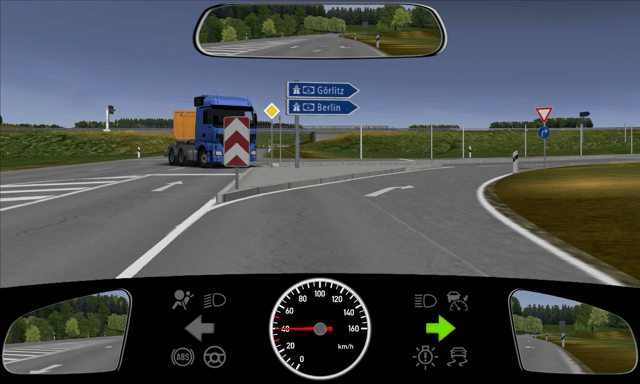
Explanation
The curve is difficult to assess for the car driver. There may be other road users or even obstacles on the route. Therefore, it makes sense to slow down the pace even before the turn and mentally adjust to a possible danger situation. Because even for oncoming drivers this is a difficult spot and caution is required.
-
Question 9 of 21
You are driving at least 20 km/h faster than the green truck. What should you do?
2.1.08-0214 Points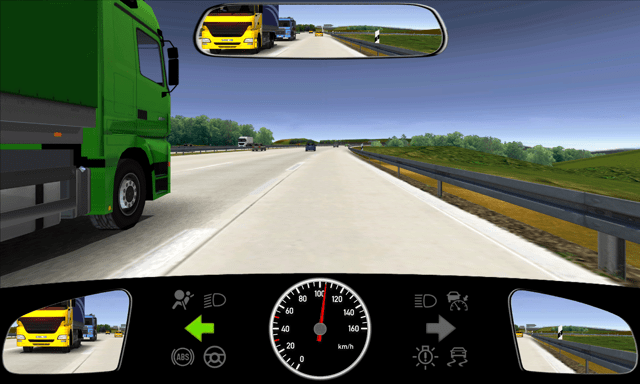
Explanation
You are on an acceleration lane to the freeway. On the acceleration lane it is permissible to drive faster than the vehicles on the continuous lane. Therefore, you can drive onto the highway at a faster pace in front of the green truck.
-
Question 10 of 21
What should you do now?
2.1.08-0243 PointsExplanation
Next to you is a red car that changes into the middle lane. Therefore, you cannot change the lane, otherwise you would endanger other road users.
-
Question 11 of 21
You want to join the motorway. What driving line should you follow?
2.1.08-0254 PointsExplanation
While driving onto the freeway you should continue to follow the third driving line, so stay true to the lane and do not cut the boundary line.
-
Question 12 of 21
What should you be prepared for now?
2.1.08-0263 PointsExplanation
No traffic jam can be seen in this situation. Since the motorcycle is driving on the left, it will not leave the motorway. On the other hand, the car driving on your left flashes to the right. You can be prepared for the driver to leave the motorway.
-
Question 13 of 21
You want to exit the motorway. What is creating a dangerous situation here?
2.1.08-0274 PointsExplanation
The motorbike behind you (see right wing mirror) creates a dangerous situation for you. Take this into account when leaving the motorway.
-
Question 14 of 21
What is the right course of action now?
2.1.08-0284 PointsExplanation
There is an object on the roadway in the right lane in front of the truck. Truck will avoid the object by using the left lane. You should therefore stay in the left lane. If you continue to drive unchanged, you could collide with the truck. You should therefore reduce your speed.
-
Question 15 of 21
Why must you reduce your speed now?
2.1.08-0294 PointsExplanation
The right lane is blocked in front of the truck. He has to change to the left lane. To allow him to do this, you should reduce your speed. The car driving behind you is no reason for you to slow down. The maximum permissible speed here is 120 km/h. Keep this in mind.
-
Question 16 of 21
You want to leave the motorway. What is the right course of action?
2.1.08-0303 Points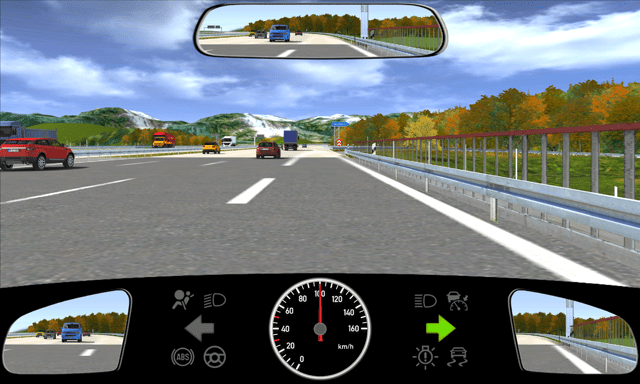
Explanation
As soon as you have entered the deceleration lane, you should brake. If you brake before entering the deceleration lane, you will unnecessarily interfere with traffic on the motorway. You should check your speedometer more often to make sure you are not entering the bend too fast. On motorways, there is a danger that you will get too used to the high speed and therefore enter an exit too fast. If you were to slow down at the turn, you would not be able to reduce your speed in time. In general, you should always brake before a bend and not only in the bend.
-
Question 17 of 21
When driving on motorways, why should you maintain the recommended speed of 130 km/h?
2.1.08-0313 PointsExplanation
The higher the speed, the longer the reaction distance, braking distance, etc. If all vehicles travel at a similar speed, the traffic flow becomes more even.
-
Question 18 of 21
What must you anticipate here?
2.1.08-0324 PointsExplanation
Due to the sudden traffic jam, the driver of the truck sees the end of the traffic jam too late. Due to the traffic jam, the motorcycle will try to go through the rows of vehicles.
-
Question 19 of 21
What should you anticipate when driving out the exit slip road?
2.1.08-0333 Points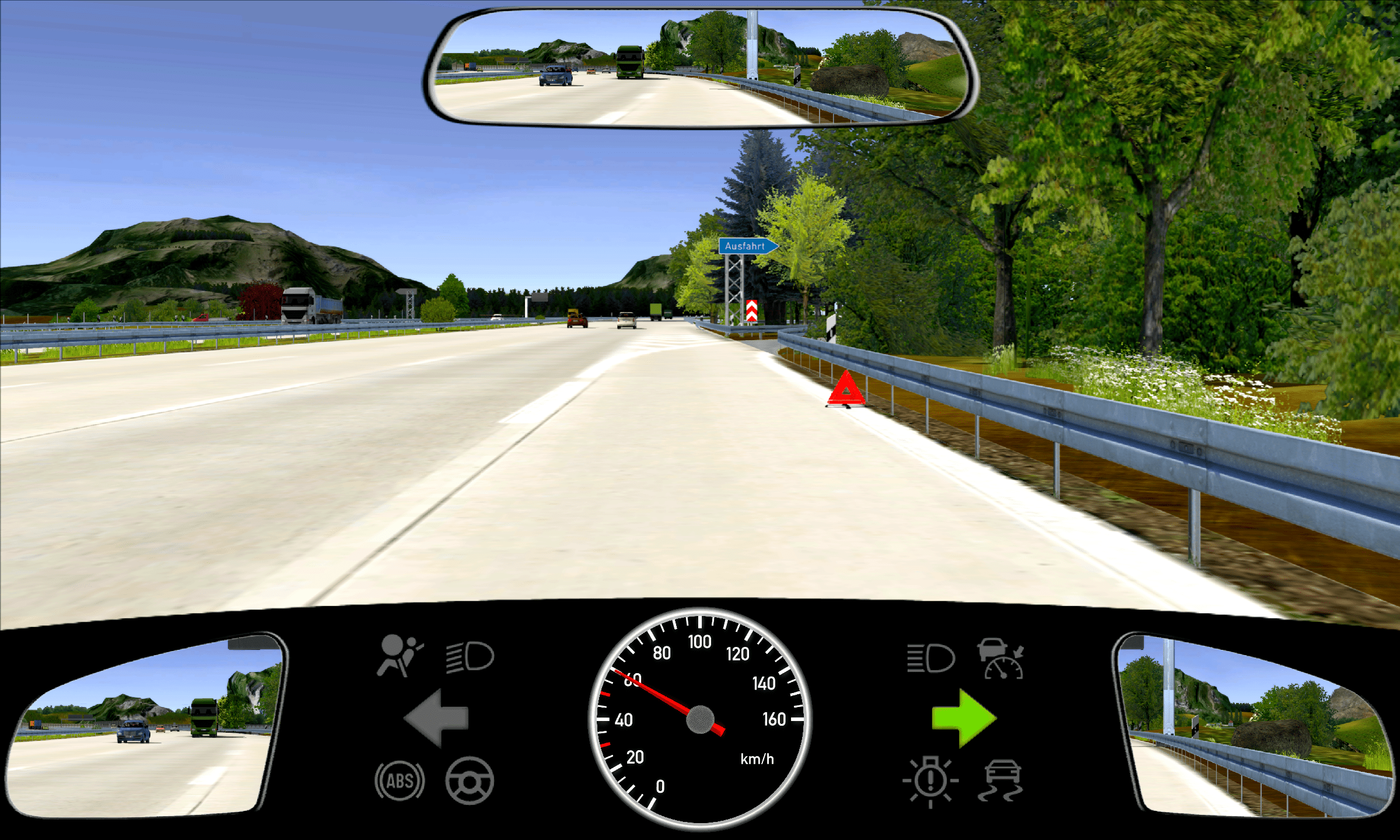
Explanation
A warning triangle indicates a nearby obstacle, e.g. people, a defective vehicle or a fallen load, in the exit lane. Therefore, enter the exit at a very reduced speed.
-
Question 20 of 21
Why should you avoid overtaking alongside the roadworks site?
2.1.08-1024 PointsExplanation
When overtaking in the construction site area, the risk of accidents is significantly increased, because there is a risk that the vehicles that you want to overtake run over the yellow lane marking. The lanes are mostly narrower and the distractions on the edge of the road can lead to inattentiveness. Overtaking in the construction site area often saves almost no time, since most drivers in the construction site area only drive the maximum speed.
-
Question 21 of 21
How can you reduce the risk of driving onto a motorway against the stipulated direction?
2.1.08-1033 PointsExplanation
To avoid driving against the direction of travel on the motorway, you should always pay attention to the relevant traffic signs. It is very important to pay attention to the exact signs, especially when the traffic routing has changed.