
2.1.07 Situações de trânsito especiais
Situações Especiais de Trânsito, Capítulo 2.1.07 — Aprenda o que fazer em situações de trânsito perigosas, pouco claras ou incomuns.
⭐ Regra do exame principal
Quando a situação não é clara, é perigosa ou outro utente da estrada pode cometer um erro: reduza a velocidade, aumente a distância, dirija com cuidado e esteja pronto para frear.
🚜 Veículos/tratores lentos
Quando você vê:
Um trator, caminhão ou ciclomotor deseja retornar do acostamento ou virar à esquerda.
Você deve:
Reduza a velocidade e permita que ela se funda com segurança.
🚗 Regra de final de pista / zíper
Quando você vê:
Uma faixa termina ou outro condutor não pode continuar na sua faixa.
Você deve:
Diminua a velocidade e deixe o veículo fundir-se usando o procedimento do zíper.
⚠ Veículos quebrados
Quando você vê:
Um carro parado, uma pessoa na estrada ou uma faixa bloqueada.
Você deve:
Reduza a velocidade, dirija para a direita, espere que pessoas ou veículos se movam repentinamente.
🦌 Animais
Quando você vê:
Animais próximos ou na estrada.
Você deve:
Diminua a velocidade, observe com atenção, esteja pronto para frear. Não desvie perigosamente.
🚴 Ciclistas
Quando você vê:
Um ciclista bloqueado por um obstáculo ou subindo uma colina.
Você deve:
Espere desviar, mantenha distância extra e só ultrapasse quando for seguro.
🏍 Motocicletas
Quando você vê:
Um motociclista ultrapassando, cortando curvas ou entrando na sua pista.
Você deve:
Dirija para a direita, reduza a velocidade e crie mais espaço.
🧠 Padrão de exame: quando você vê X → faz Y
| Situação | Reação Correta | Por que? |
|---|---|---|
| Motorista na contramão na rodovia | Mover para a direita, freio, luzes de perigo | Avise os outros e evite colisão |
| Tailgater atrás de você | Mantenha a velocidade legal | Não acelere ou freie repentinamente |
| Táxi parou à frente | Pare atrás dele se a faixa da esquerda estiver bloqueada | Não dirija na calçada |
| Visibilidade limitada perto de árvores/curvas | Diminua a velocidade e dirija para a direita | Perigos ocultos podem aparecer tarde |
| Pneu estourado ou vento cruzado forte | Libere o gás, faça contra-direção e freie suavemente | Mantenha o veículo estável |
| Colisão de animais inevitável | Freie com força, segure o volante, permaneça na faixa | Desviar pode ser mais perigoso |
📏 Distância de segurança
Fora das áreas urbanas, mantenha pelo menos:
Metade da sua velocidade em metros
Exemplo: 100 km/h → 50 m de distância
🛑 Distância de frenagem
Se a sua velocidade duplicar, a distância de travagem torna-se muito maior.
Velocidade dupla → distância de frenagem 4×
40 km/h = 16 m, 80 km/h = 64 m
🎴 Flashcards rápidos
Pergunta
O que você faz se um trator quiser fundir?
Responder
Reduza a velocidade e deixe-a fundir.
Pergunta
O que você faz se houver animais na estrada?
Responder
Diminua a velocidade e esteja pronto para frear.
Pergunta
Você pode dirigir na calçada para passar por um táxi?
Responder
Não. Pare e espere se não conseguir ultrapassar com segurança.
Pergunta
E se um motociclista puder ultrapassar perigosamente?
Responder
Dirija para a direita e reduza a velocidade.
Pergunta
O que você faz depois de acertar o jogo selvagem?
Responder
Pare, proteja o local e informe a polícia ou o departamento florestal.
Pergunta
E se um veículo vindo de um caminho florestal puder entrar?
Responder
Esteja pronto para frear, mesmo que tenha prioridade.
✅ Lista de verificação de revisão final
Perguntas de Prática (31)
-
Pergunta 1 de 31
Why must you brake now?
2.1.07-0094 PontosExplicação
You should brake because of the green vehicle, as it appears to be driving onto the road behind the tractor.
-
Pergunta 2 de 31
What must you anticipate in this parking area?
2.1.07-0103 Pontos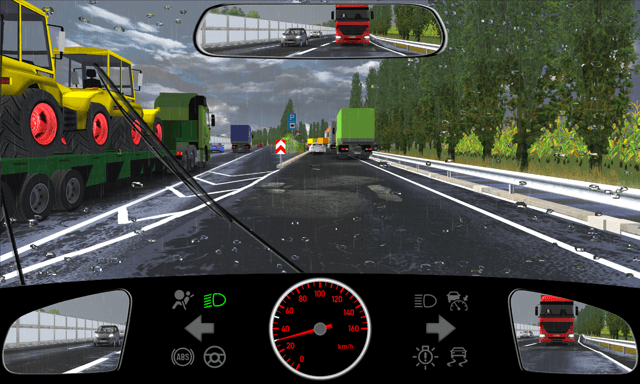
Explicação
Vehicles can leave the parking space, watch out for vehicles leaving the parking space. People can walk on the roadway because you are taking a break. Truck drivers often park in car parking spaces.
-
Pergunta 3 de 31
What should you anticipate in this situation?
2.1.07-0144 PontosExplicação
Because of the turning truck, the van could miss you. Be ready to brake.
-
Pergunta 4 de 31
Why should you further reduce your speed here?
2.1.07-0155 PontosExplicação
It's unlikely that the car in the left lane will continue as it appears to have broken down. Even if it did, it wouldn't affect you. However, since there is a person in the lane, extra caution is required here. It's also possible that other people get out of the vehicle and run onto the road. The stationary car may be hidden by the bush or no warning triangle was set up. The following car could therefore recognize too late that the vehicle has stopped in front of it. You should therefore drive with foresight and expect the car behind to swerve into your lane.
-
Pergunta 5 de 31
What should you do now?
2.1.07-0204 PontosExplicação
The yellow car comes towards you as a wrong-way driver on the highway. Drive to the right as far as possible and brake. To warn other road users, turn on the hazard warning lights.
-
Pergunta 6 de 31
What is the correct course of action in this situation?
2.1.07-0223 PontosExplicação
Animals on the road are unpredictable. You should continue to reduce your speed and monitor the situation carefully, and be ready to brake in case the animals run across the road. Hazard braking could lead to a rear-end collision if the vehicle behind you cannot react quickly enough.
-
Pergunta 7 de 31
Why should you reduce your speed now?
2.1.07-0234 PontosExplicação
Even if you keep to the speed limit of 60 km/h, an animal will run onto the road right in front of you. To avoid an accident, you have to reduce your speed. The oncoming car does not affect your driving style.
-
Pergunta 8 de 31
What is the right course of action now?
2.1.07-0254 PontosExplicação
As the blue car will probably be travelling on the road without observing the right of way rules, you must slow down sharply and give up your right of way.
-
Pergunta 9 de 31
What is the right course of action now?
2.1.07-0263 PontosExplicação
The tractor is signalling by flashing its lights that it wants to move back into the lane. You should therefore reduce your speed and allow the tractor to merge into the lane.
-
Pergunta 10 de 31
What is the right course of action now?
2.1.07-0284 PontosExplicação
The yellow car has an unusual driving style. It may be distracted or drunk. The abrupt braking and steering manoeuvres of the car in front are dangerous. Pay attention to how he continues to drive, increase the distance and be ready to brake.
-
Pergunta 11 de 31
What must you be aware of when driving along narrow avenues?
2.1.07-0294 PontosExplicação
Visibility in avenues is more restricted than in open fields and therefore requires an adapted driving style. On bends, your view of the carriageway may be restricted after the bend. You may therefore only see obstacles very late.
-
Pergunta 12 de 31
What could cause a fast travelling motor vehicle suddenly to veer sideways on a dry straight road?
2.1.07-1013 PontosExplicação
A vehicle on a straight, dry road can swing off sideways in the event of a strong crosswind or a burst tire. In this case, immediately lay off the gas pedal, countersteer and brake gently.
-
Pergunta 13 de 31
What makes driving in a stream of vehicles easier?
2.1.07-1023 PontosExplicação
Slightly offset driving allows you to observe the vehicles in front. This allows you to see the traffic situation in front of you or through the windows of the driver in front and react faster to sudden events. Driving with hazard lights in a convoy is generally prohibited.
-
Pergunta 14 de 31
One of your tyres bursts while you are travelling at high speed on an autobahn. What do you do?
2.1.07-1064 PontosExplicação
Avoid emergency braking on the freeway and instead steer and brake gently to stabilize your vehicle. If possible, bring your vehicle to a stop on the hard shoulder. Turn on your hazard lights and set up your warning triangle to warn subsequent vehicles.
-
Pergunta 15 de 31
You increase your speed from 50 km/h to 100 km/h. How is the braking distance changed according to the rule of thumb?
2.1.07-1093 PontosExplicação
According to the rule of thumb, the braking distance quadruples when the speed doubles. At 40 km/h, for example, it is 16 meters and at 80 km/h 64 meters.
-
Pergunta 16 de 31
Why must you be ready to brake in this situation?
2.1.07-1115 PontosExplicação
You see that a vehicle wants to drive onto the road from the right. Since it comes from a field or forest path, you have right of way. Due to the forest cover the visibility for the vehicle driver may be limited. It is possible that he/she will continue despite having to wait. For this reason, you must be ready to brake until you clearly recognize that he/she is stopping.
-
Pergunta 17 de 31
Why should you lower your speed now?
2.1.07-1125 PontosExplicação
Basically, you have the right of way, because you are on a priority road. However, to avoid a dangerous situation, you should still reduce your speed and be ready to brake, as the car driver of the car coming from the right-hand side might recognize you too late or miss you altogether. Due to the trees on the roadside his/her view is clearly limited.
-
Pergunta 18 de 31
What is the right course of action in this situation?
2.1.07-1135 PontosExplicação
In this situation, you need to reduce the speed and allow the car driver to go back into lane on the left. If a lane ends on a multi-lane road or if it is not possible for the drivers driving on the other lane to drive through the lane continuously, they must be able to change lanes using the zipper procedure.
-
Pergunta 19 de 31
What should you anticipate in this situation?
2.1.07-1145 PontosExplicação
Although you are on the priority road, you must always expect dangerous situations to arise. For example, the tractor driver approaching your street at a junction could not fulfill his duty of waiting and force the vehicle in front of you to brake. By driving anticipatory you can help defuse potentially dangerous situations.
-
Pergunta 20 de 31
What is the right course of action in this situation?
2.1.07-1155 PontosExplicação
The maximum speed limit on this road is 80 km/h. You drive 80 km/h. The driver driving behind you harasses you to drive quicker; he/she comes dangerously close and falls below the required safety distance. Keep your speed. If you try to increase the safety margin by accelerating, the driver behind you will probably also accelerate. Braking, even briefly, endangers you and the car behind.
-
Pergunta 21 de 31
What must you pay attention to when turning right?
2.1.07-1173 PontosExplicação
All drivers driving on the priority road must be given priority. The motorcycle is on the lane where you want to turn right. Before you turn right into the priority road, you have to wait and let the motorcycle pass.
-
Pergunta 22 de 31
What should you do, if it is no longer possible to avoid a collision with wild animals?
2.1.07-1193 PontosExplicação
If a collision with an animal is no longer avoidable, the direction of travel is to be maintained. Then brake hard and hold the steering wheel firmly. An evasive maneuver can injure other road users or increase the risk of greater damage than a controlled collision with the animal.
-
Pergunta 23 de 31
What must you do in this situation?
2.1.07-1215 PontosExplicação
In this situation, you should immediately brake hard but also not swerve.
-
Pergunta 24 de 31
You are driving on a winding section of road popular with motorcyclists. What must you anticipate?
2.1.07-1224 PontosExplicação
On curvy roads, motorcyclists can cut their curves or protrude on your roadway in curves because of their strong inclinations. Even motorcyclists who drive in the same direction of travel can also take advantage of the curves and could tend to carry out risky overtaking maneuvers.
-
Pergunta 25 de 31
What should you do now?
2.1.07-1234 PontosExplicação
The driver of the red vehicle cuts the bend. Brake and stay behind the vehicle until you are sure that it will stay in its lane after the bend.
-
Pergunta 26 de 31
What is the right behaviour now?
2.1.07-1243 PontosExplicação
On confusing roadways or when there is oncoming traffic on a narrow street, you should always pay close attention to other road users and adjust your speed. In this way, dangerous situations can be reduced in advance. You should also drive as far to the right as possible to avoid a collision with the oncoming truck. You can't see through the tree how far in the middle the oncoming truck is driving. You also create more space on the road if the motorcycle behind you tries to overtake and hasn't seen the truck yet.
-
Pergunta 27 de 31
What should you do?
2.1.07-2024 PontosExplicação
A car driving in front of you parks. You must reduce your speed and then change the lane to avoid the parked car when the motorcycle has passed you.
-
Pergunta 28 de 31
What should you know about using the rear-view mirror?
2.1.07-2034 PontosExplicação
Using the rear-view mirrors requires you to know the following: 1. Rear-view mirrors must be adjusted to the driver before starting to drive. 2. There are blind spots on all types of rear-view mirrors. These indicate areas hidden from view in which pedestrians, small vehicles or obstacles can be overlooked. By optimally adjusting the outer rearview mirror and the inner mirror, you keep the blind spot as low as possible.
-
Pergunta 29 de 31
You are driving on a rural road. A line of approximately 15 slow-moving vehicles is travelling in front of you. What should you do?
2.1.07-2063 PontosExplicação
In such a convoy, it is important to stay calm and to maintain the necessary safety distance. So-called queue, that is the overtaking of individual vehicles, brings no time gain and leads to a high accident risk.
-
Pergunta 30 de 31
You stop to allow passengers to exit your vehicle on the right-side. A cycle path runs along there. What should you do?
2.1.07-2073 PontosExplicação
You as a car driver have a special duty of care. So, if you're stopping at a bike path with a co-driver, you should warn him/her about the cyclist before he/she gets off.
-
Pergunta 31 de 31
You increase your speed from 50 km/h to 100 km/h. How does the reaction distance change in accordance with the rule of thumb?
2.1.07-2083 PontosExplicação
If the car driver doubles the speed of the vehicle, the braking distance doubles from 15 to 30 meters.