
2.1.07 Situazioni di traffico speciali
Situazioni di traffico speciali, Capitolo 2.1.07 - Scopri cosa fare in situazioni di traffico pericolose, poco chiare o insolite.
⭐ Regola principale dell'esame
Quando la situazione non è chiara, è pericolosa o un altro utente della strada potrebbe commettere un errore: ridurre la velocità, aumentare la distanza, guidare con prudenza ed essere pronti a frenare.
🚜 Veicoli/Trattori lenti
Quando vedi:
Un trattore, un camion o un motorino vuole tornare dalla corsia di emergenza o svoltare a sinistra.
Dovresti:
Ridurre la velocità e consentirgli di fondersi in sicurezza.
🚗 Fine corsia/Regola cerniera
Quando vedi:
Una corsia termina o un altro conducente non può proseguire nella propria corsia.
Dovresti:
Rallenta e lascia che il veicolo si unisca usando la procedura della cerniera.
⚠ Veicoli in panne
Quando vedi:
Un'auto ferma, una persona sulla strada o una corsia bloccata.
Dovresti:
Ridurre la velocità, guidare tutto a destra, aspettarsi che persone o veicoli si muovano improvvisamente.
🦌Animali
Quando vedi:
Animali vicini o sulla strada.
Dovresti:
Rallenta, osserva attentamente, sii pronto a frenare. Non sterzare pericolosamente.
🚴 Ciclisti
Quando vedi:
Un ciclista bloccato da un ostacolo o in salita.
Dovresti:
Aspettatevi di sterzare, mantenete una distanza maggiore e sorpassate solo quando siete sicuri.
🏍 Motociclette
Quando vedi:
Un motociclista che sorpassa, taglia curve o sporge nella tua corsia.
Dovresti:
Guida tutto a destra, riduci la velocità e crea più spazio.
🧠 Schema d'esame: Quando vedi X → Fai Y
| Situazione | Reazione corretta | Perché? |
|---|---|---|
| Autista contromano in autostrada | Muoviti a destra, frena, luci di emergenza | Avvertire gli altri ed evitare la collisione |
| Tailgater dietro di te | Mantenere la velocità legale | Non accelerare o frenare improvvisamente |
| Il taxi si è fermato più avanti | Fermati dietro se la corsia di sinistra è bloccata | Non guidare sul marciapiede |
| Visibilità limitata vicino ad alberi/curve | Rallenta e guida tutto a destra | I pericoli nascosti possono apparire tardi |
| Pneumatico scoppiato o forte vento laterale | Rilasciare il gas, controsterzare, frenare dolcemente | Mantenere il veicolo stabile |
| Inevitabile la collisione con gli animali | Frena forte, tieni il volante e resta nella corsia | Sterzare può essere più pericoloso |
📏 Distanza di sicurezza
Fuori dai centri abitati conservare almeno:
Metà della tua velocità in metri
Esempio: 100 km/h → 50 m di distanza
🛑 Spazio di frenata
Se la velocità raddoppia, lo spazio di frenata diventa molto più lungo.
Doppia velocità → 4× spazio di frenata
40 km/h = 16 m, 80 km/h = 64 m
🎴 Flashcard veloci
Domanda
Cosa fare se un trattore vuole fondersi?
Risposta
Ridurre la velocità e lasciarlo unire.
Domanda
Cosa fare se gli animali sono sulla strada?
Risposta
Rallenta e sii pronto a frenare.
Domanda
Puoi guidare sul marciapiede per superare un taxi?
Risposta
No. Fermati e aspetta se non puoi sorpassare in sicurezza.
Domanda
Cosa succede se un motociclista rischia di sorpassare pericolosamente?
Risposta
Guidare tutto a destra e ridurre la velocità.
Domanda
Cosa fai dopo aver colpito la selvaggina?
Risposta
Fermarsi, mettere in sicurezza la scena e informare la polizia o l'ufficio forestale.
Domanda
Cosa succede se può entrare un veicolo proveniente da una strada forestale?
Risposta
Sii pronto a frenare, anche se hai la priorità.
✅ Checklist di revisione finale
Domande di Pratica (31)
-
Domanda 1 di 31
Perché devi frenare proprio adesso?
2.1.07-0094 PuntiSpiegazione
You should brake because of the green vehicle, as it appears to be driving onto the road behind the tractor.
-
Domanda 2 di 31
Cosa ci si deve aspettare in quest'area di parcheggio?
2.1.07-0103 Punti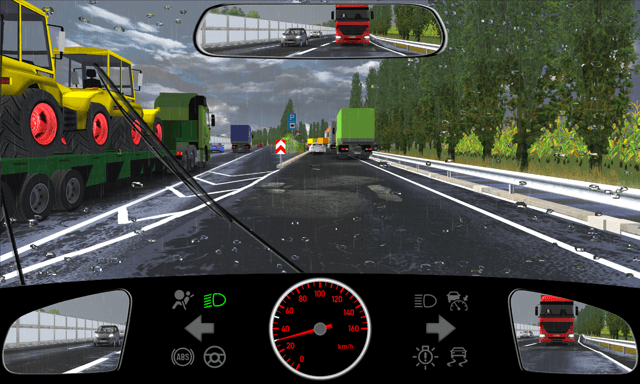
Spiegazione
Vehicles can leave the parking space, watch out for vehicles leaving the parking space. People can walk on the roadway because you are taking a break. Truck drivers often park in car parking spaces.
-
Domanda 3 di 31
Cosa dovresti aspettarti in questa situazione?
2.1.07-0144 PuntiSpiegazione
Because of the turning truck, the van could miss you. Be ready to brake.
-
Domanda 4 di 31
Perché dovresti ridurre ulteriormente la velocità qui?
2.1.07-0155 PuntiSpiegazione
It's unlikely that the car in the left lane will continue as it appears to have broken down. Even if it did, it wouldn't affect you. However, since there is a person in the lane, extra caution is required here. It's also possible that other people get out of the vehicle and run onto the road. The stationary car may be hidden by the bush or no warning triangle was set up. The following car could therefore recognize too late that the vehicle has stopped in front of it. You should therefore drive with foresight and expect the car behind to swerve into your lane.
-
Domanda 5 di 31
Cosa dovresti fare ora?
2.1.07-0204 PuntiSpiegazione
The yellow car comes towards you as a wrong-way driver on the highway. Drive to the right as far as possible and brake. To warn other road users, turn on the hazard warning lights.
-
Domanda 6 di 31
Qual è la procedura corretta da seguire in questa situazione?
2.1.07-0223 PuntiSpiegazione
Animals on the road are unpredictable. You should continue to reduce your speed and monitor the situation carefully, and be ready to brake in case the animals run across the road. Hazard braking could lead to a rear-end collision if the vehicle behind you cannot react quickly enough.
-
Domanda 7 di 31
Perché dovresti ridurre la velocità proprio ora?
2.1.07-0234 PuntiSpiegazione
Even if you keep to the speed limit of 60 km/h, an animal will run onto the road right in front of you. To avoid an accident, you have to reduce your speed. The oncoming car does not affect your driving style.
-
Domanda 8 di 31
Qual è la giusta linea d'azione ora?
2.1.07-0254 PuntiSpiegazione
As the blue car will probably be travelling on the road without observing the right of way rules, you must slow down sharply and give up your right of way.
-
Domanda 9 di 31
Qual è la giusta linea d'azione ora?
2.1.07-0263 PuntiSpiegazione
The tractor is signalling by flashing its lights that it wants to move back into the lane. You should therefore reduce your speed and allow the tractor to merge into the lane.
-
Domanda 10 di 31
Qual è la giusta linea d'azione ora?
2.1.07-0284 PuntiSpiegazione
The yellow car has an unusual driving style. It may be distracted or drunk. The abrupt braking and steering manoeuvres of the car in front are dangerous. Pay attention to how he continues to drive, increase the distance and be ready to brake.
-
Domanda 11 di 31
A cosa bisogna prestare attenzione quando si guida lungo strade strette?
2.1.07-0294 PuntiSpiegazione
Visibility in avenues is more restricted than in open fields and therefore requires an adapted driving style. On bends, your view of the carriageway may be restricted after the bend. You may therefore only see obstacles very late.
-
Domanda 12 di 31
Cosa potrebbe causare un'improvvisa sbandata laterale di un veicolo a motore che viaggia ad alta velocità su una strada rettilinea e asciutta?
2.1.07-1013 PuntiSpiegazione
A vehicle on a straight, dry road can swing off sideways in the event of a strong crosswind or a burst tire. In this case, immediately lay off the gas pedal, countersteer and brake gently.
-
Domanda 13 di 31
Cosa rende più facile guidare in un flusso continuo di veicoli?
2.1.07-1023 PuntiSpiegazione
Slightly offset driving allows you to observe the vehicles in front. This allows you to see the traffic situation in front of you or through the windows of the driver in front and react faster to sudden events. Driving with hazard lights in a convoy is generally prohibited.
-
Domanda 14 di 31
Mentre viaggi ad alta velocità su un'autostrada, uno dei tuoi pneumatici scoppia. Cosa fai?
2.1.07-1064 PuntiSpiegazione
Avoid emergency braking on the freeway and instead steer and brake gently to stabilize your vehicle. If possible, bring your vehicle to a stop on the hard shoulder. Turn on your hazard lights and set up your warning triangle to warn subsequent vehicles.
-
Domanda 15 di 31
Aumenti la velocità da 50 km/h a 100 km/h. Come cambia la distanza di frenata secondo la regola empirica?
2.1.07-1093 PuntiSpiegazione
According to the rule of thumb, the braking distance quadruples when the speed doubles. At 40 km/h, for example, it is 16 meters and at 80 km/h 64 meters.
-
Domanda 16 di 31
Perché devi essere pronto a frenare in questa situazione?
2.1.07-1115 PuntiSpiegazione
You see that a vehicle wants to drive onto the road from the right. Since it comes from a field or forest path, you have right of way. Due to the forest cover the visibility for the vehicle driver may be limited. It is possible that he/she will continue despite having to wait. For this reason, you must be ready to brake until you clearly recognize that he/she is stopping.
-
Domanda 17 di 31
Perché dovresti ridurre la velocità proprio ora?
2.1.07-1125 PuntiSpiegazione
Basically, you have the right of way, because you are on a priority road. However, to avoid a dangerous situation, you should still reduce your speed and be ready to brake, as the car driver of the car coming from the right-hand side might recognize you too late or miss you altogether. Due to the trees on the roadside his/her view is clearly limited.
-
Domanda 18 di 31
Qual è la giusta linea d'azione in questa situazione?
2.1.07-1135 PuntiSpiegazione
In this situation, you need to reduce the speed and allow the car driver to go back into lane on the left. If a lane ends on a multi-lane road or if it is not possible for the drivers driving on the other lane to drive through the lane continuously, they must be able to change lanes using the zipper procedure.
-
Domanda 19 di 31
Cosa dovresti aspettarti in questa situazione?
2.1.07-1145 PuntiSpiegazione
Although you are on the priority road, you must always expect dangerous situations to arise. For example, the tractor driver approaching your street at a junction could not fulfill his duty of waiting and force the vehicle in front of you to brake. By driving anticipatory you can help defuse potentially dangerous situations.
-
Domanda 20 di 31
Qual è la giusta linea d'azione in questa situazione?
2.1.07-1155 PuntiSpiegazione
The maximum speed limit on this road is 80 km/h. You drive 80 km/h. The driver driving behind you harasses you to drive quicker; he/she comes dangerously close and falls below the required safety distance. Keep your speed. If you try to increase the safety margin by accelerating, the driver behind you will probably also accelerate. Braking, even briefly, endangers you and the car behind.
-
Domanda 21 di 31
A cosa bisogna prestare attenzione quando si svolta a destra?
2.1.07-1173 PuntiSpiegazione
All drivers driving on the priority road must be given priority. The motorcycle is on the lane where you want to turn right. Before you turn right into the priority road, you have to wait and let the motorcycle pass.
-
Domanda 22 di 31
Cosa fare se non è più possibile evitare una collisione con animali selvatici?
2.1.07-1193 PuntiSpiegazione
If a collision with an animal is no longer avoidable, the direction of travel is to be maintained. Then brake hard and hold the steering wheel firmly. An evasive maneuver can injure other road users or increase the risk of greater damage than a controlled collision with the animal.
-
Domanda 23 di 31
Cosa bisogna fare in questa situazione?
2.1.07-1215 PuntiSpiegazione
In this situation, you should immediately brake hard but also not swerve.
-
Domanda 24 di 31
State percorrendo un tratto di strada tortuoso, molto frequentato dai motociclisti. Cosa dovete aspettarvi?
2.1.07-1224 PuntiSpiegazione
On curvy roads, motorcyclists can cut their curves or protrude on your roadway in curves because of their strong inclinations. Even motorcyclists who drive in the same direction of travel can also take advantage of the curves and could tend to carry out risky overtaking maneuvers.
-
Domanda 25 di 31
Cosa dovresti fare ora?
2.1.07-1234 PuntiSpiegazione
The driver of the red vehicle cuts the bend. Brake and stay behind the vehicle until you are sure that it will stay in its lane after the bend.
-
Domanda 26 di 31
Qual è il comportamento corretto ora?
2.1.07-1243 PuntiSpiegazione
On confusing roadways or when there is oncoming traffic on a narrow street, you should always pay close attention to other road users and adjust your speed. In this way, dangerous situations can be reduced in advance. You should also drive as far to the right as possible to avoid a collision with the oncoming truck. You can't see through the tree how far in the middle the oncoming truck is driving. You also create more space on the road if the motorcycle behind you tries to overtake and hasn't seen the truck yet.
-
Domanda 27 di 31
Cosa dovresti fare?
2.1.07-2024 PuntiSpiegazione
A car driving in front of you parks. You must reduce your speed and then change the lane to avoid the parked car when the motorcycle has passed you.
-
Domanda 28 di 31
Cosa bisogna sapere sull'utilizzo dello specchietto retrovisore?
2.1.07-2034 PuntiSpiegazione
Using the rear-view mirrors requires you to know the following: 1. Rear-view mirrors must be adjusted to the driver before starting to drive. 2. There are blind spots on all types of rear-view mirrors. These indicate areas hidden from view in which pedestrians, small vehicles or obstacles can be overlooked. By optimally adjusting the outer rearview mirror and the inner mirror, you keep the blind spot as low as possible.
-
Domanda 29 di 31
Stai guidando su una strada rurale. Davanti a te si trova una fila di circa 15 veicoli che procedono lentamente. Cosa dovresti fare?
2.1.07-2063 PuntiSpiegazione
In such a convoy, it is important to stay calm and to maintain the necessary safety distance. So-called queue, that is the overtaking of individual vehicles, brings no time gain and leads to a high accident risk.
-
Domanda 30 di 31
Ti fermi per far scendere i passeggeri sul lato destro. Lì passa una pista ciclabile. Cosa dovresti fare?
2.1.07-2073 PuntiSpiegazione
You as a car driver have a special duty of care. So, if you're stopping at a bike path with a co-driver, you should warn him/her about the cyclist before he/she gets off.
-
Domanda 31 di 31
Aumenti la velocità da 50 km/h a 100 km/h. Come cambia la distanza di reazione secondo la regola empirica?
2.1.07-2083 PuntiSpiegazione
If the car driver doubles the speed of the vehicle, the braking distance doubles from 15 to 30 meters.