
2.2.17 Illuminazione
Impara le regole di illuminazione più importanti per l'esame di guida tedesca in modo semplice e visivo. Concentrarsi sulla visibilità, sulla sicurezza e sul corretto utilizzo delle luci nelle diverse situazioni meteorologiche e stradali.
🔵 Abbaglianti (Fernlicht)
Fatti importanti
- Luce blu sul cruscotto = abbaglianti accesi
- Utilizzare gli abbaglianti solo su strade buie
- Disattivalo per il traffico in arrivo
- Non accecare gli altri guidatori
- Non utilizzare su strade ben illuminate
Quando spegnere
- Veicoli in avvicinamento
- Ai passaggi a livello
- Quando si guida dietro un altro veicolo
- Quando l'assistenza agli abbaglianti non funziona
💡 Anabbaglianti (Abblendlicht)
Usa anabbaglianti:
- Al crepuscolo
- Di notte
- Nei tunnel
- Sotto la pioggia
- Nella neve
- Nella nebbia
Perché è importante
- Puoi vedere meglio
- Gli altri possono vederti meglio
- Migliora la sicurezza stradale
Ricordare
- Le luci di parcheggio NON bastano
- Le luci automatiche potrebbero guastarsi in caso di nebbia
- Attiva manualmente se necessario
🌫️ Fendinebbia e fendinebbia posteriori
Fendinebbia
- Può essere utilizzato in caso di forte pioggia, nebbia o neve
- Consentito durante il giorno in condizioni di scarsa visibilità
- Aiuta gli altri a vedere il tuo veicolo
Fendinebbia posteriori
- Solo quando la visibilità è inferiore a 50 metri
- Utilizzare solo in caso di nebbia fitta
- La spia gialla sul cruscotto indica l'attivazione
- Può accecare i conducenti dietro di te
🚗 Regole di parcheggio e illuminazione dei veicoli
- Le auto possono parcheggiare con luci di posizione solo all'interno dei centri abitati
- Al di fuori dei centri abitati ciò non è consentito
- I camion/rimorchi di peso superiore a 3,5 t potrebbero necessitare di pannelli o luci di avviso di parcheggio
- Gli accessori che si estendono molto all'esterno del veicolo necessitano di illuminazione e riflettori aggiuntivi
- Gli attrezzi agricoli lunghi necessitano di catarifrangenti gialli
⚙️ Corretta regolazione dei fari
Troppo alto
Il traffico in arrivo sarà abbagliato e pericoloso.
Troppo basso
La strada è poco illuminata e la visibilità diventa pericolosa.
🧠 Suggerimenti rapidi per la memoria dell'esame
Luce blu = Abbaglianti accesi
Luce gialla = Retronebbia acceso
Non guidare mai solo con le luci di posizione
Utilizzare gli anabbaglianti in caso di nebbia, neve, pioggia, tunnel, crepuscolo e oscurità
Domande di Pratica (18)
-
Domanda 1 di 18
Come si fa a capire se il fendinebbia posteriore è acceso?
2.2.17-0012 PuntiSpiegazione
A look at the dashboard is enough and the car driver immediately recognizes from the yellow warning light that the rear fog-lamp is in operation. According to the highway traffic act, the warning light must be in direct field of vision.
-
Domanda 2 di 18
La visibilità è notevolmente ridotta. Quando è consentito accendere i fendinebbia?
2.2.17-0053 PuntiSpiegazione
If the visibility during the day is badly affected by fog, snowfall or rain, then you, as a car driver, have to switch on to low beam. Only in weather conditions with strong visual impairment you may also turn on the fog lights.
-
Domanda 3 di 18
Stai guidando di notte su una strada non illuminata. Un veicolo a motore ti precede di poco. Quali luci devi tenere accese?
2.2.17-0084 PuntiSpiegazione
The car driver must turn on the low beam on his own vehicle in order not to blind vehicles driving in front of you nor oncoming traffic. Using high beam is out of the question, as it would dazzle the other driver.
-
Domanda 4 di 18
I sistemi di illuminazione posteriore della tua auto sono coperti dalla garanzia. Cosa bisogna fare?
2.2.17-0102 PuntiSpiegazione
You must always attach a light carrier with all the rear lights to your vehicle. Keep in mind that you as a car driver are responsible for the effectiveness of the lighting equipment. A kilometer limit does not exist in this situation.
-
Domanda 5 di 18
In linea di massima, quali luci di un veicolo a motore devono essere accese quando si guida di notte?
2.2.17-0123 PuntiSpiegazione
In Germany it is compulsory to switch on the dipped headlights in the dark. When the low beam is switched on, you see more and you are also seen better.
-
Domanda 6 di 18
Quando è consentito utilizzare i fendinebbia anche di giorno?
2.2.17-1013 PuntiSpiegazione
In the event of heavy weather-related visibility restriction due to fog, snow or rain, fog lights may be switched on during the day. These strong weather-related restrictions of visibility usually only occur in autumn and winter months. You are generally not allowed to drive with ice on the windscreen. You need to remove it before starting your journey.
-
Domanda 7 di 18
Quando è consentito accendere i fendinebbia posteriori?
2.2.17-1023 PuntiSpiegazione
The rear fog-lamps of your vehicle may only be used if the visibility is less than 50 m in heavy fog. Due to the high risk of glare, the lights can otherwise become a security risk for subsequent traffic.
-
Domanda 8 di 18
In quali casi è sufficiente utilizzare le luci di posizione quando l'auto è parcheggiata su una strada non illuminata?
2.2.17-1033 PuntiSpiegazione
Cars may only be parked on unlit roads with parking lights switched on within built-up areas. Because within built-up areas, people drive at lower speeds, so that the parked car can be detected in time. Outside built-up areas this is not permitted.
-
Domanda 9 di 18
Quando è necessario utilizzare gli anabbaglianti anche di giorno?
2.2.17-1094 PuntiSpiegazione
If visibility is severely limited due to weather conditions - rain, fog, snowfall - you must use the prescribed lighting equipment, usually low beam, even during the daytime driving. This is necessary to be seen better by other road users and to help you see the others better.
-
Domanda 10 di 18
Durante il crepuscolo o le ore notturne, quando è obbligatorio tenere accese le luci di posizione come requisito minimo?
2.2.17-1113 PuntiSpiegazione
At dusk and in the dark always drive with low beam. So, you are clearly visible and you can see well yourself. Vehicles are not allowed to only drive with parking light, because the luminosity of these lights, which are also known as the sidelights, is not sufficient.
-
Domanda 11 di 18
Quando bisogna accendere gli anabbaglianti?
2.2.17-1144 PuntiSpiegazione
In poor visibility you must always turn on the low beam. This is always the case during dusk, in darkness or in weather-related poor visibility conditions such as rain, fog or snow. Even if you drive through a tunnel, you must always turn on the low beam.
-
Domanda 12 di 18
Quali possono essere le conseguenze di una regolazione errata del controllo di livellamento dei fari?
2.2.17-1153 PuntiSpiegazione
If the headlights are set too high, you will dazzle oncoming traffic. If the headlights are set too low, they will barely illuminate the road and you will not have sufficient visibility ahead. If the headlights are set incorrectly, the lights may not turn off completely.
-
Domanda 13 di 18
Qual è la funzione del sistema di assistenza agli abbaglianti del vostro veicolo durante le ore notturne?
2.2.17-1163 PuntiSpiegazione
The assistant switches the high beam on and off automatically so that other road users are not dazzled. The high beam is only switched on automatically if the road is not sufficiently lit.
-
Domanda 14 di 18
In quale situazione il sistema di assistenza agli abbaglianti potrebbe non essere in grado di attenuare tempestivamente gli abbaglianti del veicolo in presenza di veicoli provenienti dalla direzione opposta?
2.2.17-1173 PuntiSpiegazione
When crossing a crest and driving through a bend, the high beam assist camera may not be able to recognise oncoming traffic in time. Switch off the high beam manually when you notice it so as not to dazzle oncoming traffic and endanger yourself.
-
Domanda 15 di 18
Il sistema di illuminazione automatico è attivo sulla tua auto. Cosa devi aspettarti quando guidi nelle condizioni di illuminazione mostrate?
2.2.17-1183 Punti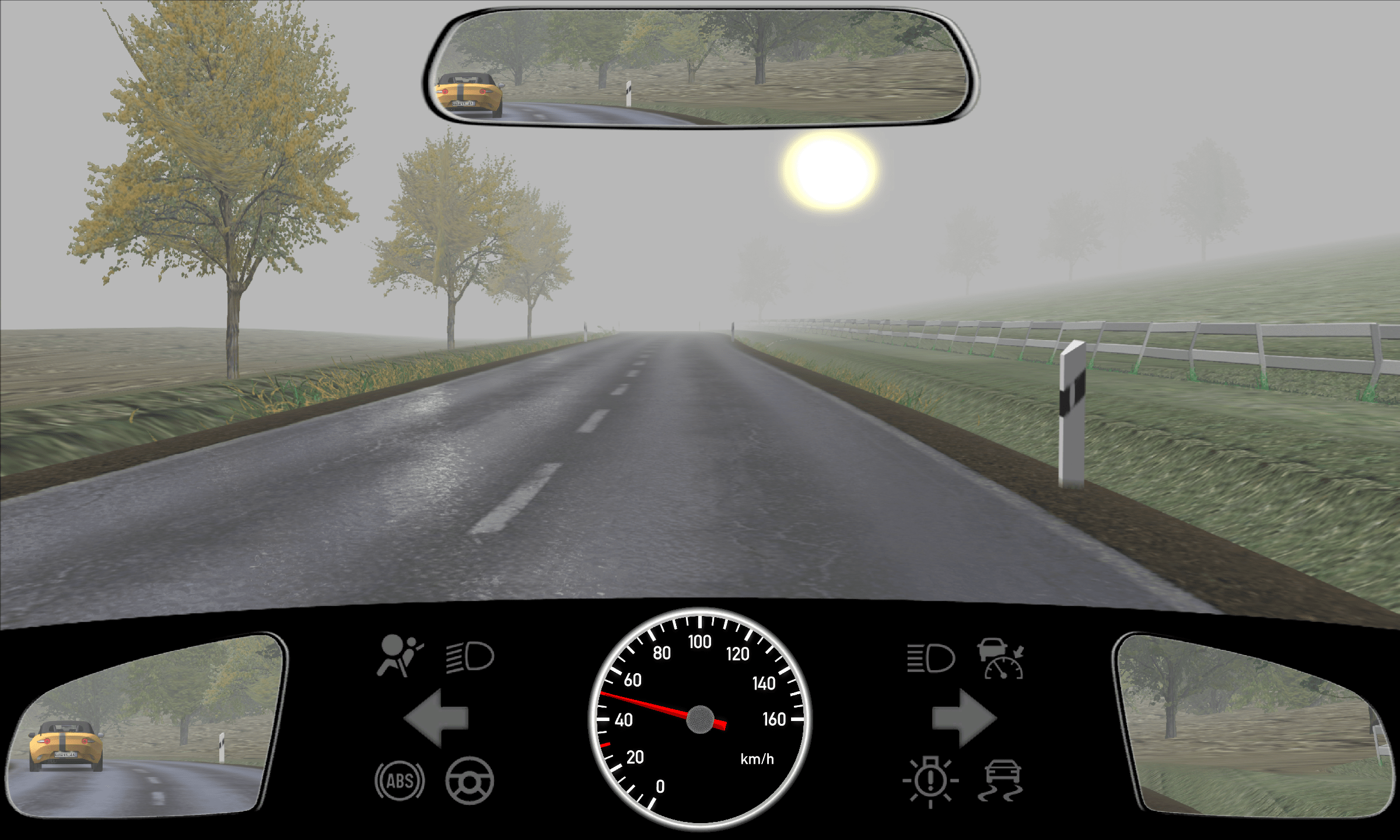
Spiegazione
The light and visibility conditions are poor due to the low sun and foggy air. However, the automatic light system does not recognise poor light conditions. Switch on the low beam manually so that following road users can see you better.
-
Domanda 16 di 18
Stai guidando al buio con i fari abbaglianti accesi. Quando devi abbassare gli anabbaglianti?
2.2.17-4024 PuntiSpiegazione
You must not dazzle the oncoming traffic with high beam. So, turn it off immediately if you realize that other vehicles are driving towards you. Pedestrians will not be dazzled by your high beam if they travel in the same direction as you.
-
Domanda 17 di 18
Stai guidando al buio con i fari abbaglianti accesi. Quando devi abbassare gli anabbaglianti?
2.2.17-4033 PuntiSpiegazione
When driving in the dark with high beam, you need to turn it off when approaching oncoming traffic. You are not allowed to drive with high beam on roads that have sufficient lighting throughout. The head lamps of waiting vehicles should not blind others. That's why you have to dip your lights at railroad crossings. If pedestrians precede in the same direction, they are not dazzled by the high beam.
-
Domanda 18 di 18
Perché mai si dovrebbe guidare con gli anabbaglianti anche di giorno, quando la visibilità è ridotta da nebbia, pioggia o neve?
2.2.17-4044 PuntiSpiegazione
If visibility is poor during the day, due to weather conditions such as rain, fog or snow, you as the driver must switch on the low beam. The primary concern here is that your vehicle is better seen by other road users. The traffic signs are not better seen from a greater distance.