
2.2.17 Encendiendo
Aprende las reglas de iluminación más importantes para el examen de conducir alemán de forma sencilla y visual. Concéntrese en la visibilidad, la seguridad y el uso correcto de las luces durante diferentes situaciones climáticas y de la carretera.
🔵 Luz De Carretera (Fernlicht)
Hechos importantes
- Luz azul del tablero = luz alta encendida
- Utilice las luces altas sólo en carreteras oscuras
- Apáguelo para el tráfico que viene en sentido contrario
- No dejes ciegos a otros conductores
- No utilizar en carreteras bien iluminadas.
Cuándo apagar
- Vehículos que se acercan
- En los cruces de ferrocarril
- Al conducir detrás de otro vehículo
- Cuando falla la asistencia de luces altas
💡 Luz de cruce (Abblendlicht)
Usar luz baja:
- al anochecer
- Por la noche
- en túneles
- bajo la lluvia
- en la nieve
- en la niebla
Por qué es importante
- puedes ver mejor
- Otros pueden verte mejor
- Mejora la seguridad vial
Recordar
- Las luces de estacionamiento NO son suficientes
- Las luces automáticas pueden fallar en caso de niebla
- Activar manualmente si es necesario
🌫️ Luces antiniebla y luces antiniebla traseras
Luces antiniebla
- Se puede utilizar bajo lluvia intensa, niebla o nieve.
- Permitido durante el día con poca visibilidad.
- Ayuda a otros a ver su vehículo
Luces antiniebla traseras
- Sólo cuando la visibilidad es inferior a 50 metros.
- Úselo solo en niebla intensa
- La luz amarilla de advertencia del tablero muestra activación
- ¿Puede cegar a los conductores detrás de usted?
🚗 Reglas de estacionamiento e iluminación de vehículos
- Los coches podrán aparcar con luces de estacionamiento únicamente en zonas urbanizadas.
- Fuera de zonas urbanizadas esto no está permitido.
- Los camiones/remolques de más de 3,5 t pueden necesitar luces o paneles de advertencia de estacionamiento
- Los accesorios que se extienden mucho más allá del vehículo necesitan iluminación y reflectores adicionales
- Los implementos agrícolas largos necesitan reflectores amarillos
⚙️ Ajuste correcto de los faros
demasiado alto
El tráfico que viene en sentido contrario quedará deslumbrado y será inseguro.
Demasiado bajo
La carretera está mal iluminada y la visibilidad se vuelve peligrosa.
🧠 Consejos rápidos para recordar el examen
luz azul = Luz alta encendida
luz amarilla = Luz antiniebla trasera encendida
Nunca conduzcas sólo con las luces de estacionamiento
Utilice las luces bajas en niebla, nieve, lluvia, túneles, anochecer y oscuridad.
Preguntas de práctica (18)
-
Pregunta 1 de 18
¿Cómo puede reconocer si la luz trasera antiniebla está encendida?
2.2.17-0012 puntosExplicación
A look at the dashboard is enough and the car driver immediately recognizes from the yellow warning light that the rear fog-lamp is in operation. According to the highway traffic act, the warning light must be in direct field of vision.
-
Pregunta 2 de 18
Ha disminuido considerablemente la visibilidad. ¿Cuándo puede Ud. encender los faros antiniebla?
2.2.17-0053 puntosExplicación
If the visibility during the day is badly affected by fog, snowfall or rain, then you, as a car driver, have to switch on to low beam. Only in weather conditions with strong visual impairment you may also turn on the fog lights.
-
Pregunta 3 de 18
Ud. circula de noche por una carretera sin alumbrado. Un vehículo le precede a poca distancia. ¿Qué luz debe tener encendida?
2.2.17-0084 puntosExplicación
The car driver must turn on the low beam on his own vehicle in order not to blind vehicles driving in front of you nor oncoming traffic. Using high beam is out of the question, as it would dazzle the other driver.
-
Pregunta 4 de 18
Los dispositivos traseros de iluminación de su vehículo a motor quedan tapados. ¿Qué hay que hacer?
2.2.17-0102 puntosExplicación
You must always attach a light carrier with all the rear lights to your vehicle. Keep in mind that you as a car driver are responsible for the effectiveness of the lighting equipment. A kilometer limit does not exist in this situation.
-
Pregunta 5 de 18
Por norma general, ¿qué dispositivo de iluminación tiene que activar en su vehículo de motor al viajar de noche?
2.2.17-0123 puntosExplicación
In Germany it is compulsory to switch on the dipped headlights in the dark. When the low beam is switched on, you see more and you are also seen better.
-
Pregunta 6 de 18
¿Cuándo puede encender los faros antiniebla incluso de día?
2.2.17-1013 puntosExplicación
In the event of heavy weather-related visibility restriction due to fog, snow or rain, fog lights may be switched on during the day. These strong weather-related restrictions of visibility usually only occur in autumn and winter months. You are generally not allowed to drive with ice on the windscreen. You need to remove it before starting your journey.
-
Pregunta 7 de 18
¿Cuándo puede encender las luces antiniebla traseras?
2.2.17-1023 puntosExplicación
The rear fog-lamps of your vehicle may only be used if the visibility is less than 50 m in heavy fog. Due to the high risk of glare, the lights can otherwise become a security risk for subsequent traffic.
-
Pregunta 8 de 18
¿Dónde es suficiente dejar la luz de estacionamiento encendida al estacionar un turismo en carreteras sin alumbrado?
2.2.17-1033 puntosExplicación
Cars may only be parked on unlit roads with parking lights switched on within built-up areas. Because within built-up areas, people drive at lower speeds, so that the parked car can be detected in time. Outside built-up areas this is not permitted.
-
Pregunta 9 de 18
¿Cuándo tiene que conducir de día con luz de corto alcance?
2.2.17-1094 puntosExplicación
If visibility is severely limited due to weather conditions - rain, fog, snowfall - you must use the prescribed lighting equipment, usually low beam, even during the daytime driving. This is necessary to be seen better by other road users and to help you see the others better.
-
Pregunta 10 de 18
¿En qué circunstancias debe encender en la penumbra o la oscuridad sólo la luz de posición?
2.2.17-1113 puntosExplicación
At dusk and in the dark always drive with low beam. So, you are clearly visible and you can see well yourself. Vehicles are not allowed to only drive with parking light, because the luminosity of these lights, which are also known as the sidelights, is not sufficient.
-
Pregunta 11 de 18
¿Cuándo tiene que accionar el alumbrado de corto alcance?
2.2.17-1144 puntosExplicación
In poor visibility you must always turn on the low beam. This is always the case during dusk, in darkness or in weather-related poor visibility conditions such as rain, fog or snow. Even if you drive through a tunnel, you must always turn on the low beam.
-
Pregunta 12 de 18
¿A qué puede dar lugar un ajuste manual incorrecto de la altura de los faros?
2.2.17-1153 puntosExplicación
If the headlights are set too high, you will dazzle oncoming traffic. If the headlights are set too low, they will barely illuminate the road and you will not have sufficient visibility ahead. If the headlights are set incorrectly, the lights may not turn off completely.
-
Pregunta 13 de 18
¿Cuál es la función del asistente de luces largas en la oscuridad?
2.2.17-1163 puntosExplicación
The assistant switches the high beam on and off automatically so that other road users are not dazzled. The high beam is only switched on automatically if the road is not sufficiently lit.
-
Pregunta 14 de 18
¿En qué situación puede que el asistente de luces largas de su vehículo de motor no cambie al alumbrado de corto alcance a tiempo cuando vienen vehículos circulando en sentido contrario?
2.2.17-1173 puntosExplicación
When crossing a crest and driving through a bend, the high beam assist camera may not be able to recognise oncoming traffic in time. Switch off the high beam manually when you notice it so as not to dazzle oncoming traffic and endanger yourself.
-
Pregunta 15 de 18
Su turismo lleva activado el sistema automático de iluminación. ¿Con qué tiene que contar ante las condiciones de luz de la imagen?
2.2.17-1183 puntos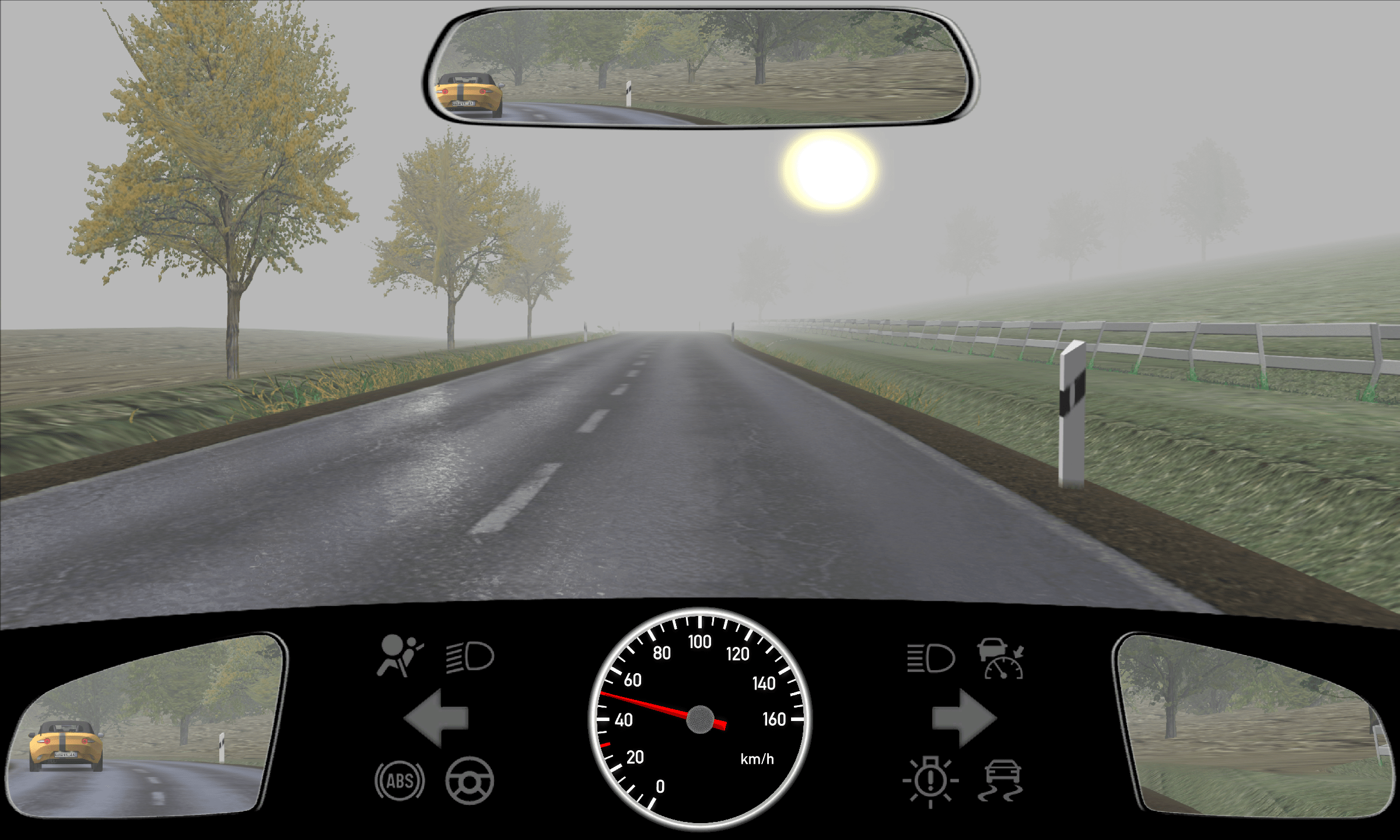
Explicación
The light and visibility conditions are poor due to the low sun and foggy air. However, the automatic light system does not recognise poor light conditions. Switch on the low beam manually so that following road users can see you better.
-
Pregunta 16 de 18
Es de noche y Ud. lleva el alumbrado de largo alcance. ¿En qué momento tiene que cambiar al alumbrado de corto alcance?
2.2.17-4024 puntosExplicación
You must not dazzle the oncoming traffic with high beam. So, turn it off immediately if you realize that other vehicles are driving towards you. Pedestrians will not be dazzled by your high beam if they travel in the same direction as you.
-
Pregunta 17 de 18
Es de noche y lleva el alumbrado de largo alcance. ¿En qué momento tiene que cambiar al de corto alcance?
2.2.17-4033 puntosExplicación
When driving in the dark with high beam, you need to turn it off when approaching oncoming traffic. You are not allowed to drive with high beam on roads that have sufficient lighting throughout. The head lamps of waiting vehicles should not blind others. That's why you have to dip your lights at railroad crossings. If pedestrians precede in the same direction, they are not dazzled by the high beam.
-
Pregunta 18 de 18
¿Por qué tiene que circular con el alumbrado de corto alcance también durante el día si hay visibilidad muy reducida debido a niebla, lluvia o nieve?
2.2.17-4044 puntosExplicación
If visibility is poor during the day, due to weather conditions such as rain, fog or snow, you as the driver must switch on the low beam. The primary concern here is that your vehicle is better seen by other road users. The traffic signs are not better seen from a greater distance.