
2.1.06 Adelantamiento
Regla de oro:
Sólo adelantar cuando todo el camino de adelantamiento sea claramente visible, seguro y se pueda mantener una distancia lateral suficiente.
🚦 Reglas de memoria rápida
✅ PUEDES adelantar cuando
- El camino por delante es completamente visible.
- No existe tráfico en sentido contrario
- Puedes mantener suficiente distancia lateral
- No hay curvas ni intersecciones que bloqueen tu vista.
- El vehículo de delante no gira a la izquierda.
❌ NUNCA adelante cuando
- La visibilidad es limitada
- Hay tráfico en sentido contrario
- Un vehículo detrás ya empezó a adelantar
- No puedes mantener suficiente distancia lateral.
- El vehículo de delante hace señales a la izquierda.
📏 Distancias Importantes
- 🚴 Ciclistas: 1,5 m dentro de las ciudades
- 🚴 Fuera de las localidades: Distancia mínima de 2 m.
- 🚗 Nunca adelantar si la carretera es demasiado estrecha para mantener una distancia lateral segura.
👀 Reglas de visibilidad
- No adelantar antes de las curvas
- No adelantar cerca de las intersecciones
- Las curvas y los árboles reducen la visibilidad
- Los cambios de luz y sombra pueden engañar al juicio de distancia
- Sólo adelantar cuando todo el camino sea visible.
🚛 Convoy y vehículos múltiples
- Los vehículos deberán adelantar uno tras otro.
- El último vehículo tiene el recorrido de adelantamiento más largo.
- No interrumpir una asociación cerrada
- No adelantar a varios coches antes de una curva
- Mantenga suficiente espacio para regresar de manera segura
🛣 Reglas de la autopista
- Normalmente está prohibido adelantar por la derecha.
- Excepción: atasco o cola lenta en el carril izquierdo
- No cambie de carril demasiado pronto
- Complete el adelantamiento de forma segura antes de cambiar de carril.
- Las luces delanteras intermitentes NO dan prioridad a los demás
⚠ Situaciones peligrosas
- Si alguien adelanta peligrosamente, reduzca la velocidad.
- Conduce lo más a la derecha posible
- Nunca aceleres mientras te adelantan
- Si es necesario, utilice el borde del césped con cuidado.
- Ayude a evitar colisiones creando espacio
🚴 Adelantos a ciclistas
- Mantenga una distancia mínima de 1,5 a 2 m
- No adelantar en carreteras estrechas
- Las obras en la carretera a menudo hacen imposible adelantar
- Mala visibilidad = no adelantar
- Reduzca la velocidad si no se puede mantener la distancia segura
🚜 Tractores y vehículos grandes
- Si el tractor señala hacia la izquierda → NUNCA adelantar
- Los tractores pueden girar a la izquierda antes de girar.
- Los vehículos grandes bloquean tu visibilidad.
- La distancia de adelantamiento se hace mucho más larga
- Esté atento a las motocicletas detrás de usted.
🧠 Trucos y consejos para el examen
Trampas comunes en los exámenes
- Tráfico oculto en sentido contrario
- Las motocicletas se acercan rápidamente por detrás.
- Vehículos que ya adelantan
- Distancia lateral insuficiente
- Intermitentes izquierdos de tractores
Mejor reacción segura
- Reducir la velocidad
- Mantén la calma
- Muévete hacia la derecha cuando sea necesario
- Cancelar el adelantamiento antes de tiempo
- Nunca obligues a otros a frenar repentinamente
Preguntas de práctica (26)
-
Pregunta 1 de 26
Quiere adelantar. ¿Qué es correcto hacer en este momento?
2.1.06-0073 puntosExplicación
As the vehicle behind you has already started the overtaking process, you should refrain from overtaking.
-
Pregunta 2 de 26
Quiere adelantar. ¿Qué debería tener en cuenta?
2.1.06-0084 puntosExplicación
Here you can overtake if you can see over the required distance and if there is no oncoming vehicle (limited visibility).
-
Pregunta 3 de 26
¿Por qué tiene que frenar bruscamente en este momento?
2.1.06-0114 puntosExplicación
Since the blue passenger car will most likely get on your lane, you have to slow down immediately and keep to the right.
-
Pregunta 4 de 26
¿Qué es lo correcto?
2.1.06-0125 puntosExplicación
As the car driver, you do not have to dodge to the middle lane when another car pushes you from behind or uses the flash light. You should overtake the blue car and the red van as usual. To change safely to the middle lane, the overtaking process must be completed. Only then you can change.
-
Pregunta 5 de 26
Quiere adelantar. ¿Qué es lo correcto en este momento?
2.1.06-0135 puntosExplicación
You already indicated and want to overtake the truck. In the rearview mirror you can see a red car approaching on the left lane at high speed. You need to stop the overtaking process immediately and stay behind the truck. If you continue, you force the red car to brake suddenly. He could drive against your car.
-
Pregunta 6 de 26
¿Qué es lo correcto?
2.1.06-0145 puntosExplicación
While overtaking a truck, you observe a fast approaching car in the rearview mirror. It is too late to complete the overtaking process. Accelerate and complete the overtaking process quickly but safely. Basically, subsequent vehicles do not have priority; even not on the freeway.
-
Pregunta 7 de 26
¿Qué es lo correcto?
2.1.06-0155 puntosExplicación
A driver drives dangerously close to you on the left-hand lane and signals his/her overtaking intent with his flash light. You should still overtake the transporter on the mid-lane and then get back into the lane in front of it to defuse the situation.
-
Pregunta 8 de 26
¿Por qué debe disminuir la velocidad en este caso?
2.1.06-0173 puntosExplicación
The oncoming car overtakes despite opposing traffic about 250 m in front of you. You have to reduce your speed and drive to the far right. So, you defuse the situation and give the overtaking car more time and space to complete the overtaking process. The tractor moves away from the intersection and poses no danger.
-
Pregunta 9 de 26
¿Cómo debe comportarse ahora?
2.1.06-0185 puntosExplicación
If a car overtakes you despite oncoming traffic, you should delay and try to drive to the right as far as possible. This gives the other vehicle enough space to safely complete the overtaking process.
-
Pregunta 10 de 26
Quiere adelantar. ¿Qué es correcto hacer en este momento?
2.1.06-0214 puntosExplicación
You should not overtake the truck, as you cannot see the distance required for this.
-
Pregunta 11 de 26
¿Qué es correcto hacer en este momento?
2.1.06-0234 puntosExplicación
You should not overtake because the tractor will swerve to the left (see indicator).
-
Pregunta 12 de 26
Quiere adelantar. ¿Qué es correcto hacer en esta situación?
2.1.06-0244 puntos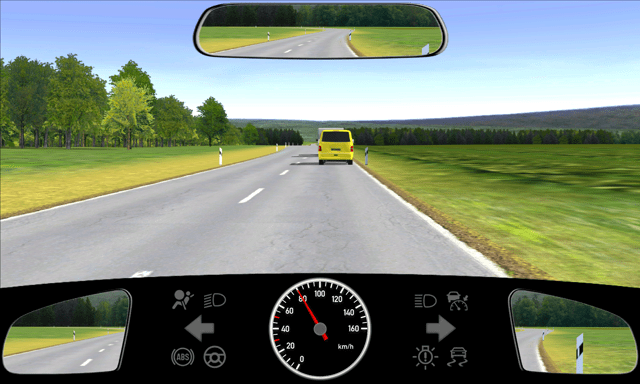
Explicación
The correct behavior (proactive) here is not to overtake as the yellow vehicle could overtake and oncoming traffic could appear (restricted view).
-
Pregunta 13 de 26
En este momento, ¿por qué no puede adelantar?
2.1.06-0265 puntosExplicación
Because of the motorcycle (oncoming traffic) and the course of the road and the resulting poor visibility, you are not allowed to overtake the cyclist.
-
Pregunta 14 de 26
En este momento, ¿por qué no puede adelantar?
2.1.06-0274 puntosExplicación
At this moment, a motorcyclist passes the tractor. Wait until you can safely begin the overtaking manoeuvre.
-
Pregunta 15 de 26
En esta situación, ¿por qué no puede adelantar?
2.1.06-0284 puntos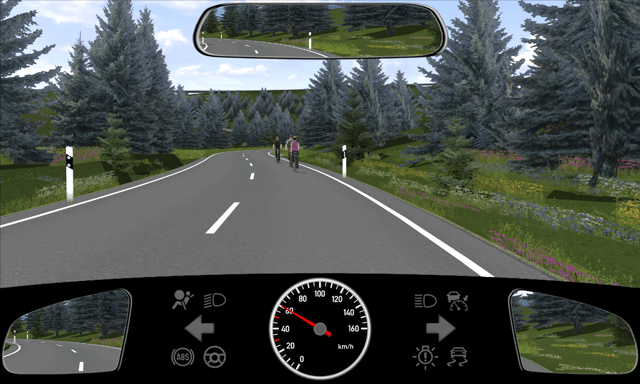
Explicación
Due to the curve and the trees, you cannot see the rest of the road sufficiently. Out of town, you must keep a minimum distance of 2 metres to the side of cyclists. In the event of sudden oncoming traffic, you would not be able to maintain this distance when overtaking. Therefore, you must not overtake here.
-
Pregunta 16 de 26
En esta situación, ¿por qué no puede adelantar?
2.1.06-0294 puntos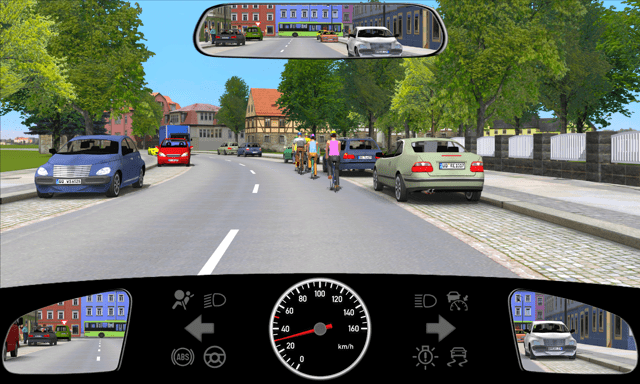
Explicación
The road is too small to allow enough side distance to cyclists and oncoming traffic at the same time.
-
Pregunta 17 de 26
Va circulando por una vía con árboles a los lados y quiere adelantar. ¿Qué particularidad se recomienda tener en cuenta?
2.1.06-0304 puntosExplicación
The avenue is framed by trees. Therefore, the change of light and shadow often leads to the incorrect estimation of distances. Likewise, it can often lead to trees falling and vehicles with high bodies trying to avoid branches.
-
Pregunta 18 de 26
¿Por qué tiene que suspender la maniobra de adelantamiento en este momento?
2.1.06-0314 puntosExplicación
The tractor starts to turn left. The tractor drives across the left lane of the road. If you overtake now, you would collide with the tractor.
-
Pregunta 19 de 26
Se encuentra circulando por una vía con un carril para cada sentido. Delante de usted va un convoy de vehículos de motor. ¿Por qué se recomienda no adelantar para evitar situaciones peligrosas?
2.1.06-0323 puntosExplicación
A group of pedestrians, cyclists or motor vehicles, which is traveling together in road traffic, is called a closed association. Closed associations must be clearly marked and must not be interrupted. Because a closed association consists of several vehicles, you cannot really understand the traffic situation. When overtaking a closed bandage, you should avoid premature inserting, which makes the overtaking path significantly longer.
-
Pregunta 20 de 26
En esta situación, ¿por qué resulta demasiado peligroso adelantar?
2.1.06-0335 puntosExplicación
You are driving in a convoy of several cars behind a lorry on a winding road with oncoming traffic. Ideally, the car behind the lorry overtakes first before the vehicles behind move up and start to overtake. On the left-hand bend, you cannot see the overtaking lane sufficiently. You will probably have to cancel the overtaking manoeuvre and pull in between two vehicles. There is a possibility that the distance between the vehicles in front is too small and that you will endanger yourself and other road users by pulling in.
-
Pregunta 21 de 26
Los vehículos que van delante del suyo circulan a unos 30 km/h. ¿Por qué no puede adelantar antes de la curva?
2.1.06-0354 puntos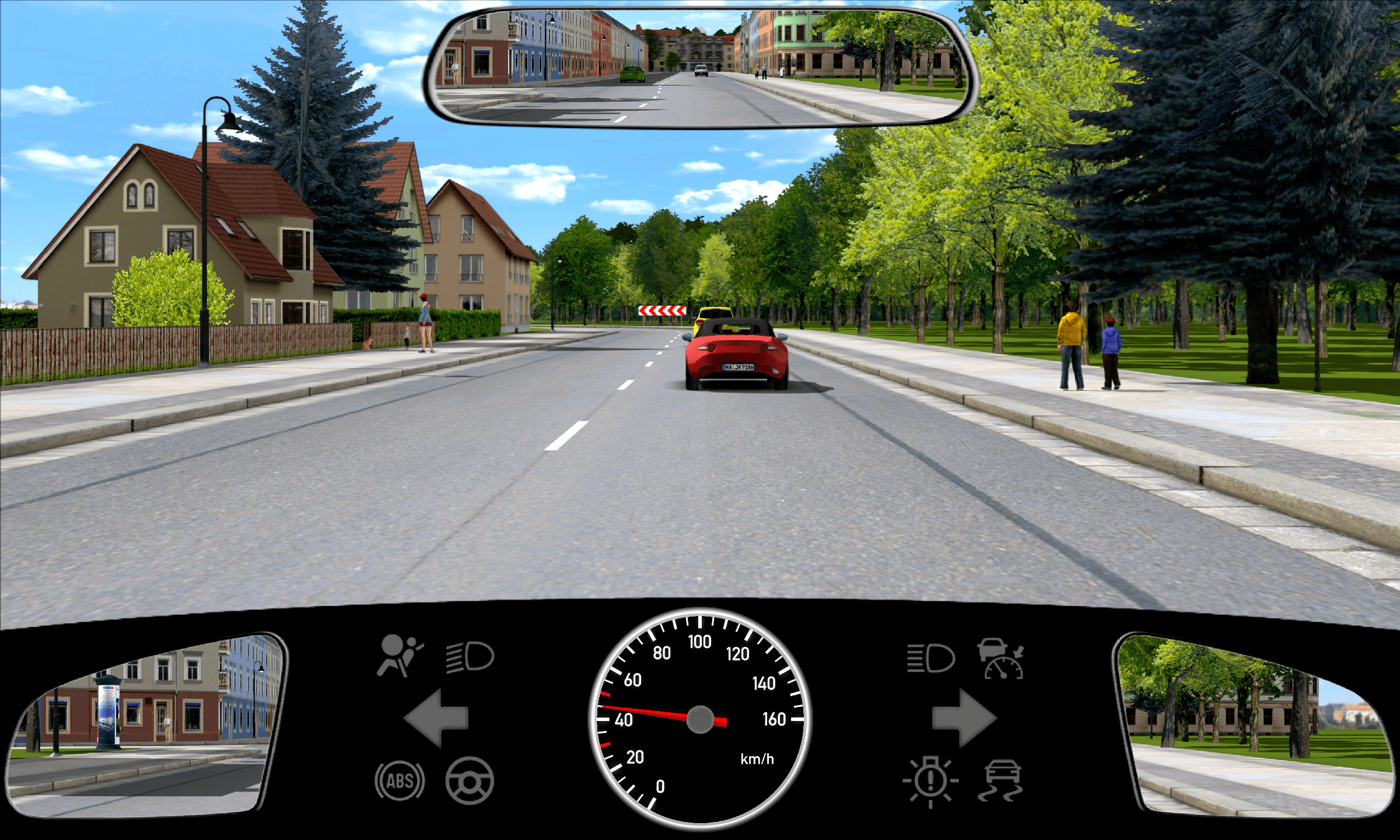
Explicación
You are not allowed to overtake before the bend as your overtaking distance is too long to overtake both vehicles before the bend. There is also not enough distance between the two cars for you to pull in. In addition, the red car has the right of way to overtake in front of you; if you both start the overtaking manoeuvre, there is a danger for you and oncoming traffic. As the bend is not visible, you cannot know whether oncoming traffic is coming.
-
Pregunta 22 de 26
¿Por qué tiene que incorporarse al carril de la derecha en este momento?
2.1.06-1034 puntosExplicación
The traffic sign indicates a narrowing (end of a lane) in 200 metres. The lane is led into oncoming traffic through the narrowing, so you must be extra vigilant not to end up in oncoming traffic.
-
Pregunta 23 de 26
¿Qué es correcto hacer en esta situación?
2.1.06-1044 puntosExplicación
You should not overtake for the time being, as you are driving side by side and you can't keep enough lateral distance.
-
Pregunta 24 de 26
¿Qué es correcto hacer en este momento?
2.1.06-1054 puntosExplicación
In such a situation, you must slow down to walking speed and keep to the right as much as possible. You should not drive past the pedestrians because the danger is too high.
-
Pregunta 25 de 26
¿Qué es correcto hacer en este momento?
2.1.06-1064 puntosExplicación
You have to reduce your speed because the side distance to the cyclist cannot be kept.
-
Pregunta 26 de 26
¿Por qué no debería adelantar al ciclomotorista en esta situación?
2.1.06-1074 puntosExplicación
In the roadworks area, the speed limit is 30 km/h and the road is narrowed. You are therefore not allowed to drive as fast as would be necessary to overtake the moped rider safely. Due to the narrowness of the road, you cannot keep the required distance to the side and the poor condition of the road could cause the moped rider to fall if you overtake him.