
1.2.36 Señales e instrucciones de los oficiales de policía
👮 ¿Cómo controlan el tráfico los agentes de policía, qué significan sus señales y por qué las instrucciones policiales siempre tienen la máxima prioridad? Aprendamoslos.
🧠 Orden de prioridad en el tráfico
1. Oficial de policía
Máxima autoridad
2. Semáforos
Anular señales
3. Señales de tráfico
Anular las reglas básicas
4. Justo antes de izquierda
Regla básica
🚦 Señales de oficiales de policía
Frente a ti
Si el oficial lo mira con el pecho o la espalda, debe detenerse y esperar.
De lado / Perfil
Si ve el perfil del oficial, puede continuar conduciendo con cuidado.
Brazo levantado
Deténgase y prepárese para nuevas instrucciones de tráfico.
🚓 Señal "POR FAVOR SIGUE"
📢 Qué significa
- La policía quiere detener su vehículo
- Debes seguir el coche de policía.
- No adelantar al vehículo policial.
- Detente cuando la policía pare
⚠ Regla importante
La señal suele aplicarse al vehículo que va directamente detrás del coche de policía.
⚠ Situaciones de tráfico importantes
🚗 Girar a la derecha
Si el oficial está de lado a usted, puede continuar y girar a la derecha con cuidado.
↩ Girar a la izquierda
Ingrese a la intersección con cuidado y espere la siguiente instrucción policial.
🚦 ¿Semáforo en rojo?
Ignore el semáforo si el policía da instrucciones diferentes.
👀 Tenga cuidado
Incluso cuando la policía controle el tráfico, siempre vigile a los peatones, ciclistas y otros vehículos.
📚 Tabla de memoria fácil
| Posición policial | Significado | Tu acción |
|---|---|---|
| frente a ti | Carretera Cerrada | DETENER |
| De lado/perfil | Camino abierto | Conduce con cuidado |
| brazo levantado | Atención / transición | Espere instrucciones |
🎯 Consejos sencillos para el examen
- Oficial de policía = máxima autoridad
- Frente a ti = PARAR
- Perfil/lateral = IR
- "POR FAVOR SIGA" debe ser obedecido
- Seguir los semáforos en lugar de la policía
- Ignorando "POR FAVOR SIGUE"
- Conducir demasiado rápido en una intersección
- No mirar a los peatones
Preguntas de práctica (11)
-
Pregunta 1 de 11
Un agente de policía regula el tráfico en una intersección, a pesar de que los semáforos estén funcionando. ¿Qué es correcto?
1.2.36-0014 puntos -
Pregunta 2 de 11
¿Qué importancia tienen las órdenes de los agentes de policía?
1.2.36-0034 puntosExplicación
The driver must always follow the signs and instructions of police officers. Other arrangements and rules, such as traffic lights or traffic signs, are put last. However, the road user must not neglect due diligence.
-
Pregunta 3 de 11
¿Cuál es el comportamiento correcto?
1.2.36-0044 puntos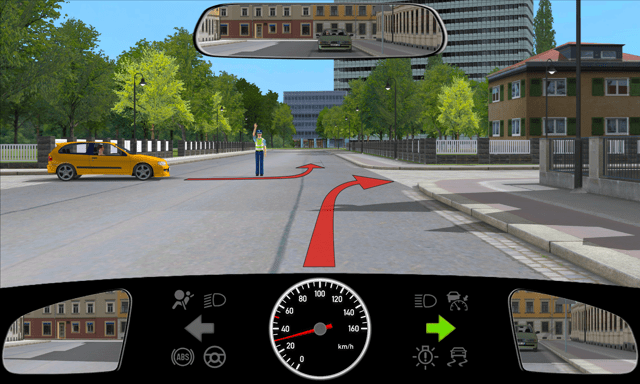
Explicación
The police officer gives the traffic instructions by his body position and with specific arm movements. A raised arm means: The drivers waiting at the intersection are not allowed to continue driving, previously locked drivers should prepare for the onward journey. For this, the policeman spreads his arms from the body or puts them on the body, depending on the instructions. If the police officer stands with his chest to the driver, the driver must stop. If the police officer stands sideways and the driver sees his profile, the driver may continue driving at a moderate speed.
-
Pregunta 4 de 11
En el espejo retrovisor ve Ud. en el techo de un coche patrulla inmediatamente detrás de Ud. en letras luminosas roja "STOP POLIZEI" (STOP POLICÍA). ¿Para quién vale?
1.2.36-0073 puntosExplicación
Since the request is displayed to the front and you are directly front of the police car, the request is addressed to you. You are required by law to follow the instructions from police officers.
-
Pregunta 5 de 11
Un vehículo de policía lo adelanta y se incorpora directamente delante de Ud. En el techo se ve un rótulo luminoso rojo que dice "BITTE FOLGEN" (SIGA AL VEHÍCULO). ¿Qué tiene que hacer?
1.2.36-0113 puntosExplicación
The signal "PLEASE FOLLOW" always applies to the driver directly behind the police car. So, you have to follow the instructions of the police, drive after the officers and stop behind the police car as soon as it stops.
-
Pregunta 6 de 11
Un vehículo de policía lo adelanta y se incorpora directamente delante de Ud. En el techo se ve un rótulo luminoso rojo que dice "BITTE FOLGEN" (SIGA AL VEHÍCULO). ¿A quién va dirigido el mensaje?
1.2.36-0123 puntosExplicación
The signal "PLEASE FOLLOW" on a police car applies to the vehicle immediately behind the police, in this case for you. The police may stop you for traffic control. Follow the police vehicle and stop when it stops.
-
Pregunta 7 de 11
Desde el interior de un vehículo que circula justo delante de Ud. le hacen señas con una "paleta de policía". ¿Eso qué implica?
1.2.36-0133 puntosExplicación
Basically, the driver who drives directly behind the police car has to follow the signal given by the police. If this is recognizable, the police signaling disc may also apply to drivers in front. You must not overtake the police car and you have to follow it.
-
Pregunta 8 de 11
¿Qué es correcto hacer en este momento?
1.2.36-0144 puntos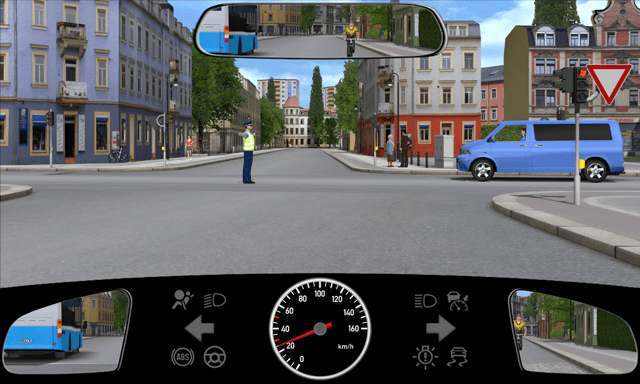
Explicación
The police officer is hierarchically first in the right-of-way. Basic rule "right before left", traffic signs and light signals have no effect at this moment. Nevertheless, be attentive because other road users could still behave incorrectly.
-
Pregunta 9 de 11
¿Quién puede pasar primero?
1.2.36-0154 puntos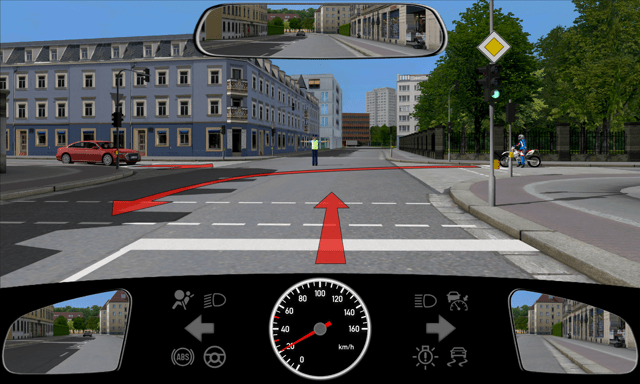
Explicación
The traffic is regulated by the police so that the red car is allowed to drive first.
-
Pregunta 10 de 11
¿Qué es lo correcto en esta situación?
1.2.36-0164 puntos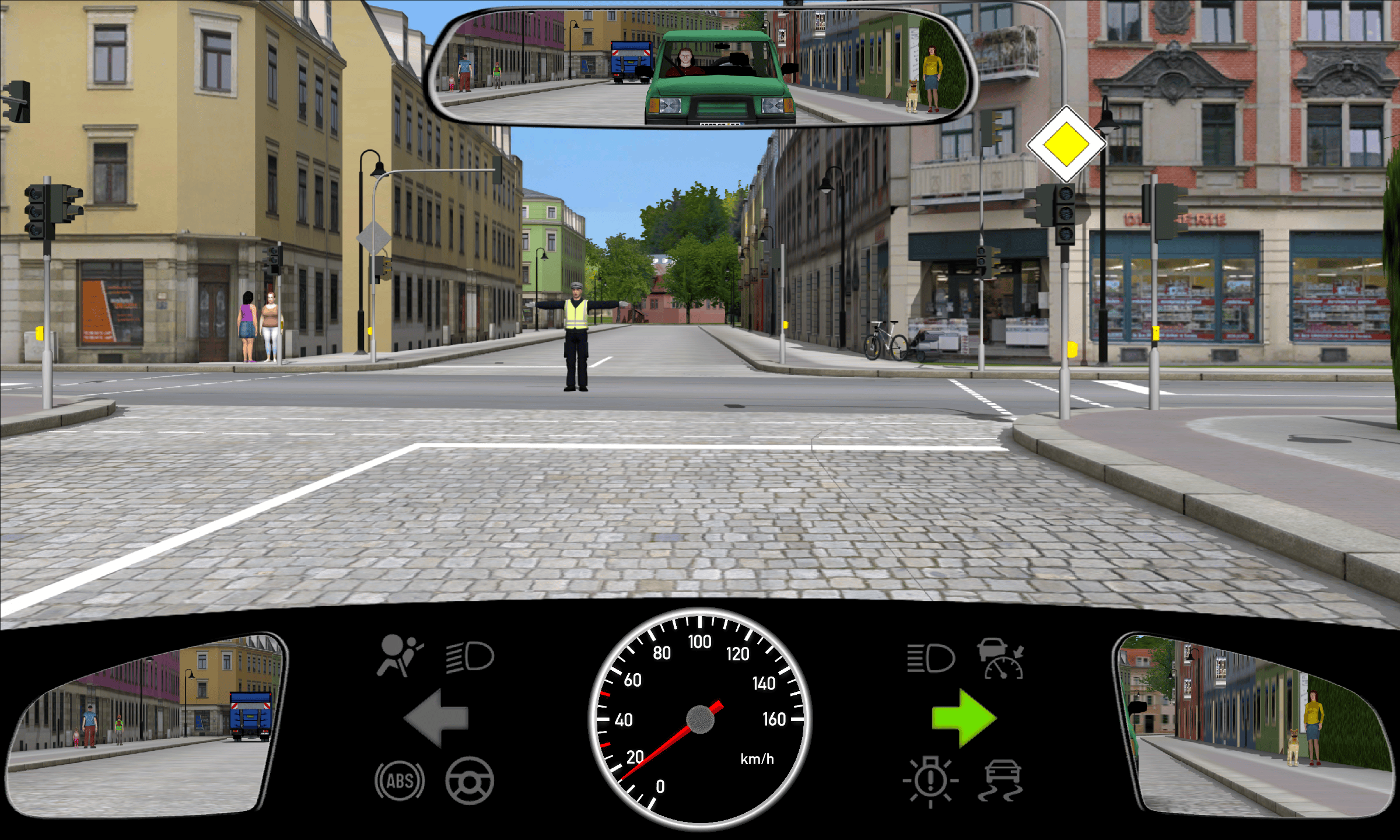
Explicación
If a traffic police officer is directing traffic, the instructions must be followed. In this situation, the traffic policeman stands in front of you, facing you and with his arms outstretched. This means that you have to wait at the intersection and vehicles from the right and left have the right of way.
-
Pregunta 11 de 11
¿Qué es correcto aquí?
1.2.36-1014 puntos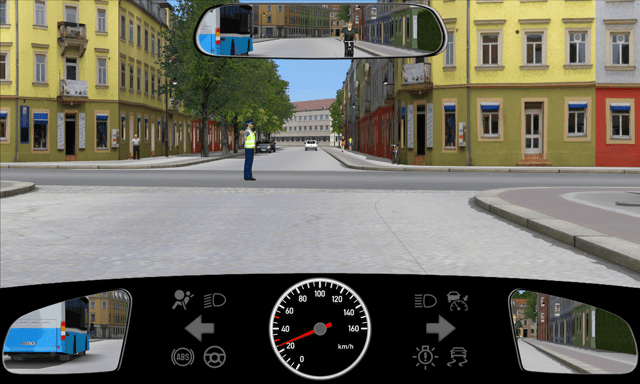
Explicación
The traffic policeman's gesture dictates the behavior in traffic. If the officer stands lengthways to your direction of travel and you can see his profile, you can continue and turn right. Right-turning drivers should cross the intersection quickly, as long as no pedestrian or cyclist approaches them. If you want to turn left, enter the intersection to ensure undisturbed traffic flow and wait for the policeman's instructions.