
1.2.11 Situazioni di traffico speciali
🚦 Regole d'oro da ricordare
Mantieni liberi gli incroci
Non bloccare mai incroci, strisce pedonali o passaggi a livello durante gli ingorghi.
Innanzitutto i veicoli di emergenza
Lasciare spazio sufficiente per polizia, ambulanze e camion dei pompieri.
I ciclisti hanno bisogno di spazio
Mantenere una distanza di sicurezza di 1,5-2 metri. Non sorpassare su strade strette.
Semaforo verde ≠ Guida sempre
Anche con il semaforo verde, attendi se la strada da percorrere è bloccata.
La polizia ignora i segnali
Le istruzioni della polizia sono più forti dei semafori e dei segnali stradali.
Aspetta i veicoli di grandi dimensioni
I camion e i tram potrebbero aver bisogno di spazio extra durante le svolte.
🚧 Mantieni libere le aree importanti
- NON bloccare gli incroci.
- NON bloccare i passaggi a livello.
- NON bloccare gli attraversamenti pedonali.
- Entra in un incrocio solo se puoi uscire velocemente.
- Fanno eccezione le fermate degli autobus.
“Se non puoi uscire, non entrare”.
⛔ Priorità al traffico in arrivo
Una freccia rossa indica che il traffico in arrivo ha la priorità.
❌ Mai
Guidare sul marciapiede.
✅ Sempre
Aspetta finché la strada non sarà libera.
🚶 Le strisce pedonali devono restare libere
Gli attraversamenti pedonali servono per attraversare in sicurezza. Non fermarti mai su di loro.
🚴 Associazioni chiuse
I gruppi di ciclisti, pedoni o veicoli che viaggiano insieme sono chiamati associazioni chiuse.
- Non interrompere il gruppo.
- Aspetta che tutti i membri passino.
- Se necessario, rimanere dietro la linea di stop.
🚲 Non sorpassare mai in modo pericoloso
- Restringimento della strada = il ciclista può spostarsi a sinistra.
- Traffico in arrivo = attendere dietro al ciclista.
- Mantenere una distanza di 1,5–2 metri.
⚠ Osserva attentamente i ciclisti
I ciclisti possono cambiare improvvisamente direzione senza segnali manuali.
🚋 Binari del tram
Quando si svolta a sinistra sui binari del tram:
- Fermarsi prima dei binari.
- Mantieni una distanza sufficiente.
- Aspetta che passi il tram.
- Girare a sinistra in tutta sicurezza dopo.
🟢 Verde NON significa “Vai sempre”
Se il traffico è bloccato, attendere prima di entrare nell'incrocio.
👮 Le istruzioni della polizia vengono prima di tutto
I comandi di polizia ignorano semafori e segnali stradali.
🚑 Veicoli di emergenza
Mantenere gli incroci liberi per ambulanze, polizia e camion dei pompieri.
🚛 I camion hanno bisogno di più spazio
I veicoli di grandi dimensioni possono compiere ampie oscillazioni durante la svolta.
✋ Segnale manuale vs luci lampeggianti
- Segnale manuale = rinuncia alla priorità valida.
- Le luci lampeggianti da sole NON bastano.
↪ Camion con svolta a destra
Attendere che il camion finisca di girare completamente prima di continuare.
🧠 Revisione rapida dell'esame
| Situazione | Cosa fare |
|---|---|
| Ingorgo stradale | Mantenere liberi gli incroci e le intersezioni |
| Ciclista avanti | Mantieni la distanza e attendi se non sei sicuro |
| Semaforo verde | Guidare solo se l'uscita è libera |
| Indicazioni di polizia | Segui sempre prima la polizia |
| Camion che gira | Attendi fino al completamento del turno |
| Incrocio del tram | Aspetta prima delle tracce |
✅ Consiglio per l'esame finale
Nella teoria tedesca della guida, molte domande mettono alla prova un’idea principale: Non bloccare o mettere in pericolo gli altri. Pensa sempre a:
Domande di Pratica (11)
-
Domanda 1 di 11
Quali sono le zone in cui è vietato guidare in caso di traffico intenso?
1.2.11-0034 PuntiSpiegazione
In the case of stagnant traffic, the following areas must be kept free for example for emergency vehicles: intersections, level crossings and cross-walks. For residential exits, this rule does not apply. If you notice that someone wants to drive off his property onto the road, you should give the driver the opportunity to enter the road.
-
Domanda 2 di 11
In caso di traffico intenso, quali parti dell'infrastruttura stradale devono essere mantenute libere?
1.2.11-0064 PuntiSpiegazione
The pedestrian crossing (“zebra crossing”) is intended to enable pedestrians to cross the road safely and without danger. For this reason, you must leave pedestrian crossings free under all circumstances. If you drive into a junction (or crossing) in slow-moving traffic, there is a risk that you will block oncoming cross traffic or that oncoming traffic turning left will have to wait unnecessarily long. The junction or crossing would thus become even more clogged and traffic would be obstructed more than necessary.
-
Domanda 3 di 11
Vuoi continuare a guidare dritto. Qual è la cosa corretta in questa situazione?
1.2.11-0074 Punti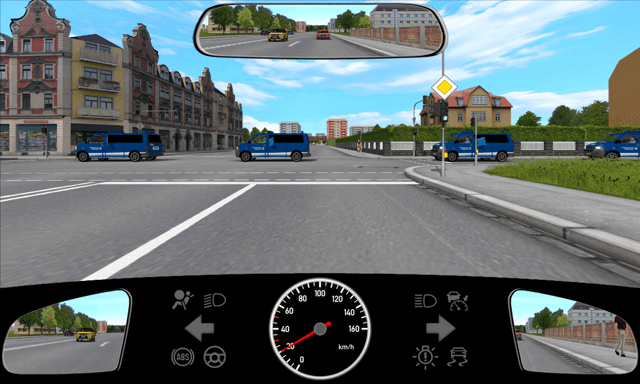
Spiegazione
A group of pedestrians, cyclists or motor vehicles, which is traveling together in road traffic, is called a closed association. Closed associations must be clearly marked and must not be interrupted. So you have to wait until all vehicles drove past you and as long as you have to wait at the stop line.
-
Domanda 4 di 11
Vuoi continuare a guidare dritto. Qual è la procedura corretta?
1.2.11-1034 Punti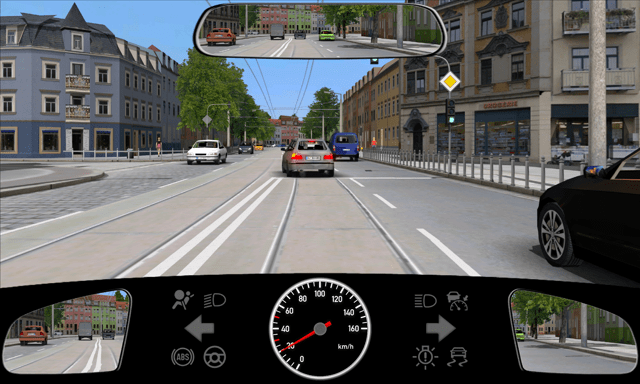
Spiegazione
The car ahead blocks you in your lane. Nevertheless, you should not overtake on the right before the intersection, as this would be too dangerous. Keep your distance, reduce the speed and stop if necessary. Continue straight ahead when the free lane is free and the traffic light turns green. You can only change on the right lane if there is a sufficiently large traffic gap.
-
Domanda 5 di 11
Cosa dovresti fare?
1.2.11-1045 PuntiSpiegazione
If tram rails lead through the left turn lane and you want to turn left when the tram approaches, it is important to wait with sufficient distance in front of the tram rails. When the tram passed, you can turn left.
-
Domanda 6 di 11
Qual è la giusta linea d'azione?
1.2.11-1055 PuntiSpiegazione
If a cyclist who moves to the left drives in front of you, you must not overtake him if the road is narrowed at this point and there is oncoming traffic. A safety distance of 1.5 to 2 meters could not be maintained here.
-
Domanda 7 di 11
In quali situazioni è vietato attraversare un incrocio anche se il semaforo è verde?
1.2.11-1084 PuntiSpiegazione
In the following cases, you must not enter a crossroad, even though the traffic light shows "green": with slow-moving traffic, as crossings, for example, must remain free for emergency vehicles. Secondly, when police officers regulate traffic and give instructions that deviate from the meanings of the colors of the traffic lights. In general, a green traffic light tells you that you are allowed to drive and overrules other traffic signs that regulate the right of way. Policeman orders have the highest rank and override traffic lights.
-
Domanda 8 di 11
Perché devi rallentare qui ed essere pronto a frenare?
1.2.11-1105 PuntiSpiegazione
You don't have to slow down because of pedestrians. He is far enough away from the constriction. The red vehicle is standing and is therefore no reason to slow down as well. However, reduce the speed because of the cyclist. He could change lanes without a hand signal and bring about a dangerous situation.
-
Domanda 9 di 11
Perché devi continuare a frenare?
1.2.11-1114 PuntiSpiegazione
A garbage truck comes towards the blue truck and forces him to stop. Since the garbage truck could swing out and get on your lane as it turns, you'll need to wait for the vehicle to be properly merged. The cyclist is no reason for braking.
-
Domanda 10 di 11
Vuoi proseguire dritto. Cosa devi fare?
1.2.11-1124 PuntiSpiegazione
In case of halting traffic, you are not allowed to block any intersection or T-junction despite the green traffic light or right of way. You may need to wait at the stop line and cannot close up until the front vehicles are far enough away.
-
Domanda 11 di 11
Quando puoi fare il giro?
1.2.11-1143 PuntiSpiegazione
As you want to turn left, oncoming traffic has priority. Only when the lorry driver gives up his right of way with a clear hand signal can you pass with due regard for oncoming traffic. Flashing your lights is not sufficient here.