
2.1.03 Fahrbahn- und Witterungsverhältnisse
Goldene Regel ⭐
Schlechtes Wetter = weniger Haftung + längerer Bremsweg + schlechte Sicht.
👉 Fahren Sie langsamer, halten Sie mehr Abstand und vermeiden Sie ruckartiges Lenken und Bremsen.
🌧️ Regen und nasse Fahrbahn
- Regnet es nach längerer Trockenheit, bildet sich ein gefährlicher Schmierfilm auf der Fahrbahn.
- Der Bremsweg wird länger.
- Die Sicht wird schlechter – durch Spritzwasser, ein beschlagenes Visier und weil die Scheibenwischer nicht sofort klare Sicht schaffen.
- Bremsen und beschleunigen Sie nicht ruckartig.
- Vergrößern Sie sofort den Sicherheitsabstand.
- Nasse Fahrbahnmarkierungen sind sehr glatt.
Besonders gefährlich ist der erste Regen nach einer langen Trockenzeit.
💧 Aquaplaning (Wasserglätte)
- Entsteht bei hoher Geschwindigkeit auf nasser Fahrbahn, besonders mit abgefahrenen Reifen.
- Die Reifen schwimmen auf und verlieren den Kontakt zur Straße.
- Sie können kaum noch lenken oder bremsen.
- Besonders gefährlich: Spurrillen und Fahrbahnsenken, in denen Wasser steht.
- Nehmen Sie vorsichtig den Fuß vom Gaspedal.
- Halten Sie das Lenkrad möglichst gerade.
- Bremsen Sie NICHT stark ab.
🌬️ Seitenwind
- Besonders gefährlich auf Brücken, an Tunnelausfahrten und beim Überholen von Lkws.
- Motorräder können plötzlich zur Seite versetzt werden.
- Fahren Sie in den Windschatten eines Lkws hinein oder wieder heraus, ändert sich der Winddruck schlagartig.
- Je schneller Sie fahren, desto gefährlicher ist Seitenwind.
Fahren Sie langsamer und lenken Sie vorsichtig gegen.
⚠️ Glatte Stellen
- Fahrbahnmarkierungen
- Ölspuren
- Kopfsteinpflaster
- Laub und Sand
- Kanaldeckel und Straßenbahnschienen
- Nasse Fahrbahn und Rollsplitt
Hier rutschen und stürzen Sie leichter.
🌫️ Nebel und schlechte Sicht
- Schalten Sie das Abblendlicht ein und passen Sie Ihr Tempo sofort an die Sicht an.
- Die Nebelschlussleuchte nur einschalten, wenn die Sichtweite unter 50 m liegt.
- Mit Nebelschlussleuchte höchstens 50 km/h.
- Fahren Sie nicht ständig über der Leitlinie in der Fahrbahnmitte – das gefährdet den Gegenverkehr.
- Orientieren Sie sich am rechten Fahrbahnrand.
Nur mit Standlicht dürfen Sie bei Nebel NICHT fahren.
❄️ Schnee und Eis
- Die Fahrbahn wird extrem glatt.
- Schneehaufen am Rand verdecken die Sicht.
- Der Bremsweg wird deutlich länger.
- Überholen Sie nicht bei Schneematsch.
- Fahren Sie ruhig und lenken Sie nicht ruckartig.
Bremsen Sie früh und fahren Sie so, dass andere Sie gut einschätzen können.
🏍️ Besondere Gefahren auf dem Motorrad
- Seitenwind kann das Motorrad zur Seite drücken.
- Nasse Fahrbahnmarkierungen sind sehr glatt – möglichst nicht darauf fahren oder auf kurzem Weg überqueren.
- Straßenbahnschienen in möglichst großem Winkel überfahren, also fast im rechten Winkel.
- Kopfsteinpflaster bietet viel weniger Haftung.
- Laub, Sand, Öl und Bodenwellen erhöhen in Kurven die Sturzgefahr.
- Halten Sie beim Fahren in der Gruppe genug Abstand.
- Bremsen Sie in Schräglage nicht plötzlich.
- Auf nassem Kopfsteinpflaster blockieren die Räder beim Bremsen leichter, und beim Beschleunigen rutscht das Hinterrad schneller weg.
🧠 Schnell gemerkt
🌧️ Regen = glatt + schlechte Sicht
💧 Aquaplaning = kaum lenken + kaum bremsen
🌬️ Seitenwind = vorsichtig gegenlenken
❄️ Schnee/Eis = früh bremsen + langsam fahren
⚠️ Glatte Stellen = keine ruckartigen Bewegungen
Übungsfragen (26)
-
Frage 1 von 26
Was kann auf nasser Fahrbahn zu Aquaplaning (Wasserglätte) führen?
2.1.03-0155 PunkteErklärung
Aquaplaning - also known as hydroplaning - occurs when the tread depth of the tires is too low to displace the accumulated amount of water or when the amount of water to be discharged is too large due to a high speed (from 60 km/h). In addition, wheel ruts in the road, in which water accumulates, favor this effect.
-
Frage 2 von 26
Wozu kann eine plötzliche Verschlechterung des Fahrbahnzustandes führen?
2.1.03-0253 PunkteErklärung
As the road surface deteriorates, it always results in a change and deterioration of traction. As the wheels lose stiction, the vehicle is slipping and skidding faster. The tire noise also depends on the condition of the road surface and changes when, for example, the road turns from a paved road to a cobblestone track.
-
Frage 3 von 26
Wie verhalten Sie sich richtig?
2.1.03-0285 PunkteErklärung
While overtaking a cyclist, the oncoming truck also partly gets on your lane. Brake and drive as far to the right as possible.
-
Frage 4 von 26
Warum sollten Sie jetzt bremsen?
2.1.03-0293 PunkteErklärung
Snow is a special danger for you as a car driver. Your lane is covered in snow. In addition, your view is restricted by a heap of snow. The upcoming green car does not respect the right of way. Therefore, you should brake early, because due to the slipperiness of the braking distance is extended. Probably the green car is also hampered by the snow pile.
-
Frage 5 von 26
Wie verhalten Sie sich jetzt richtig?
2.1.03-0334 PunkteErklärung
Due to the bad weather conditions, you should reduce your speed and avoid jerky steering movements (see danger sign) as you could otherwise skid.
-
Frage 6 von 26
Was kann Aquaplaning (Wasserglätte) zur Folge haben?
2.1.03-0344 PunkteErklärung
In the event of aquaplaning, your vehicle has no direct contact with the road surface, so the steering command and the braking command cannot be implemented.
-
Frage 7 von 26
Wie verhalten Sie sich in dieser Situation richtig?
2.1.03-0363 Punkte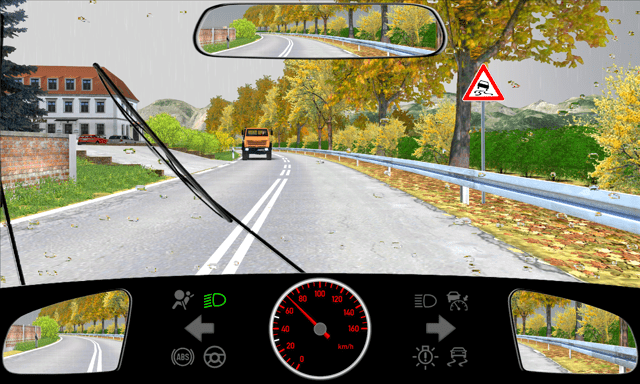
Erklärung
The traffic sign indicates a risk of skidding and sliding. To avoid skidding, you should reduce your speed, especially when it is raining and leaves are falling on the road, as is the case here. Braking hard, accelerating hard or steering jerkily can cause the tyres to lose their grip and you could skid or slide.
-
Frage 8 von 26
Worauf sollten Sie sich hier einstellen?
2.1.03-0374 Punkte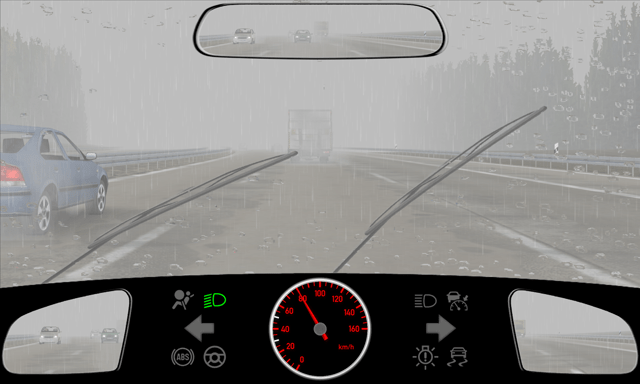
Erklärung
Because of the rain, you should be prepared for the fact that other vehicles will not be able to see your vehicle and that your braking distance will be longer due to the reduced grip.
-
Frage 9 von 26
Wann sind Sie hier beim Überholvorgang besonders gefährdet?
2.1.03-0384 Punkte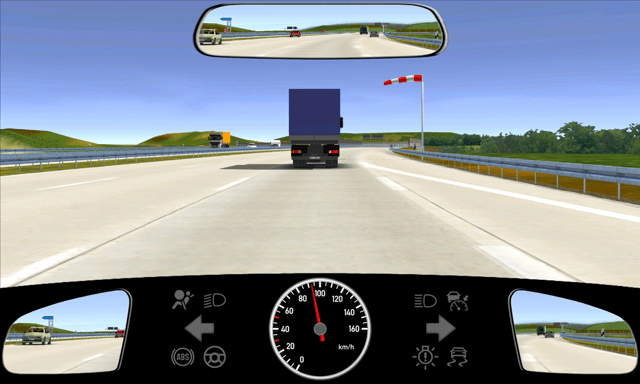
Erklärung
If there is a strong side wind from the right, you as a motorist are particularly at risk if, when driving off-road, you overtake in the slipstream of a truck. This hazard arises from the fact that strong cross winds from the right push your vehicle to the left, whereupon you automatically countersteer. As you overtake a truck, you slipstream into it; the crosswind is gone instantly and you have to adjust the steering. As soon as you pull out of the slipstream, the pressure starts up again with the crosswind; You have to countersteer again.
-
Frage 10 von 26
Womit müssen Sie in dieser Situation rechnen?
2.1.03-0444 Punkte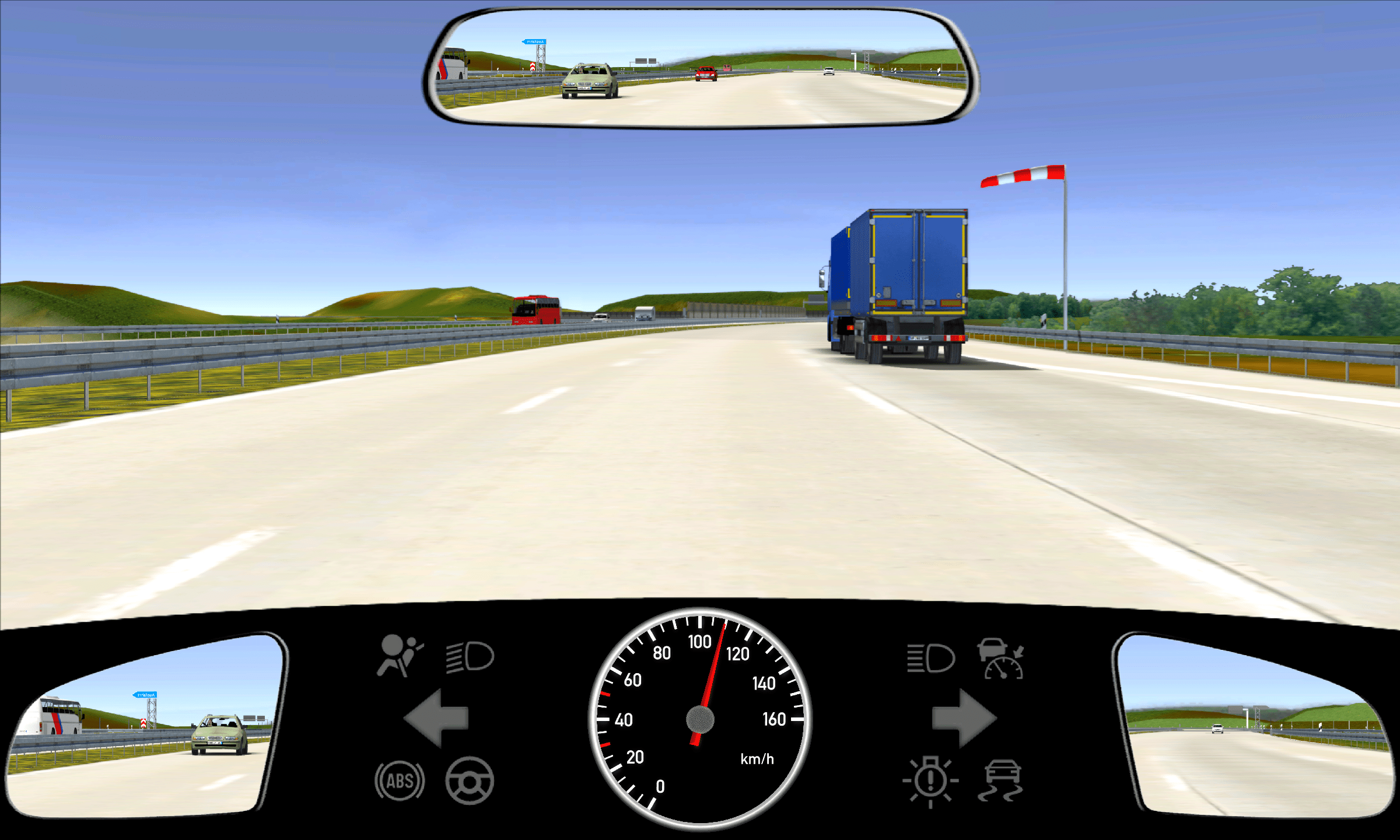
Erklärung
You can see from the windsock that a strong wind is blowing from the right. The strong wind could move your vehicle to the left. Be prepared to steer to the right. In addition, when entering the slipstream of the truck, you must be prepared for your vehicle to be moved to the right because its large surface area will keep out the crosswind. Be prepared to steer to the left to avoid colliding with the truck.
-
Frage 11 von 26
Wo tritt besonders häufig Aquaplaning (Wasserglätte) auf?
2.1.03-1015 PunkteErklärung
If the speed is too high and/or there is more water than can be drained from the tire profiles, aquaplaning occurs. A water film prevents contact between tires and the road. The vehicle is no longer controllable. The risk of aquaplaning exists in particular in ruts and road subsidence. Level crossings usually have no increased risk for aquaplaning, since water can usually run well here.
-
Frage 12 von 26
Worauf müssen Sie sich einstellen, wenn es nach längerer Trockenheit anfängt zu regnen?
2.1.03-1034 PunkteErklärung
If rain sets in after prolonged drought, a dangerous film of lubricant forms on the road, which is only washed away after a long period of rain. This film is more dangerous than rain alone. Brake very carefully. This lubricating film is also deposited on the windscreen. After turning on the windscreen wipers, it first worsens the view drastically. The braking distance is extended by the poorer traction.
-
Frage 13 von 26
Es fängt an zu regnen. Warum müssen Sie den Sicherheitsabstand sofort vergrößern?
2.1.03-1044 PunkteErklärung
When it starts raining, you must immediately increase the safety distance for the following reasons: Under the influence of moisture, the dirt, dust and fine deposits from tire abrasion or pollen on the road turn into a dangerous film of grease. This reduces the traction and thereby extends the braking distance. This lubricating film also forms on the windscreen and on the brake drums. If you use the windscreen wipers, they will first worsen your view and smudge the window. On the brake drums, this lubricating film leads to a slower response of the brakes in wet conditions.
-
Frage 14 von 26
Sie fahren außerorts bei dichtem Nebel auf einer Bundesstraße. Dürfen Sie auf der Fahrbahnmitte ständig über der Leitlinie fahren?
2.1.03-1054 PunkteErklärung
Driving on the center line is not allowed even in dense fog, especially as drivers can always collide with oncoming traffic due to reduced visibility. If there's fog, slow down and orient yourself on the right side of the road for a safe ride.
-
Frage 15 von 26
Was müssen Sie am Tage bei einer plötzlich auftretenden Nebelbank tun?
2.1.03-1064 PunkteErklärung
As a car driver you must turn on low beam during the day when there's fog, snowfall and other poor visibility. Because of the insufficient luminosity driving with parking light is not permitted. Adjust your speed to the visibility conditions and use the rear fog light when you can see less than 50 meters.
-
Frage 16 von 26
Wie können Sie ausreichende Sicht durch die Frontscheibe erhalten?
2.1.03-1073 PunkteErklärung
Turn your windscreen wipers to interval switching, during fog in order to remove fine water droplets from the mist. Turn on your windscreen wipers before overtaking or being overtaken so that obstructions caused by slush or spray water are immediately removed. Avoid fogged windows with the correct ventilation setting: Set ventilation to outside air supply and not to circulating air. Open the windows a gap to let the moisture escape. Briefly switching on the air conditioning dehumidifies the air very quickly.
-
Frage 17 von 26
Sie sind beim Überholen mehrerer Lkws in diese Situation geraten. Wie verhalten Sie sich jetzt?
2.1.03-1114 Punkte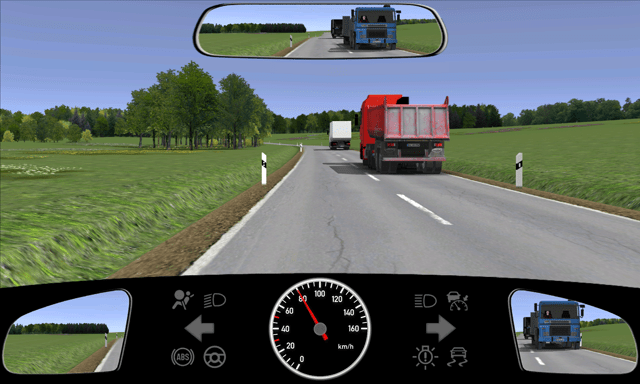
Erklärung
The visibility is very poor due to the weather and the road is not sufficiently visible. In order not to endanger anyone, you should stop the overtaking process as quickly as possible and ensure that you are at a safe distance from the vehicle in front of you when you go back into lane.
-
Frage 18 von 26
Wie verhalten Sie sich richtig?
2.1.03-1154 PunkteErklärung
There are two lanes in your direction of travel. You drive on the right side of the two tracks. In oncoming traffic, a snow plow truck approaches. You see in the mirror that a vehicle in the left lane next to you wants to overtake. Snowdrifts hinder you while driving on the lane. You cannot turn left unless the overtaking is completed. Therefore, you must delay further and wait in front of the obstacle until you can dodge to the left.
-
Frage 19 von 26
Wie sollten Sie sich hier verhalten?
2.1.03-1164 Punkte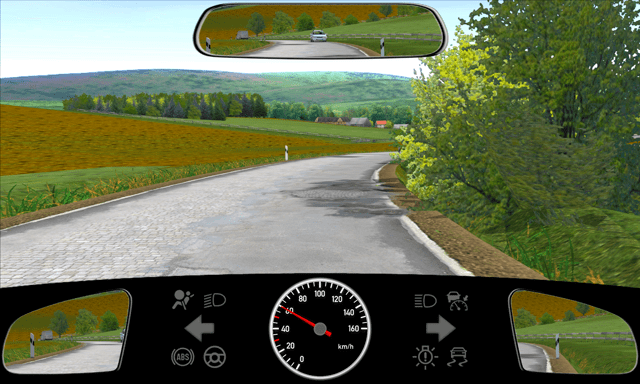
Erklärung
In the event of lane damage before a turn, you should reduce your speed considerably to avoid damaging the vehicle. Due to the confusion of the curve, you should not drive past the lane damage on the left, but continue on the right on your lane.
-
Frage 20 von 26
Sie fahren auf der Autobahn. Was ist in dieser Situation richtig?
2.1.03-1175 PunkteErklärung
Due to the severely restricted view on the motorway, you can switch on your rear fog light and drive a maximum of 50 km / h.
-
Frage 21 von 26
Sie benutzen auf Ihrer Fahrt die Adaptive Geschwindigkeitsregelanlage (AGR) Ihres Fahrzeugs. Womit müssen Sie bei dieser Witterung rechnen?
2.1.03-1193 Punkte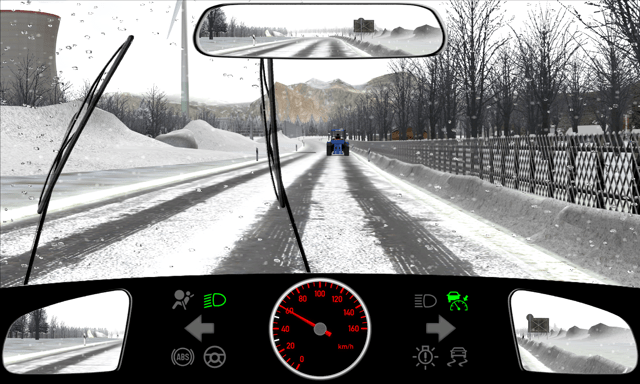
Erklärung
The adaptive cruise control system (ASC) independently estimates the distance and speed of the vehicle in front. This can be limited in bad weather, e.g. due to snow and dirt. Therefore, you must regulate the distance and speed yourself.
-
Frage 22 von 26
Sie befahren eine schmale Allee. Was müssen Sie beachten?
2.1.03-1204 PunkteErklärung
The narrow width of the road and its often curved shape due to tree roots force you to take extra care when cornering and when facing oncoming traffic. Choose your speed in such a way that the vehicle can be brought to a halt within half the visible distance. Example: With a visibility of approx. 40 metres, you should choose your speed so that you come to a stop within approx. 20 metres. In purely mathematical terms, the stopping distance at 30 km/h is 18 metres.
-
Frage 23 von 26
Die Anzeige für die Fahrdynamikregelung (ESC) hat mehrfach geleuchtet. Wie verhalten Sie sich in dieser Situation richtig?
2.1.03-1213 PunkteErklärung
You have to reduce your speed. Due to the slippery road surface and the obviously too high speed in the curves for the road conditions, the wheels lose grip and the car could skid.
-
Frage 24 von 26
Womit müssen Sie hier rechnen?
2.1.03-1224 Punkte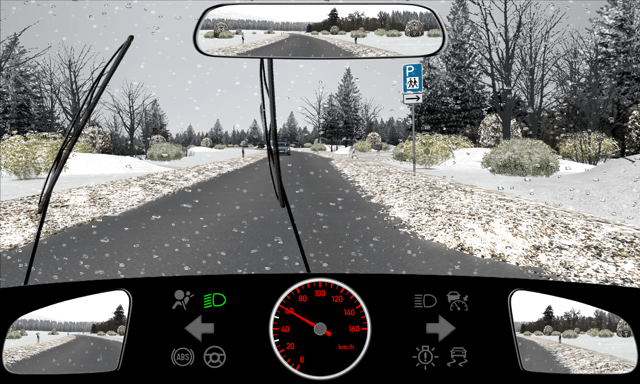
Erklärung
The snow on the right and left sides of the road may limit the lane. Therefore, you must expect that the distance to oncoming traffic is reduced. In addition, you can see from the traffic sign that there is a parking area for walkers on the right-hand side. Therefore, you must expect that there are pedestrians on the roadway.
-
Frage 25 von 26
Bei einer Geradeausfahrt verlieren Sie durch Aquaplaning die Kontrolle über Ihr Fahrzeug. Wie reagieren Sie jetzt richtig?
2.1.03-1234 PunkteErklärung
During aquaplaning, you cannot turn or change the direction of your car. You should also not accelerate or brake. So just carefully take your foot off the gas pedal and try to keep the wheel straight until your wheels touch the road again.
-
Frage 26 von 26
Warum ist das Überholen auf dieser verschneiten Fahrbahn gefährlich?
2.1.03-1244 Punkte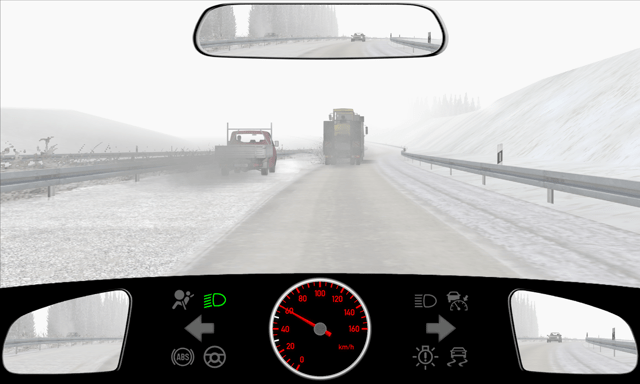
Erklärung
In the event of sneaky, icy road, the tires have less liability and can slip. You should avoid sudden braking through slow, forward -looking driving so as not to skid. In addition, the in front can also be thrown on the left lane due to the clearing/ stray vehicle in front and your view also deteriorates.