
1.2.05 Ultrapassando
🚗 Ultrapassagem e distância de segurança
Manter uma distância segura é uma das regras de segurança mais importantes na teoria de condução alemã.
A distância correta ajuda você:
- Evite colisões traseiras
- Reaja com segurança a travagens bruscas
- Melhore a visibilidade à frente
- Dirija com mais suavidade e calma
"Mais distância = Mais tempo para reagir."
📏 Regra de distância de segurança
A distância de segurança depende de:
👀 Visibilidade
Nevoeiro, chuva, neve ou escuridão exigem distâncias maiores.
🚗 Velocidade
Maior velocidade significa maior distância de parada.
🌧 Superfície da estrada
Estradas molhadas ou geladas reduzem a aderência dos pneus.
Mantenha pelo menos metade da sua velocidade em metros.
100 km/h → distância mínima de 50 metros
80 km/h → distância mínima de 40 metros
"Distância = metade da sua velocidade."
🚲 Distância ao ultrapassar bicicletas e scooters
Os ciclistas e os condutores de trotinetes elétricas estão menos protegidos e podem mover-se subitamente para os lados devido ao vento, buracos, carros estacionados ou perda de equilíbrio.
Portanto, a lei de trânsito alemã exige uma distância mínima de ultrapassagem.
🏙 Dentro de áreas construídas
Mantenha pelo menos 1,5m distância ao ultrapassar:
- Bicicletas
- E-scooters
- Pequenos veículos de duas rodas
🛣 Fora de áreas construídas
Fora das cidades você deve manter pelo menos 2 metros distância.
Velocidades mais elevadas fora das cidades criam mais perigo, pelo que é necessária uma lacuna de segurança maior.
⚠ Regra importante
Se NÃO houver espaço suficiente para manter a distância exigida, você NÃO poderá ultrapassar.
⚠ Ações corretas no trânsito
Quando outro veículo entra na sua faixa
Você deve criar uma distância segura imediatamente.
Se outro carro entrar na sua faixa, sua distância de segurança será menor. Você deve desacelerar para restaurar uma distância segura.
Quando outro carro ultrapassa você
Nunca acelere ao ser ultrapassado.
A redução da velocidade ajuda o veículo que ultrapassa a retornar com segurança à faixa. Acelerar é perigoso e ilegal.
✅ Benefícios de manter distância suficiente
👀 Melhor visibilidade
Você pode ver situações de trânsito mais cedo e dirigir com mais suavidade.
🛡 Menor risco de acidentes
Mais distância proporciona mais tempo de reação.
Resposta correta e errada
🧠 Resumo do exame de ultrapassagem e distância
Perguntas de Prática (19)
-
Pergunta 1 de 19
When driving outside of a built-up area, you want to overtake cyclists or pedestrians. What is the minimum space to the side that you must maintain?
1.2.05-0034 PontosCorreto: 2
Explicação
Outside built-up areas, the minimum distance to be maintained for pedestrians, cyclists and personal transporters is 2 metres.
-
Pergunta 2 de 19
Driving within a built-up area, you want to overtake a cyclist. What is the minimum space to the side that you must maintain?
1.2.05-0044 PontosCorreto: 1,5
Explicação
When overtaking, you must keep a sufficient distance to the side so as not to endanger other road users. In built-up areas, the minimum distance for pedestrians, cyclists and personal transporters is 1.5 metres.
-
Pergunta 3 de 19
Driving within a built-up area, you want to overtake an electric scooter. What is the minimum space to the side that you must maintain?
1.2.05-0054 PontosCorreto: 1,5
Explicação
When overtaking, you must keep a sufficient distance to the side so as not to endanger other road users. In built-up areas, the minimum distance for pedestrians, cyclists and personal transporters is 1.5 metres.
-
Pergunta 4 de 19
Where is overtaking prohibited?
1.2.05-1014 PontosExplicação
Overtaking is prohibited in the following cases: 1. in the event of an unclear traffic situation; 2. in the event of violation of traffic regulations. In one-way streets, however, there is no general rule of no overtaking. Before you start the overtaking process, look back in the mirror and over your shoulder to make sure you are not hindering or jeopardizing other road users.
-
Pergunta 5 de 19
What is the correct procedure for pulling out to overtake?
1.2.05-1034 PontosExplicação
For pulling out when overtaking the following rules apply: You need to convince yourself with a look in the mirror and a glance over the shoulder that your overtaking maneuver will neither jeopardize nor hinder subsequent traffic. Only then you are allowed to indicate and pull out. During the overtaking process you must take care not to hinder oncoming traffic. If the driver in front of you is flashing to the right, you should not be tempted to overtake.
-
Pergunta 6 de 19
What must you do to end an overtaking manoeuvre?
1.2.05-1043 PontosExplicação
As an overtaking driver, you must merge right as soon as possible. However, do not go back into the lane as long as you're still too close to the driver you just overtook, as you may obstruct or even endanger him. Use the turn signal in good time before starting to pull out and merging back into the lane again.
-
Pergunta 7 de 19
What are the regulations governing speed when overtaking?
1.2.05-1054 PontosExplicação
You may only overtake a vehicle in front of you if you are significantly (at least 20 km/h) faster. Also, when overtaking: Do not exceed the maximum speed limit. The one who is being overtaken must not increase its initial speed during the maneuver.
-
Pergunta 8 de 19
What must you do when you are being overtaken?
1.2.05-1064 PontosExplicação
Drive as far to the right as possible so as not to jeopardize the oncoming traffic and overtaking vehicle. During the entire overtaking process, you, as the one who is being overtaken, must not increase the speed, as otherwise safe overtaking would not be possible.
-
Pergunta 9 de 19
On which side must you overtake a tram which is travelling in the middle of the roadway (not a one-way street)?
1.2.05-1073 PontosExplicação
Trams must in general be overtaken on the right. If vehicles are parked here, you have to drive behind the tram. If the rails are too far to the right, trams may also be overtaken on the left.
-
Pergunta 10 de 19
When may a tram be overtaken on the left?
1.2.05-1083 PontosExplicação
Rail vehicles such as trams may basically only be overtaken on the right. For once, you can overtake on the left when the rails are too far to the right or when the rail vehicle is traveling in a one-way street. The right-hand traffic obstructing vehicles are not a sufficient reason to overtake rail vehicles on the left.
-
Pergunta 11 de 19
Which vehicles may be overtaken only by maintaining a specially great lateral distance?
1.2.05-1094 PontosExplicação
When overtaking you must always keep sufficient distance to the road users next to you. This must be particularly large with motorcycle and bicycle riders. Single lane vehicles are more unstable and can sway. The lateral minimum distance to two-wheeled vehicles is 1.5 meters.
-
Pergunta 12 de 19
When must you signal?
1.2.05-1103 PontosExplicação
Whenever you want to make a lane change or turn, you need to indicate. This also applies when following a turning priority road, but not when you leave the priority road straight ahead. Even if the direction indicator is set: always make sure that you do not endanger anyone when pulling out or going back into a lane.
-
Pergunta 13 de 19
You are driving a slow-moving vehicle on a main road. How can you facilitate faster-moving vehicles in overtaking?
1.2.05-1164 PontosExplicação
To allow faster vehicles to overtake you on a country road, you can dodge on a suitable side stripe, a lay by or in a rest stop. It is also possible to slow down or even stop at a suitable location.
-
Pergunta 14 de 19
How can you tell if a horse-drawn carriage wants to change direction?
1.2.05-1193 PontosExplicação
When a horse-drawn carriage wants to change its driving direction, it can be recognized by one of the following signs: The horse-drawn carriage indicates; the coachman beckons with his arm or with a signaling disk.
-
Pergunta 15 de 19
You want to overtake a horse-drawn carriage on a rural road. What should you do?
1.2.05-1204 PontosExplicação
Drive past the horses at an appropriate speed and with as much distance as possible. The animals may be frightened by sudden and loud noises such as a car horn or high engine speed, and may bolt. Therefore, avoid noise and proximity.
-
Pergunta 16 de 19
You want to overtake a horse-drawn carriage on a rural road. What is the right course of action?
1.2.05-1234 PontosExplicação
When overtaking a carriage, you must pay attention to hand signals from the coachman, who may give you separate instructions. Carriages should always be overtaken at a safe distance so as not to frighten the horse.
-
Pergunta 17 de 19
What amount of side clearance must you maintain when overtaking pedestrians and cyclists?
1.2.05-1244 PontosExplicação
To protect cyclists and pedestrians, you must keep a distance of at least 1.5 metres to the side in built-up areas and at least 2 metres outside built-up areas.
-
Pergunta 18 de 19
What must you note when overtaking the cyclists in this situation?
1.2.05-1254 Pontos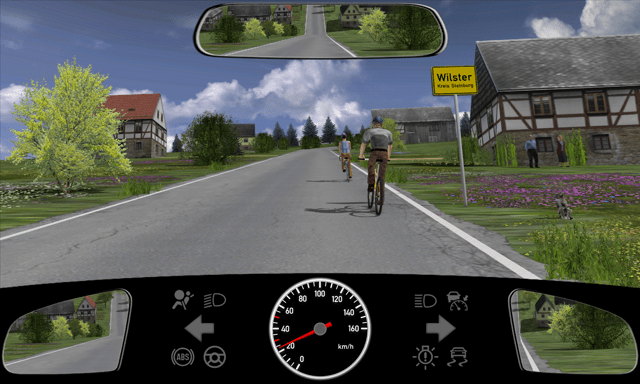
Explicação
When overtaking in built-up areas, you must maintain a distance of at least 1.5 metres to the side of the cyclist. Due to the commuting of cyclists, a larger minimum distance is recommended.
-
Pergunta 19 de 19
What is the correct course of action in this situation?
1.2.05-1265 PontosExplicação
The driving lane line is solid. Therefore, overtaking is forbidden here.