
2.1.07 Situações de trânsito especiais
Situações Especiais de Trânsito, Capítulo 2.1.07 — Aprenda o que fazer em situações de trânsito perigosas, pouco claras ou incomuns.
⭐ Regra do exame principal
Quando a situação não é clara, é perigosa ou outro utente da estrada pode cometer um erro: reduza a velocidade, aumente a distância, dirija com cuidado e esteja pronto para frear.
🚜 Veículos/tratores lentos
Quando você vê:
Um trator, caminhão ou ciclomotor deseja retornar do acostamento ou virar à esquerda.
Você deve:
Reduza a velocidade e permita que ela se funda com segurança.
🚗 Regra de final de pista / zíper
Quando você vê:
Uma faixa termina ou outro condutor não pode continuar na sua faixa.
Você deve:
Diminua a velocidade e deixe o veículo fundir-se usando o procedimento do zíper.
⚠ Veículos quebrados
Quando você vê:
Um carro parado, uma pessoa na estrada ou uma faixa bloqueada.
Você deve:
Reduza a velocidade, dirija para a direita, espere que pessoas ou veículos se movam repentinamente.
🦌 Animais
Quando você vê:
Animais próximos ou na estrada.
Você deve:
Diminua a velocidade, observe com atenção, esteja pronto para frear. Não desvie perigosamente.
🚴 Ciclistas
Quando você vê:
Um ciclista bloqueado por um obstáculo ou subindo uma colina.
Você deve:
Espere desviar, mantenha distância extra e só ultrapasse quando for seguro.
🏍 Motocicletas
Quando você vê:
Um motociclista ultrapassando, cortando curvas ou entrando na sua pista.
Você deve:
Dirija para a direita, reduza a velocidade e crie mais espaço.
🧠 Padrão de exame: quando você vê X → faz Y
| Situação | Reação Correta | Por que? |
|---|---|---|
| Motorista na contramão na rodovia | Mover para a direita, freio, luzes de perigo | Avise os outros e evite colisão |
| Tailgater atrás de você | Mantenha a velocidade legal | Não acelere ou freie repentinamente |
| Táxi parou à frente | Pare atrás dele se a faixa da esquerda estiver bloqueada | Não dirija na calçada |
| Visibilidade limitada perto de árvores/curvas | Diminua a velocidade e dirija para a direita | Perigos ocultos podem aparecer tarde |
| Pneu estourado ou vento cruzado forte | Libere o gás, faça contra-direção e freie suavemente | Mantenha o veículo estável |
| Colisão de animais inevitável | Freie com força, segure o volante, permaneça na faixa | Desviar pode ser mais perigoso |
📏 Distância de segurança
Fora das áreas urbanas, mantenha pelo menos:
Metade da sua velocidade em metros
Exemplo: 100 km/h → 50 m de distância
🛑 Distância de frenagem
Se a sua velocidade duplicar, a distância de travagem torna-se muito maior.
Velocidade dupla → distância de frenagem 4×
40 km/h = 16 m, 80 km/h = 64 m
🎴 Flashcards rápidos
Pergunta
O que você faz se um trator quiser fundir?
Responder
Reduza a velocidade e deixe-a fundir.
Pergunta
O que você faz se houver animais na estrada?
Responder
Diminua a velocidade e esteja pronto para frear.
Pergunta
Você pode dirigir na calçada para passar por um táxi?
Responder
Não. Pare e espere se não conseguir ultrapassar com segurança.
Pergunta
E se um motociclista puder ultrapassar perigosamente?
Responder
Dirija para a direita e reduza a velocidade.
Pergunta
O que você faz depois de acertar o jogo selvagem?
Responder
Pare, proteja o local e informe a polícia ou o departamento florestal.
Pergunta
E se um veículo vindo de um caminho florestal puder entrar?
Responder
Esteja pronto para frear, mesmo que tenha prioridade.
✅ Lista de verificação de revisão final
Perguntas de Prática (30)
-
Pergunta 1 de 30
Why must you brake now?
2.1.07-0094 PontosExplicação
You should brake because of the green vehicle, as it appears to be driving onto the road behind the tractor.
-
Pergunta 2 de 30
What must you anticipate in this parking area?
2.1.07-0103 Pontos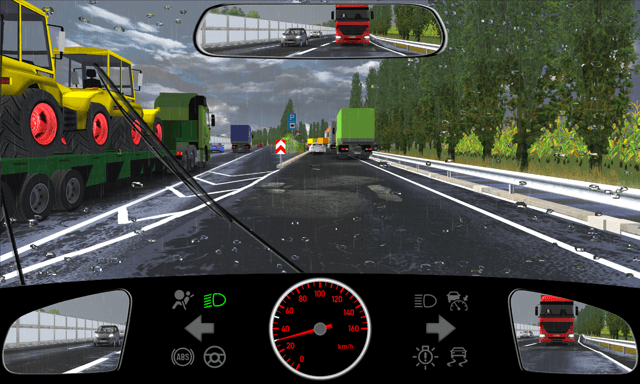
Explicação
Vehicles can leave the parking space, watch out for vehicles leaving the parking space. People can walk on the roadway because you are taking a break. Truck drivers often park in car parking spaces.
-
Pergunta 3 de 30
What is the right course of action now?
2.1.07-0114 PontosExplicação
The car will probably overtake the cyclist. To be on the safe side, slow down and ride as far to the right as possible.
-
Pergunta 4 de 30
Why should you be ready to brake in this situation?
2.1.07-0124 Pontos -
Pergunta 5 de 30
What must be observed when several motorcycles are travelling together in a group?
2.1.07-0133 PontosExplicação
Drive in a staggered manner to avoid rear-end collisions caused by sudden braking. Group rides are not easy; if one driver makes a mistake, all the others have to react.
-
Pergunta 6 de 30
What should you anticipate in this situation?
2.1.07-0144 PontosExplicação
Because of the turning truck, the van could miss you. Be ready to brake.
-
Pergunta 7 de 30
Why should you further reduce your speed here?
2.1.07-0155 PontosExplicação
It's unlikely that the car in the left lane will continue as it appears to have broken down. Even if it did, it wouldn't affect you. However, since there is a person in the lane, extra caution is required here. It's also possible that other people get out of the vehicle and run onto the road. The stationary car may be hidden by the bush or no warning triangle was set up. The following car could therefore recognize too late that the vehicle has stopped in front of it. You should therefore drive with foresight and expect the car behind to swerve into your lane.
-
Pergunta 8 de 30
What is the right course of action now?
2.1.07-0164 PontosExplicação
The stalled vehicle is blocking the other vehicle's lane and restricting your view. You should reduce your speed and drive as far to the right as possible in your driving.
-
Pergunta 9 de 30
What is the right course of action now?
2.1.07-0195 PontosExplicação
The motorcyclist is approaching you at high speed. He could overtake you even though the blue truck is already very close. Drive as far to the right as possible to increase the distance to the oncoming lane and reduce your speed so that the motorcyclist can complete the overtaking manoeuvre safely and in good time.
-
Pergunta 10 de 30
What should you do now?
2.1.07-0204 PontosExplicação
The yellow car comes towards you as a wrong-way driver on the highway. Drive to the right as far as possible and brake. To warn other road users, turn on the hazard warning lights.
-
Pergunta 11 de 30
What is the correct course of action in this situation?
2.1.07-0223 PontosExplicação
Animals on the road are unpredictable. You should continue to reduce your speed and monitor the situation carefully, and be ready to brake in case the animals run across the road. Hazard braking could lead to a rear-end collision if the vehicle behind you cannot react quickly enough.
-
Pergunta 12 de 30
Why should you reduce your speed now?
2.1.07-0234 PontosExplicação
Even if you keep to the speed limit of 60 km/h, an animal will run onto the road right in front of you. To avoid an accident, you have to reduce your speed. The oncoming car does not affect your driving style.
-
Pergunta 13 de 30
What do you have to be aware of in this situation?
2.1.07-0243 Pontos -
Pergunta 14 de 30
What is the right course of action now?
2.1.07-0254 PontosExplicação
As the blue car will probably be travelling on the road without observing the right of way rules, you must slow down sharply and give up your right of way.
-
Pergunta 15 de 30
What is the right course of action now?
2.1.07-0263 PontosExplicação
The tractor is signalling by flashing its lights that it wants to move back into the lane. You should therefore reduce your speed and allow the tractor to merge into the lane.
-
Pergunta 16 de 30
What is the right thing to do in this situation?
2.1.07-0274 PontosExplicação
On the narrow country road, it is possible that you and the tractor will not be able to pass each other easily. Be prepared to stop and let the tractor pass.
-
Pergunta 17 de 30
What is the right course of action now?
2.1.07-0284 PontosExplicação
The yellow car has an unusual driving style. It may be distracted or drunk. The abrupt braking and steering manoeuvres of the car in front are dangerous. Pay attention to how he continues to drive, increase the distance and be ready to brake.
-
Pergunta 18 de 30
What must you be aware of when driving along narrow avenues?
2.1.07-0294 PontosExplicação
Visibility in avenues is more restricted than in open fields and therefore requires an adapted driving style. On bends, your view of the carriageway may be restricted after the bend. You may therefore only see obstacles very late.
-
Pergunta 19 de 30
What is the right behaviour now?
2.1.07-0304 PontosExplicação
There is no other option for you in this situation other than to pull over behind the taxi. Because you are not allowed to pass to the right of the taxi as this is a sidewalk. Driving on a sidewalk is generally prohibited. You also can't change to the left lane because there is a motorcycle next to you. If you change lane you risk a collision.
-
Pergunta 20 de 30
You are taking part in a group tour with several motorbikes. What is the right behaviour?
2.1.07-0313 Pontos -
Pergunta 21 de 30
You increase your speed from 50 km/h to 100 km/h. How is the braking distance changed according to the rule of thumb?
2.1.07-1093 PontosExplicação
According to the rule of thumb, the braking distance quadruples when the speed doubles. At 40 km/h, for example, it is 16 meters and at 80 km/h 64 meters.
-
Pergunta 22 de 30
Why must you be ready to brake in this situation?
2.1.07-1115 PontosExplicação
You see that a vehicle wants to drive onto the road from the right. Since it comes from a field or forest path, you have right of way. Due to the forest cover the visibility for the vehicle driver may be limited. It is possible that he/she will continue despite having to wait. For this reason, you must be ready to brake until you clearly recognize that he/she is stopping.
-
Pergunta 23 de 30
Why should you lower your speed now?
2.1.07-1125 PontosExplicação
Basically, you have the right of way, because you are on a priority road. However, to avoid a dangerous situation, you should still reduce your speed and be ready to brake, as the car driver of the car coming from the right-hand side might recognize you too late or miss you altogether. Due to the trees on the roadside his/her view is clearly limited.
-
Pergunta 24 de 30
What is the right course of action in this situation?
2.1.07-1135 PontosExplicação
In this situation, you need to reduce the speed and allow the car driver to go back into lane on the left. If a lane ends on a multi-lane road or if it is not possible for the drivers driving on the other lane to drive through the lane continuously, they must be able to change lanes using the zipper procedure.
-
Pergunta 25 de 30
What should you anticipate in this situation?
2.1.07-1145 PontosExplicação
Although you are on the priority road, you must always expect dangerous situations to arise. For example, the tractor driver approaching your street at a junction could not fulfill his duty of waiting and force the vehicle in front of you to brake. By driving anticipatory you can help defuse potentially dangerous situations.
-
Pergunta 26 de 30
What is the right course of action in this situation?
2.1.07-1155 PontosExplicação
The maximum speed limit on this road is 80 km/h. You drive 80 km/h. The driver driving behind you harasses you to drive quicker; he/she comes dangerously close and falls below the required safety distance. Keep your speed. If you try to increase the safety margin by accelerating, the driver behind you will probably also accelerate. Braking, even briefly, endangers you and the car behind.
-
Pergunta 27 de 30
What must you pay attention to when turning right?
2.1.07-1173 PontosExplicação
All drivers driving on the priority road must be given priority. The motorcycle is on the lane where you want to turn right. Before you turn right into the priority road, you have to wait and let the motorcycle pass.
-
Pergunta 28 de 30
You want to remain on the priority road. What must you anticipate now?
2.1.07-1183 Pontos -
Pergunta 29 de 30
You are driving on a rural road. A line of approximately 15 slow-moving vehicles is travelling in front of you. What should you do?
2.1.07-2063 PontosExplicação
In such a convoy, it is important to stay calm and to maintain the necessary safety distance. So-called queue, that is the overtaking of individual vehicles, brings no time gain and leads to a high accident risk.
-
Pergunta 30 de 30
You increase your speed from 50 km/h to 100 km/h. How does the reaction distance change in accordance with the rule of thumb?
2.1.07-2083 PontosExplicação
If the car driver doubles the speed of the vehicle, the braking distance doubles from 15 to 30 meters.