
2.1.07 Special traffic situations
Special Traffic Situations, Chapter 2.1.07 — Learn what to do in dangerous, unclear, or unusual traffic situations.
⭐ Main Exam Rule
When the situation is unclear, dangerous, or another road user may make a mistake: reduce speed, increase distance, drive carefully, and be ready to brake.
🚜 Slow Vehicles / Tractors
When you see:
A tractor, truck, or moped wants to return from the hard shoulder or turn left.
You should:
Reduce speed and allow it to merge safely.
🚗 Lane Ending / Zipper Rule
When you see:
A lane ends or another driver cannot continue in their lane.
You should:
Slow down and let the vehicle merge using the zipper procedure.
⚠ Broken-Down Vehicles
When you see:
A stopped car, person on the road, or blocked lane.
You should:
Reduce speed, drive far right, expect people or vehicles to move suddenly.
🦌 Animals
When you see:
Animals near or on the road.
You should:
Slow down, watch carefully, be ready to brake. Do not swerve dangerously.
🚴 Cyclists
When you see:
A cyclist blocked by an obstacle or riding uphill.
You should:
Expect swerving, keep extra distance, and only overtake when safe.
🏍 Motorcycles
When you see:
A motorcyclist overtaking, cutting curves, or leaning into your lane.
You should:
Drive far right, reduce speed, and create more space.
🧠 Exam Pattern: When You See X → Do Y
| Situation | Correct Reaction | Why? |
|---|---|---|
| Wrong-way driver on highway | Move right, brake, hazard lights | Warn others and avoid collision |
| Tailgater behind you | Keep legal speed | Do not accelerate or brake suddenly |
| Taxi stopped ahead | Stop behind it if left lane is blocked | Do not drive on the sidewalk |
| Limited visibility near trees/curves | Slow down and drive far right | Hidden hazards may appear late |
| Burst tire or strong crosswind | Release gas, countersteer, brake gently | Keep vehicle stable |
| Animal collision unavoidable | Brake hard, hold steering wheel, stay in lane | Swerving can be more dangerous |
📏 Safety Distance
Outside built-up areas, keep at least:
Half your speed in meters
Example: 100 km/h → 50 m distance
🛑 Braking Distance
If your speed doubles, braking distance becomes much longer.
Double speed → 4× braking distance
40 km/h = 16 m, 80 km/h = 64 m
🎴 Quick Flashcards
Question
What do you do if a tractor wants to merge?
Answer
Reduce speed and let it merge.
Question
What do you do if animals are on the road?
Answer
Slow down and be ready to brake.
Question
Can you drive on the sidewalk to pass a taxi?
Answer
No. Stop and wait if you cannot safely overtake.
Question
What if a motorcyclist may overtake dangerously?
Answer
Drive far right and reduce speed.
Question
What do you do after hitting wild game?
Answer
Stop, secure the scene, and inform police or forestry office.
Question
What if a vehicle from a forest path may enter?
Answer
Be ready to brake, even if you have priority.
✅ Final Revision Checklist
Practice Questions (30)
-
Question 1 of 30
Why must you brake now?
2.1.07-0094 PointsExplanation
You should brake because of the green vehicle, as it appears to be driving onto the road behind the tractor.
-
Question 2 of 30
What must you anticipate in this parking area?
2.1.07-0103 Points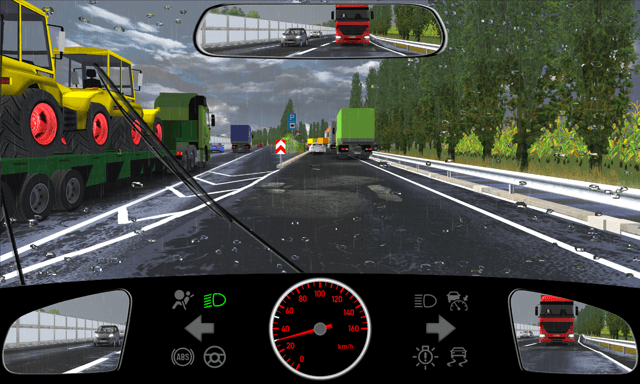
Explanation
Vehicles can leave the parking space, watch out for vehicles leaving the parking space. People can walk on the roadway because you are taking a break. Truck drivers often park in car parking spaces.
-
Question 3 of 30
What is the right course of action now?
2.1.07-0114 PointsExplanation
The car will probably overtake the cyclist. To be on the safe side, slow down and ride as far to the right as possible.
-
Question 4 of 30
Why should you be ready to brake in this situation?
2.1.07-0124 Points -
Question 5 of 30
What must be observed when several motorcycles are travelling together in a group?
2.1.07-0133 PointsExplanation
Drive in a staggered manner to avoid rear-end collisions caused by sudden braking. Group rides are not easy; if one driver makes a mistake, all the others have to react.
-
Question 6 of 30
What should you anticipate in this situation?
2.1.07-0144 PointsExplanation
Because of the turning truck, the van could miss you. Be ready to brake.
-
Question 7 of 30
Why should you further reduce your speed here?
2.1.07-0155 PointsExplanation
It's unlikely that the car in the left lane will continue as it appears to have broken down. Even if it did, it wouldn't affect you. However, since there is a person in the lane, extra caution is required here. It's also possible that other people get out of the vehicle and run onto the road. The stationary car may be hidden by the bush or no warning triangle was set up. The following car could therefore recognize too late that the vehicle has stopped in front of it. You should therefore drive with foresight and expect the car behind to swerve into your lane.
-
Question 8 of 30
What is the right course of action now?
2.1.07-0164 PointsExplanation
The stalled vehicle is blocking the other vehicle's lane and restricting your view. You should reduce your speed and drive as far to the right as possible in your driving.
-
Question 9 of 30
What is the right course of action now?
2.1.07-0195 PointsExplanation
The motorcyclist is approaching you at high speed. He could overtake you even though the blue truck is already very close. Drive as far to the right as possible to increase the distance to the oncoming lane and reduce your speed so that the motorcyclist can complete the overtaking manoeuvre safely and in good time.
-
Question 10 of 30
What should you do now?
2.1.07-0204 PointsExplanation
The yellow car comes towards you as a wrong-way driver on the highway. Drive to the right as far as possible and brake. To warn other road users, turn on the hazard warning lights.
-
Question 11 of 30
What is the correct course of action in this situation?
2.1.07-0223 PointsExplanation
Animals on the road are unpredictable. You should continue to reduce your speed and monitor the situation carefully, and be ready to brake in case the animals run across the road. Hazard braking could lead to a rear-end collision if the vehicle behind you cannot react quickly enough.
-
Question 12 of 30
Why should you reduce your speed now?
2.1.07-0234 PointsExplanation
Even if you keep to the speed limit of 60 km/h, an animal will run onto the road right in front of you. To avoid an accident, you have to reduce your speed. The oncoming car does not affect your driving style.
-
Question 13 of 30
What do you have to be aware of in this situation?
2.1.07-0243 Points -
Question 14 of 30
What is the right course of action now?
2.1.07-0254 PointsExplanation
As the blue car will probably be travelling on the road without observing the right of way rules, you must slow down sharply and give up your right of way.
-
Question 15 of 30
What is the right course of action now?
2.1.07-0263 PointsExplanation
The tractor is signalling by flashing its lights that it wants to move back into the lane. You should therefore reduce your speed and allow the tractor to merge into the lane.
-
Question 16 of 30
What is the right thing to do in this situation?
2.1.07-0274 PointsExplanation
On the narrow country road, it is possible that you and the tractor will not be able to pass each other easily. Be prepared to stop and let the tractor pass.
-
Question 17 of 30
What is the right course of action now?
2.1.07-0284 PointsExplanation
The yellow car has an unusual driving style. It may be distracted or drunk. The abrupt braking and steering manoeuvres of the car in front are dangerous. Pay attention to how he continues to drive, increase the distance and be ready to brake.
-
Question 18 of 30
What must you be aware of when driving along narrow avenues?
2.1.07-0294 PointsExplanation
Visibility in avenues is more restricted than in open fields and therefore requires an adapted driving style. On bends, your view of the carriageway may be restricted after the bend. You may therefore only see obstacles very late.
-
Question 19 of 30
What is the right behaviour now?
2.1.07-0304 PointsExplanation
There is no other option for you in this situation other than to pull over behind the taxi. Because you are not allowed to pass to the right of the taxi as this is a sidewalk. Driving on a sidewalk is generally prohibited. You also can't change to the left lane because there is a motorcycle next to you. If you change lane you risk a collision.
-
Question 20 of 30
You are taking part in a group tour with several motorbikes. What is the right behaviour?
2.1.07-0313 Points -
Question 21 of 30
You increase your speed from 50 km/h to 100 km/h. How is the braking distance changed according to the rule of thumb?
2.1.07-1093 PointsExplanation
According to the rule of thumb, the braking distance quadruples when the speed doubles. At 40 km/h, for example, it is 16 meters and at 80 km/h 64 meters.
-
Question 22 of 30
Why must you be ready to brake in this situation?
2.1.07-1115 PointsExplanation
You see that a vehicle wants to drive onto the road from the right. Since it comes from a field or forest path, you have right of way. Due to the forest cover the visibility for the vehicle driver may be limited. It is possible that he/she will continue despite having to wait. For this reason, you must be ready to brake until you clearly recognize that he/she is stopping.
-
Question 23 of 30
Why should you lower your speed now?
2.1.07-1125 PointsExplanation
Basically, you have the right of way, because you are on a priority road. However, to avoid a dangerous situation, you should still reduce your speed and be ready to brake, as the car driver of the car coming from the right-hand side might recognize you too late or miss you altogether. Due to the trees on the roadside his/her view is clearly limited.
-
Question 24 of 30
What is the right course of action in this situation?
2.1.07-1135 PointsExplanation
In this situation, you need to reduce the speed and allow the car driver to go back into lane on the left. If a lane ends on a multi-lane road or if it is not possible for the drivers driving on the other lane to drive through the lane continuously, they must be able to change lanes using the zipper procedure.
-
Question 25 of 30
What should you anticipate in this situation?
2.1.07-1145 PointsExplanation
Although you are on the priority road, you must always expect dangerous situations to arise. For example, the tractor driver approaching your street at a junction could not fulfill his duty of waiting and force the vehicle in front of you to brake. By driving anticipatory you can help defuse potentially dangerous situations.
-
Question 26 of 30
What is the right course of action in this situation?
2.1.07-1155 PointsExplanation
The maximum speed limit on this road is 80 km/h. You drive 80 km/h. The driver driving behind you harasses you to drive quicker; he/she comes dangerously close and falls below the required safety distance. Keep your speed. If you try to increase the safety margin by accelerating, the driver behind you will probably also accelerate. Braking, even briefly, endangers you and the car behind.
-
Question 27 of 30
What must you pay attention to when turning right?
2.1.07-1173 PointsExplanation
All drivers driving on the priority road must be given priority. The motorcycle is on the lane where you want to turn right. Before you turn right into the priority road, you have to wait and let the motorcycle pass.
-
Question 28 of 30
You want to remain on the priority road. What must you anticipate now?
2.1.07-1183 Points -
Question 29 of 30
You are driving on a rural road. A line of approximately 15 slow-moving vehicles is travelling in front of you. What should you do?
2.1.07-2063 PointsExplanation
In such a convoy, it is important to stay calm and to maintain the necessary safety distance. So-called queue, that is the overtaking of individual vehicles, brings no time gain and leads to a high accident risk.
-
Question 30 of 30
You increase your speed from 50 km/h to 100 km/h. How does the reaction distance change in accordance with the rule of thumb?
2.1.07-2083 PointsExplanation
If the car driver doubles the speed of the vehicle, the braking distance doubles from 15 to 30 meters.