
2.1.05 Speed
Speed is not only about obeying limits. It is about choosing a speed that lets you react safely to bends, pedestrians, animals, parked cars, poor visibility, road width, and the behavior of other road users.
Golden Rule
Always drive at a speed that allows you to stay in control, keep enough safety distance, and stop within the visible area ahead.
Exam memory sentence:
If visibility, road layout, traffic, pedestrians, animals, or weather create risk, reduce speed early.
1. Why Speed Becomes Dangerous
You get used to speed
After driving fast for a long time, your senses adapt. You may underestimate bends, exits, and danger situations.
Concentration drops
Fast and monotonous driving reduces concentration. Reaction readiness becomes weaker and reaction time becomes longer.
Distance is neglected
Drivers often follow too closely after long high-speed driving. At high speed, braking distance becomes much longer.
2. Roads Can Trick Your Speed Feeling
Dangerous underestimation happens on:
- Wide and clear roads
- Roads without changing roadside development
- Long highway trips at higher speeds
- Monotonous roads with little visual movement
What makes speed feel more real?
Strong engine noise and tire noise can make you perceive your actual speed more consciously.
3. Typical Exam Situations
Parked vehicles on the roadside
Stay below the speed limit. Children or pedestrians may appear between parked cars, and car doors may suddenly open.
Correct reaction: slow down, watch the sides, be ready to brake.
Sharp bend or freeway exit ramp
High speed creates strong centrifugal force. Your vehicle can skid out of the bend, especially to the outside of the curve.
Correct reaction: reduce speed before the bend, not inside the bend.
High speed on highways
Other road users may underestimate your speed and suddenly pull out to overtake. At high speed, even slight crosswind can move your vehicle sideways.
Correct reaction: look far ahead, reduce speed early when danger is possible, keep safety distance.
Avenue with narrow lanes and rows of trees
Changing light and shadows make it harder to judge side distance and oncoming traffic. Wide or tall vehicles may drive near the middle.
Correct reaction: choose a speed that lets you stop within half of the visible road section.
Animal suddenly runs onto the road
If there is no vehicle behind you, brake, delay, and drive to the right. This reduces the risk if another vehicle swerves or if you lose control.
Correct reaction: brake safely, keep right, avoid risky swerving.
Poor visibility, forests, residential areas, schools
Obstacles, animals, children, pedestrians, or broken-down vehicles may appear late. At dusk, wild animals are especially likely in forest areas.
Correct reaction: expect sudden danger and reduce speed before the danger becomes immediate.
4. Dangerous Overtaking Ahead
If a vehicle ahead overtakes dangerously, reduce your own speed. This prevents you from becoming part of the accident and gives others space to evade.
5. Oncoming Traffic in a Narrow Situation
If an oncoming vehicle approaches, reduce speed and keep as far right as possible. This creates more safety space.
6. Confusing Right Turn
In a confusing or unclear right turn, you must expect hidden dangers immediately after the bend.
Correct reaction: slow down before entering the curve.
Easy Memory System: S.P.E.E.D.
Safety distance
Pedestrians and parked cars
Expect hidden danger
Enter bends slowly
Drive below limit when risk rises
Mini Quiz for Exam Practice
Why do drivers often enter freeway exit ramps too fast?
Because after long high-speed driving, the senses adapt to speed and the driver underestimates the sharpness of the bend.
What should you do near parked vehicles?
Drive below the speed limit, watch for pedestrians or children, and expect doors to open suddenly.
Why must you slow down before a bend?
Because centrifugal force can make the vehicle skid out of the bend if the speed is too high.
What should you do if another vehicle overtakes dangerously ahead?
Reduce your own speed to avoid becoming involved and to give other vehicles more space.
What is the safest reaction when an animal runs onto the road and no one is behind you?
Brake, slow down, and keep to the right. Avoid sudden risky swerving.
Final Exam Summary
- ✅ High speed makes reaction time and braking distance more dangerous.
- ✅ Long, fast, monotonous driving makes you underestimate your speed.
- ✅ Reduce speed before bends, unclear turns, poor visibility, parked cars, animals, schools, and narrow roads.
- ✅ Keep enough safety distance and look far ahead.
- ✅ When danger is possible, slow down early — not at the last second.
Practice Questions (5)
-
Question 1 of 5
What can result from driving for a long time at high speed?
2.1.05-0024 PointsExplanation
The senses have become accustomed to the fast pace and you start to underestimate certain situations. Therefore, drivers often drive at high speed into sharp turns on the freeway exit ramps. The fast and monotonous driving decreases the ability to concentrate and thus the readiness to react. Often the safety distance is neglected and drivers drive too close to the car in front.
-
Question 2 of 5
You are approaching a sharp left-hand bend at high speed. Why is it necessary to reduce your speed before you have actually reached the bend?
2.1.05-0084 PointsExplanation
Due to your high speed, the centrifugal force may cause your vehicle to skid out of the bend on the right. Therefore, you should reduce your speed before the bend.
-
Question 3 of 5
In what situation does a driver frequently underestimate their own speed?
2.1.05-0094 PointsExplanation
When driving constantly at high speed, the ability to concentrate decreases. You get used to the speed. Also, wide roads with little peripheral development make you less aware of how fast you are actually going. The reaction time is prolonged.
-
Question 4 of 5
What should you anticipate when driving at high speed on the motorway?
2.1.05-0103 PointsExplanation
Other road users may underestimate your speed and suddenly pull out to overtake, for example. You may not be able to brake in time at high speed if a dangerous situation arises. If you see that danger is imminent, reduce your speed accordingly beforehand. In addition, at high speeds, even a slight crosswind can cause your vehicle to veer to the right or left.
-
Question 5 of 5
What should you anticipate in this situation?
2.1.05-1054 Points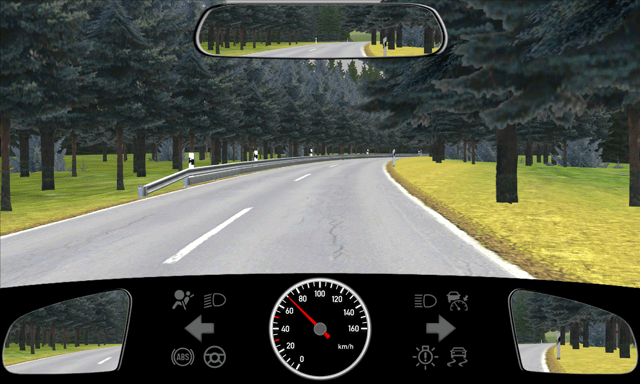
Explanation
With a confusing right turn you have to expect different situations. Especially at dusk times, wild animals can switch sides right after the turn. But it can also happen that oncoming traffic cuts the curve and is recognized very late or that a vehicle is driving at a very low speed right after the curve.