
1.1.06 Overtaking
Overtaking is one of the most dangerous maneuvers in traffic. Learn the strict German regulations concerning visibility, speed, and prohibited zones to pass your theory exam.
If the traffic situation is unclear, overtaking is strictly forbidden.
check_circle Allowed Only If:
- You can see the entire overtaking stretch clearly.
- You are significantly faster than the vehicle being overtaken.
- You can return to the right lane without hindering others.
cancel Strictly Forbidden If:
- Visibility is restricted by fog, rain, or snow.
- Approaching a pedestrian crossing.
- The vehicle ahead is already indicating to overtake.
02. Visibility & Road Conditions
Road geometry often dictates whether overtaking is legal. Even without a sign, the nature of the road can impose a ban.
Bends & Curves
Never overtake on a bend. Even if the road seems clear initially, fast-approaching oncoming traffic is invisible.
Hill Crests
The crest creates a blind spot. Overtaking is forbidden approaching the crest. It is allowed after you have passed the highest point and can see down.
Crosswalks
Overtaking is strictly prohibited at and immediately before pedestrian crossings.
PRO TIP
80% of exam failures on this topic happen due to misunderstanding "unclear traffic situations".
03. Minimum Lateral Distance
Germany has precise laws regarding how much space you must leave when passing vulnerable road users.
When passing cyclists, pedestrians, or e-scooters within city limits.
When passing cyclists or pedestrians on country roads (Landstraßen).
04. Your Duty When Being Overtaken
-
arrow_forward
Keep Right Drive as far to the right as possible to give the overtaking vehicle space.
-
visibility
Maintain Awareness Monitor the overtaking vehicle in your mirrors but do not fixate on it.
-
speed
Do Not Accelerate Increasing speed while being overtaken is illegal and extremely dangerous.
-
turn_left
Do Not Swerve Left Maintain your line. Do not move towards the center line.
05. Public Buses & School Buses
If a bus is approaching a stop with its hazard warning lights flashing, you may not overtake it while it is moving.
If the bus has stopped and hazards are flashing, you may pass at walking speed (4-7 km/h) only. This applies to oncoming traffic too!
Practice Questions (15)
-
Question 1 of 15
Is it irresponsible to overtake a truck and trailer a short distance before a crossroads?
1.1.06-0025 PointsExplanation
Under no circumstances should you start an overtaking manoeuvre just before a crossing. There is an increased risk of accidents. This applies especially to overtaking trucks. You may not be able to see cross-traffic or traffic signs.
-
Question 2 of 15
Why are you not allowed to overtake now?
1.1.06-0055 Points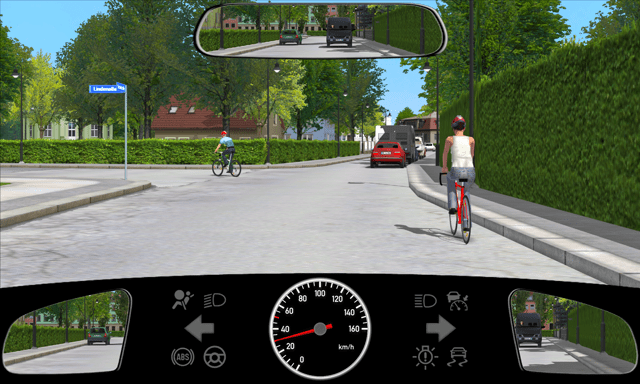
Explanation
You are not allowed to overtake because the cyclist could turn and the oncoming traffic is not detected in time.
-
Question 3 of 15
When are you in danger when overtaking?
1.1.06-1045 PointsExplanation
If you notice that the vehicle behind you wants to overtake you, do not increase your own speed under any circumstances. This prolongs the overtaking manoeuvre and can lead to dangerous situations. Before you start to overtake, make sure that the vehicle behind you is not about to overtake you. Otherwise they will have to brake heavily.
-
Question 4 of 15
In which cases must you abandon overtaking?
1.1.06-1055 PointsExplanation
Sudden oncoming traffic requires that an overtaking manoeuvre be stopped immediately. The same applies if the vehicle to be overtaken accelerates. This means that you can no longer estimate the overtaking distance and endanger oncoming traffic if you continue. If the vehicle being overtaken reduces its speed, there is no danger.
-
Question 5 of 15
When is overtaking forbidden?
1.1.06-1064 PointsExplanation
If you encounter an unclear traffic situation, overtaking is prohibited. This applies in particular: - On bends - On unclear stretches of road - Immediately before and at junctions where the right of way is unclear - When the traffic situation is unclear - If you cannot judge exactly what the vehicle in front is doing. - If it would take you too long to overtake because your vehicle is not fast enough. Before overtaking, make sure that you do not endanger other road users and oncoming traffic.
-
Question 6 of 15
Why can it be dangerous to overtake even on clearly visible, straight roads?
1.1.06-1115 PointsExplanation
On a straight stretch of road, you may be able to see oncoming traffic from a distance, but often underestimate their speed. If an overtaking manoeuvre takes too long, dangerous situations can arise. If there is oncoming traffic, it is better to wait until the road is clear before overtaking.
-
Question 7 of 15
What should you do?
1.1.06-1145 PointsExplanation
You just want to start overtaking the cyclist, when the blue car suddenly drives out of its parking space. Apparently, he has not noticed the cyclist yet. It might happen that the cyclist now moves to the left, without looking back. Immediately stop the overtaking maneuver to avoid endangering the cyclist.
-
Question 8 of 15
What should you anticipate, if you want to overtake?
1.1.06-1224 Points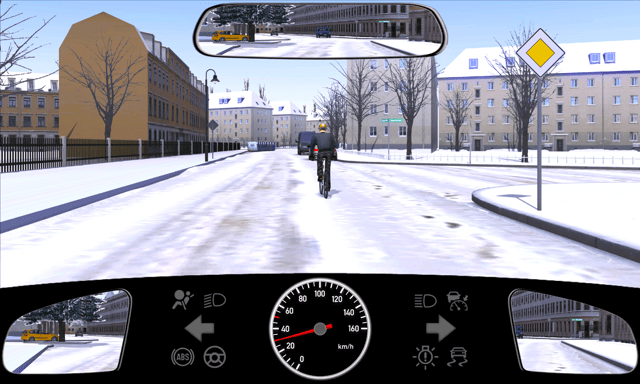
Explanation
On snow-covered roads, the braking and stopping distance is longer and there is also an increased risk of slipping. Cyclists in particular have difficulty riding safely. Their risk of falling is significantly increased. Keep a greater distance from the cyclist, also because his stopping distance is very long.
-
Question 9 of 15
You want to overtake cyclists on a narrow road. The width of the road means that the maximum possible space between them and the car is 50 cm. What should you do?
1.1.06-1245 PointsExplanation
To avoid danger, as a vehicle driver you must always keep a sufficient safety distance of at least 1.50 metres when overtaking cyclists. If it is not possible to pass the cyclist at such a distance, you must not overtake him under any circumstances.
-
Question 10 of 15
What is the right course of action?
1.1.06-1274 PointsExplanation
The cyclist will overtake the lorry and pull out to do so. It is too dangerous to overtake him before the bend, as you may not yet be able to see oncoming vehicles. Only overtake the cyclist after the bend. As a general rule, you may only overtake if you can see that there is no danger to or obstruction of oncoming traffic during the entire overtaking process.
-
Question 11 of 15
In which situation is overtaking prohibited?
1.1.06-1284 PointsExplanation
Overtaking is prohibited here, because in these situations you greatly increase the risk of an accident as the person overtaking.
-
Question 12 of 15
Why can it be dangerous to overtake on an unobscured, straight road?
1.1.06-1305 PointsExplanation
If you misjudge the speed and distance of an oncoming vehicle, your overtaking distance is longer than expected. This can cause accidents.
-
Question 13 of 15
What is the right course of action now?
1.1.06-1315 PointsExplanation
The vehicle overtaking you has estimated its overtaking path too short. You should reduce your speed so that the overtaking person can re-enter earlier and that the risk of an accident is reduced.
-
Question 14 of 15
Why may you not overtake in this situation?
1.1.06-2014 PointsExplanation
The overtaking lane is not visible due to the cyclists and the course of the road. If you cannot see the overtaking lane, you must not overtake. As you cannot go much faster than the cyclists, the overtaking lane becomes much longer and therefore more dangerous.
-
Question 15 of 15
Why are you not allowed to overtake now?
1.1.06-2024 PointsExplanation
The cyclist swings to the left and looks over his shoulder. He will probably turn left. Reduce your speed to give the cyclist enough space and ensure that he does not feel pressurised. In this way, you will also avoid endangering the cyclist in the event of an abrupt braking manoeuvre and possible rear-end collisions due to a lack of distance.