
2.5.01 Environmental protection
Drive smoothly, avoid unnecessary noise, reduce fuel consumption, and use your vehicle responsibly to protect the environment. Eco-friendly driving saves fuel, lowers emissions, reduces wear, and improves road safety.
🔊 Avoid Noise Pollution
- Avoid high engine revolutions.
- Do not modify intake or exhaust systems.
- Drive in high gears at low RPM.
- Avoid racing starts and squealing tires.
- Turn off the engine during long waits.
- Do not “play” with the gas pedal while standing.
- Honking is only acceptable to avoid danger.
- Too loud music reduces concentration and reaction time.
Easy Memory Tip:
Quiet driving = eco driving.
⛽ Save Fuel
- Shift early into higher gears.
- Drive smoothly and avoid hard acceleration.
- Use Eco Mode if available.
- Avoid kick-down unless necessary.
- Turn off air conditioning when possible.
- Remove roof racks when not needed.
- Keep correct tire pressure.
- Do not warm up the engine while standing.
Remember:
Fast driving = much higher fuel consumption.
🛞 Tire Protection
- Use winter tires only in winter.
- Low tire pressure increases wear.
- Fast starts damage tires quickly.
- Correct tire use lowers fuel consumption.
- Greater speed = greater air resistance.
Important Formula:
Double speed = 4× air resistance.
🌍 Environmental Zones
- You need a valid emission sticker.
- The sticker must be visible on the windshield.
- Motorcycles are generally exempt.
- Historic and special vehicles may be exempt.
- Without a valid badge, entry is forbidden.
Quick Tip:
Always check the environmental zone sign before entering.
🚗 Eco-Friendly Driving Habits
Before Driving
- Plan trips carefully.
- Avoid unnecessary trips.
- Use carpools or public transport.
- Store luggage in the trunk.
While Driving
- Drive with foresight.
- Brake gently and early.
- Maintain low engine speed.
- Use engine braking downhill.
Electric Vehicles
- Recuperation recovers energy.
- Start-stop systems reduce emissions.
- Electric driving lowers pollution.
- Charging regularly improves efficiency.
📚 Important Exam Facts
| Topic | Key Fact |
|---|---|
| 160 km/h | Fuel consumption may increase up to 35% |
| Start-Stop System | Can save up to 15% fuel |
| Cold Engine | Consumes more fuel and causes more wear |
| Roof Rack | Increases aerodynamic drag and fuel use |
| Eco Driving | Gentle acceleration and early braking save energy |
Practice Questions (8)
-
Question 1 of 8
What can you do to avoid unnecessary noise?
2.5.01-0013 PointsExplanation
To avoid unnececessary noise, avoid making high revolutions with your engine and do not modify either the intake/exhaust system. Removing fairings do not impact noise.
-
Question 2 of 8
Why should you avoid driving off at a rapid pace?
2.5.01-0073 PointsExplanation
Making a racing start is an additional noise pollution for other road users. You as a car driver damage your vehicle as well as the tires due to high wear and abrasion with a racing start. The environment is additionally burdened. On the other hand, the rear-wheel brake is no longer and not any less loaded when starting.
-
Question 3 of 8
What motor vehicles may enter an environment zone that has this sign?
2.5.01-0123 Points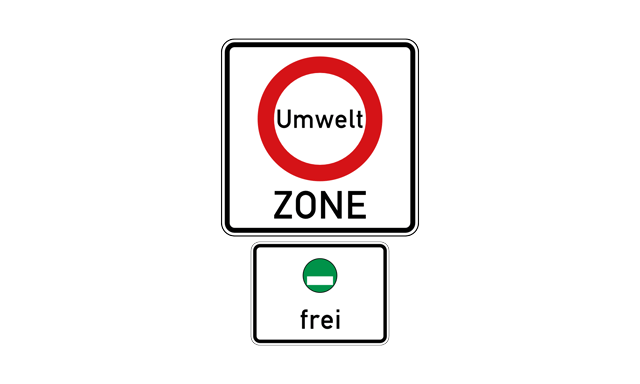
Explanation
The additional sign shows which motor vehicles with which sticker may enter. Motorbikes may enter in any case.
-
Question 4 of 8
What are the effects of driving at high speed in motor vehicles with combustion engines?
2.5.01-0163 PointsExplanation
Be aware that fast, high-speed driving results in high fuel consumption and high exhaust emissions. This also leads to more noise and to a not lower noise level.
-
Question 5 of 8
When riding a motorcycle, what can you do to avoid unnecessary noise?
2.5.01-0173 Points -
Question 6 of 8
Why is an environmentally considerate driving style also beneficial for road safety?
2.5.01-0183 PointsExplanation
Alternative fuels can also be used to drive fast. However, you will be driving in an environmentally friendly way if you avoid high speeds, if you drive with foresight and thus avoid, for example, braking hard and starting again.
-
Question 7 of 8
What motor vehicles are permitted to enter an environment zone without a fine-particle badge?
2.5.01-2093 PointsExplanation
All two- and three-wheeled motor vehicles and agricultural and forestry tractors may enter an environmental zone without the carbon emission sticker. They are exempt from the restrictions of the environmental zone. The installation of a catalytic converter does not exempt you as a car driver from the obligation to obtain an environmental badge.
-
Question 8 of 8
Why are short journeys performed with a cold engine especially damaging to the environment?
2.5.01-2113 PointsExplanation
Short trips with a cold engine usually consume more fuel than driving with a motor in operating temperature. That's why they are particularly harmful to the environment. In addition, the friction is greater in short-distance driving with a cold engine. This leads to a higher material wear.