
2.2.07 Use of lanes by motor vehicles
Stay predictable, keep right when required, and never overtake on the right. In difficult lane situations, reduce speed early and make space instead of forcing your priority.
Keep right
Outside built-up areas, use the right lane when it is free. Move left only to overtake slower vehicles.
Do not pass queues
Wait behind the last vehicle in your lane. Do not try to pass the queue from either side.
Slow down first
When someone may merge, a lane ends, or overtaking is not allowed, reduce your speed and create space.
The core rules
1. Right-hand driving rule
In Germany, you normally drive on the right. If there is no slower vehicle in front of you, move back to the right lane.
2. Built-up areas exception
Inside built-up areas, vehicles up to 3.5 tons may freely choose their lane. The strict right-hand lane requirement does not apply to them there.
3. Overtake only on the left
If a vehicle on the left lane is slower than you, do not pass it on the right. Stay behind and reduce your speed.
4. Do not force your right of way
If another driver is entering or merging and you cannot safely change lanes, slow down and allow space.
Exam situations made simple
You are in the middle or left lane, but the right lane is free
Correct action: Move back to the right lane. You may use the middle or left lane again only when overtaking slower traffic.
A fast truck may pull out to overtake
Correct action: Expect the truck to change lanes and be ready to brake. Do not move left if a car is already close behind you there.
A car accelerates on the acceleration lane
Correct action: Help the driver merge by reducing your speed, especially when changing to the left lane is not safe.
A lane is ending
Correct action: Use the zipper merge principle. Let vehicles from the ending lane move into the adjacent lane one by one.
You are in the middle lane and both side changes are unsafe
Correct action: Stay in your lane and reduce speed. Do not make a risky lane change to the left or right.
A slower car is on the left lane
Correct action: Do not overtake from the right. Reduce your speed and wait until overtaking on the left is possible.
Hard shoulder
The hard shoulder is not a normal lane. You may usually use it only in an emergency, such as a breakdown.
Exception: if a traffic sign opens the hard shoulder, then it must be used like the right-hand lane.
Direction signs
Some signs show that you must choose your direction soon. Use the left lanes only if you intend to turn left.
Look ahead early so you do not need sudden or dangerous lane changes.
Memory checklist
Practice Questions (12)
-
Question 1 of 12
You are approaching a "red" traffic light. Several cars are waiting in all lanes. What do you do?
2.2.07-0013 PointsExplanation
You should always wait in line behind the last car in your lane and not try to pass over other cars by either side.
-
Question 2 of 12
Which motor vehicles may freely choose their lane inside built-up areas?
2.2.07-0023 PointsCorrect: 3
Explanation
In Germany, the legal driving requirement applies. Vehicles up to 3.5 tons are excluded from the right-hand drive requirement within built-up areas and can freely choose their lane.
-
Question 3 of 12
What is the right course of action now?
2.2.07-0043 PointsExplanation
In Germany, you must drive on the right. As there is no vehicle in front of you that is travelling slower than you, you must move into the right lane. As soon as slower vehicles appear, you may move back into the centre or left lane to overtake them.
-
Question 4 of 12
How could a dangerous situation arise?
2.2.07-0055 PointsExplanation
The fast driving style of the yellow truck suggests that he will overtake the blue truck in front of him as well. Their speed is faster than that of the trucks. You cannot dodge to the left as a car on the left lane is directly behind you. If the yellow truck swings out, you have to brake hard.
-
Question 5 of 12
What should you do?
2.2.07-0072 PointsExplanation
Stay on the middle lane and delay. The leading car will also delay soon to let the car on the left lane merge into traffic, because this lane ends. You cannot go to the left, changing to the right lane would be too dangerous as well.
-
Question 6 of 12
What is the right course of action?
2.2.07-0085 PointsExplanation
You drive on the middle lane and in this situation you have to stay on the lane and reduce the speed. The driver on the left lane drives more slowly. You must not overtake him from the right. You cannot change to the right lane, there is a vehicle.
-
Question 7 of 12
What must you anticipate in this situation?
2.2.07-0095 PointsExplanation
Since the vehicle drives very fast from the right onto the freeway, you have to expect that it will change to the middle lane. This impression is reinforced by the fact that trucks maintain their speed and distance.
-
Question 8 of 12
What is the right course of action?
2.2.07-0105 PointsExplanation
A car drives in front of you and from the right a car drives onto the main carriageway of the freeway. It is clear that the car driving on the left lane has a slower pace than you. Since it's only allowed to overtake on the left, you must delay and reduce your speed.
-
Question 9 of 12
You are driving on a road that has several marked lanes going in one direction. When should the alternate merging procedure be employed?
2.2.07-0113 PointsExplanation
The zipper merge is to be used when a lane cannot be used any further. The exception is on the motorway.
-
Question 10 of 12
What is true about using the hard shoulder in this situation?
2.2.07-0124 Points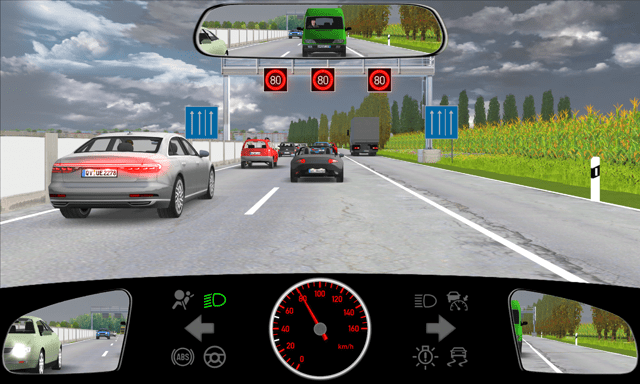
Explanation
The traffic sign indicates that the hard shoulder is to be used like the right-hand lane.
-
Question 11 of 12
What is true in this situation about using the hard shoulder?
2.2.07-0134 Points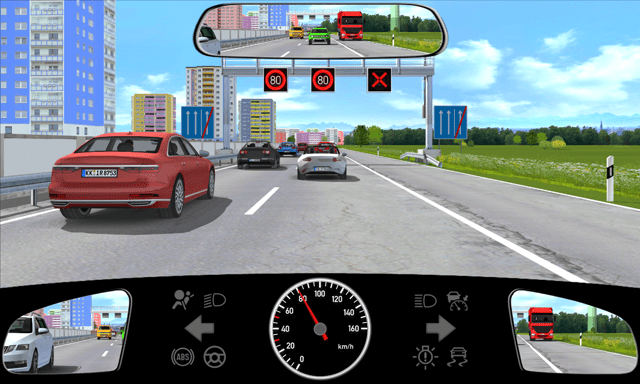
Explanation
The hard shoulder may not be used regularly. You can only use it in case of a breakdown.
-
Question 12 of 12
What is the right behaviour now?
2.2.07-0144 PointsExplanation
If one of the lanes ends on a multi-lane road, vehicles must be allowed to move to the adjacent lane. Here it is important to drive with foresight in order to be able to react to lane changes in a timely manner and to adjust your own speed if necessary.