
1.1.06 Dépassement
Le dépassement est l'une des manœuvres les plus dangereuses dans la circulation. Apprenez les réglementations allemandes strictes concernant la visibilité, la vitesse et les zones interdites pour réussir votre examen théorique.
Si la situation du trafic n'est pas claire, le dépassement est strictement interdit.
check_circle Autorisé uniquement si :
- Vous pouvez voir clairement tout le tronçon de dépassement.
- Vous êtes nettement plus rapide que le véhicule dépassé.
- Vous pouvez revenir sur la voie de droite sans gêner les autres.
cancel Strictement interdit si :
- La visibilité est limitée par le brouillard, la pluie ou la neige.
- A l'approche d'un passage piéton.
- Le véhicule qui précède indique déjà qu'il doit dépasser.
02. Visibilité et conditions routières
La géométrie de la route détermine souvent si le dépassement est légal. Même sans panneau, la nature de la route peut imposer une interdiction.
Plis et courbes
Ne dépassez jamais dans un virage. Même si la route semble dégagée au premier abord, le trafic venant en sens inverse est invisible.
Crêtes des collines
La crête crée un angle mort. Les dépassements sont interdits à l'approche de la crête. Il est permis après vous avez dépassé le point le plus élevé et pouvez voir en bas.
Passages pour piétons
Les dépassements sont strictement interdits aux passages pour piétons et immédiatement avant.
CONSEIL DE PRO
80 % des échecs aux examens sur ce sujet sont dus à une mauvaise compréhension de « situations de circulation peu claires ».
03. Distance latérale minimale
L'Allemagne a des lois précises concernant l'espace que vous devez laisser lorsque vous croisez des usagers de la route vulnérables.
Lors du dépassement de cyclistes, de piétons ou de scooters électriques dans les limites de la ville.
Lors du dépassement de cyclistes ou de piétons sur des routes de campagne (Landstraßen).
04. Votre devoir en cas de dépassement
-
arrow_forward
Restez à droite Roulez le plus à droite possible pour laisser de la place au véhicule qui dépasse.
-
visibility
Maintenir la sensibilisation Surveillez le véhicule qui dépasse dans vos rétroviseurs, mais ne vous fixez pas dessus.
-
speed
Ne pas accélérer Augmenter la vitesse tout en étant dépassé est illégal et extrêmement dangereux.
-
turn_left
Ne déviez pas à gauche Entretenez votre ligne. Ne vous déplacez pas vers la ligne médiane.
05. Bus publics et bus scolaires
Si un bus s'approche d'un arrêt avec son feux de détresse qui clignotent, vous ne pouvez pas le dépasser lorsqu'il est en mouvement.
Si le bus s'est arrêté et que des dangers clignotent, vous pouvez le dépasser à vitesse de marche (4-7 km/h) seulement. Cela s'applique également au trafic venant en sens inverse !
Questions d’entraînement (15)
-
Question 1 sur 15
Est-ce qu'il peut être dangereux de dépasser un train routier avant une intersection?
1.1.06-0025 pointsExplication
Under no circumstances should you start an overtaking manoeuvre just before a crossing. There is an increased risk of accidents. This applies especially to overtaking trucks. You may not be able to see cross-traffic or traffic signs.
-
Question 2 sur 15
Pourquoi n'êtes vous pas autorisé(e) à doubler maintenant?
1.1.06-0055 points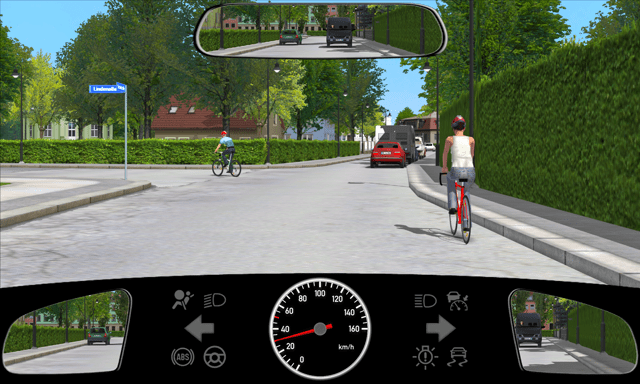
Explication
You are not allowed to overtake because the cyclist could turn and the oncoming traffic is not detected in time.
-
Question 3 sur 15
Quand le véhicule qui dépasse est-il en danger?
1.1.06-1045 pointsExplication
If you notice that the vehicle behind you wants to overtake you, do not increase your own speed under any circumstances. This prolongs the overtaking manoeuvre and can lead to dangerous situations. Before you start to overtake, make sure that the vehicle behind you is not about to overtake you. Otherwise they will have to brake heavily.
-
Question 4 sur 15
Dans quels cas devez-vous interrompre la manoeuvre de dépassement?
1.1.06-1055 pointsExplication
Sudden oncoming traffic requires that an overtaking manoeuvre be stopped immediately. The same applies if the vehicle to be overtaken accelerates. This means that you can no longer estimate the overtaking distance and endanger oncoming traffic if you continue. If the vehicle being overtaken reduces its speed, there is no danger.
-
Question 5 sur 15
Quand est-il interdit de dépasser?
1.1.06-1064 pointsExplication
If you encounter an unclear traffic situation, overtaking is prohibited. This applies in particular: - On bends - On unclear stretches of road - Immediately before and at junctions where the right of way is unclear - When the traffic situation is unclear - If you cannot judge exactly what the vehicle in front is doing. - If it would take you too long to overtake because your vehicle is not fast enough. Before overtaking, make sure that you do not endanger other road users and oncoming traffic.
-
Question 6 sur 15
Pour quelles raisons doubler un véhicule, même sur une route droite et offrant de la visibilité, peut-il être dangereux?
1.1.06-1115 pointsExplication
On a straight stretch of road, you may be able to see oncoming traffic from a distance, but often underestimate their speed. If an overtaking manoeuvre takes too long, dangerous situations can arise. If there is oncoming traffic, it is better to wait until the road is clear before overtaking.
-
Question 7 sur 15
Comment vous comportez-vous?
1.1.06-1145 pointsExplication
You just want to start overtaking the cyclist, when the blue car suddenly drives out of its parking space. Apparently, he has not noticed the cyclist yet. It might happen that the cyclist now moves to the left, without looking back. Immediately stop the overtaking maneuver to avoid endangering the cyclist.
-
Question 8 sur 15
À quoi devez-vous vous attendre si vous souhaitez doubler?
1.1.06-1224 points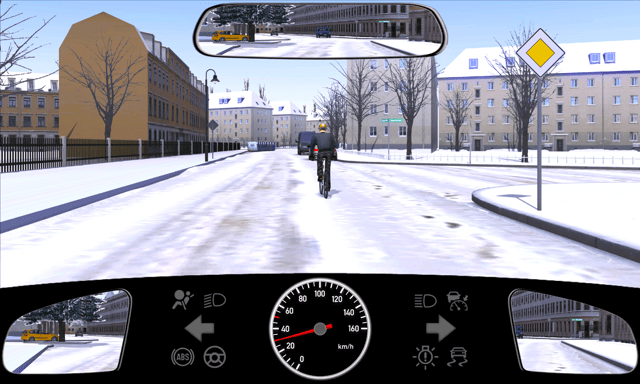
Explication
On snow-covered roads, the braking and stopping distance is longer and there is also an increased risk of slipping. Cyclists in particular have difficulty riding safely. Their risk of falling is significantly increased. Keep a greater distance from the cyclist, also because his stopping distance is very long.
-
Question 9 sur 15
Vous souhaitez doubler un cycliste dans une rue étroite. Étant donné la largeur de la route, seul un espace de 50 cm est possible entre vous et le vélo. Comment vous comportez-vous?
1.1.06-1245 pointsExplication
To avoid danger, as a vehicle driver you must always keep a sufficient safety distance of at least 1.50 metres when overtaking cyclists. If it is not possible to pass the cyclist at such a distance, you must not overtake him under any circumstances.
-
Question 10 sur 15
Quel est le comportement correct?
1.1.06-1274 pointsExplication
The cyclist will overtake the lorry and pull out to do so. It is too dangerous to overtake him before the bend, as you may not yet be able to see oncoming vehicles. Only overtake the cyclist after the bend. As a general rule, you may only overtake if you can see that there is no danger to or obstruction of oncoming traffic during the entire overtaking process.
-
Question 11 sur 15
Dans quelle situation n'est-il pas permis de doubler?
1.1.06-1284 pointsExplication
Overtaking is prohibited here, because in these situations you greatly increase the risk of an accident as the person overtaking.
-
Question 12 sur 15
Pourquoi doubler un véhicule peut-il être dangereux, même sur des voies bien droites avec une bonne visibilité?
1.1.06-1305 pointsExplication
If you misjudge the speed and distance of an oncoming vehicle, your overtaking distance is longer than expected. This can cause accidents.
-
Question 13 sur 15
Quel est le bon comportement à adopter maintenant?
1.1.06-1315 pointsExplication
The vehicle overtaking you has estimated its overtaking path too short. You should reduce your speed so that the overtaking person can re-enter earlier and that the risk of an accident is reduced.
-
Question 14 sur 15
Pourquoi n'avez-vous pas le droit de doubler dans cette situation?
1.1.06-2014 pointsExplication
The overtaking lane is not visible due to the cyclists and the course of the road. If you cannot see the overtaking lane, you must not overtake. As you cannot go much faster than the cyclists, the overtaking lane becomes much longer and therefore more dangerous.
-
Question 15 sur 15
Pourquoi n'êtes-vous pas autorisé(e) à dépasser maintenant?
1.1.06-2024 pointsExplication
The cyclist swings to the left and looks over his shoulder. He will probably turn left. Reduce your speed to give the cyclist enough space and ensure that he does not feel pressurised. In this way, you will also avoid endangering the cyclist in the event of an abrupt braking manoeuvre and possible rear-end collisions due to a lack of distance.