
1.1.06 Überholen
Überholen gehört zu den gefährlichsten Situationen im Straßenverkehr. Hier lernen Sie, wann Sie überholen dürfen, wann nicht – und worauf es in der Theorieprüfung ankommt.
Ist die Verkehrslage unklar, ist Überholen verboten. Und wird es unterwegs gefährlich – etwa durch plötzlichen Gegenverkehr oder weil der andere beschleunigt –, brechen Sie ab.
check_circle Nur erlaubt, wenn:
- Sie die gesamte Überholstrecke überblicken.
- Sie wesentlich schneller fahren können als das Fahrzeug, das Sie überholen.
- Sie wieder nach rechts einscheren können, ohne andere zu behindern.
cancel Verboten, wenn:
- Sie wegen Nebel, Regen oder Schnee die Überholstrecke nicht überblicken.
- Sie auf einen Fußgängerüberweg zufahren.
- Das Fahrzeug vor Ihnen selbst gerade zum Überholen ansetzt.
02. Sicht und Straßenverlauf
Oft entscheidet der Verlauf der Straße, ob Sie überholen dürfen. Auch ohne Verbotsschild kann Überholen verboten sein, wenn Sie nicht weit genug sehen.
Kurven
Überholen Sie nie in einer Kurve. Auch wenn die Straße frei aussieht: Schneller Gegenverkehr taucht hier plötzlich auf. Warten Sie, bis Sie nach der Kurve wieder freie Sicht haben.
Kuppen
Hinter einer Kuppe sehen Sie nichts. Können Sie den Überholvorgang nicht vor der Kuppe beenden, dürfen Sie nicht überholen. Erst nach dem höchsten Punkt, wenn Sie die Straße wieder überblicken, ist es erlaubt.
Zebrastreifen
Am Fußgängerüberweg und direkt davor ist Überholen verboten.
PROFI-TIPP
Bei diesem Thema gehen viele Prüfungsfehler auf die „unklare Verkehrslage“ zurück. Merken Sie sich: Sind Sie nicht sicher, überholen Sie nicht. Auch auf geraden, übersichtlichen Straßen verschätzt man sich leicht – Gegenverkehr ist oft schneller und näher, als er wirkt, und der eigene Überholweg ist länger als gedacht.
03. Mindestabstand zur Seite
Wie viel Platz Sie beim Überholen von Radfahrern, Fußgängern und E-Scootern lassen müssen, ist genau vorgeschrieben. Schaffen Sie diesen Abstand nicht, überholen Sie nicht.
Beim Überholen von Radfahrern, Fußgängern oder E-Scootern innerorts.
Beim Überholen von Radfahrern, Fußgängern oder E-Scootern außerorts.
04. Wenn Sie überholt werden
-
arrow_forward
Rechts bleiben Halten Sie sich möglichst weit rechts, damit der Überholende genug Platz hat.
-
visibility
Aufmerksam bleiben Behalten Sie das überholende Fahrzeug im Spiegel im Blick, aber starren Sie nicht darauf.
-
speed
Nicht beschleunigen Wer überholt wird, darf nicht schneller werden. Das ist verboten und gefährdet den Überholenden.
-
turn_left
Nicht nach links ziehen Bleiben Sie in Ihrer Spur. Fahren Sie nicht Richtung Mittellinie.
05. Linienbusse und Schulbusse
Fährt ein Bus mit Warnblinklicht auf eine Haltestelle zu, dürfen Sie ihn nicht überholen.
Steht der Bus mit Warnblinklicht an der Haltestelle, dürfen Sie nur mit Schrittgeschwindigkeit (4 bis 7 km/h) vorbeifahren. Das gilt auch für den Gegenverkehr!
Übungsfragen (15)
-
Frage 1 von 15
Ist es leichtsinnig, noch kurz vor einer Kreuzung einen Lastzug zu überholen?
1.1.06-0025 PunkteErklärung
Under no circumstances should you start an overtaking manoeuvre just before a crossing. There is an increased risk of accidents. This applies especially to overtaking trucks. You may not be able to see cross-traffic or traffic signs.
-
Frage 2 von 15
Warum dürfen Sie jetzt nicht überholen?
1.1.06-0055 Punkte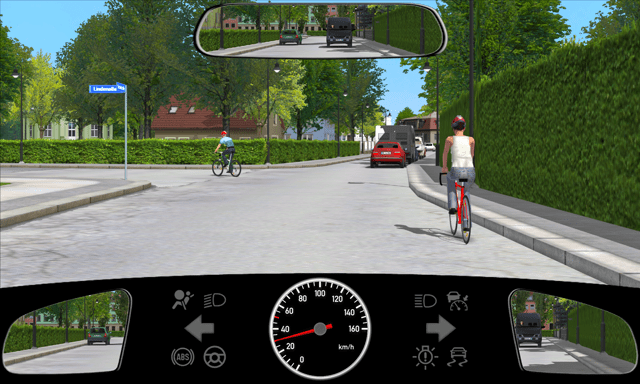
Erklärung
You are not allowed to overtake because the cyclist could turn and the oncoming traffic is not detected in time.
-
Frage 3 von 15
Wann wird ein Überholender gefährdet?
1.1.06-1045 PunkteErklärung
If you notice that the vehicle behind you wants to overtake you, do not increase your own speed under any circumstances. This prolongs the overtaking manoeuvre and can lead to dangerous situations. Before you start to overtake, make sure that the vehicle behind you is not about to overtake you. Otherwise they will have to brake heavily.
-
Frage 4 von 15
In welchen Fällen muss das Überholen abgebrochen werden?
1.1.06-1055 PunkteErklärung
Sudden oncoming traffic requires that an overtaking manoeuvre be stopped immediately. The same applies if the vehicle to be overtaken accelerates. This means that you can no longer estimate the overtaking distance and endanger oncoming traffic if you continue. If the vehicle being overtaken reduces its speed, there is no danger.
-
Frage 5 von 15
Wann ist das Überholen verboten?
1.1.06-1064 PunkteErklärung
If you encounter an unclear traffic situation, overtaking is prohibited. This applies in particular: - On bends - On unclear stretches of road - Immediately before and at junctions where the right of way is unclear - When the traffic situation is unclear - If you cannot judge exactly what the vehicle in front is doing. - If it would take you too long to overtake because your vehicle is not fast enough. Before overtaking, make sure that you do not endanger other road users and oncoming traffic.
-
Frage 6 von 15
Warum kann Überholen auch auf übersichtlichen und geraden Fahrbahnen gefährlich sein?
1.1.06-1115 PunkteErklärung
On a straight stretch of road, you may be able to see oncoming traffic from a distance, but often underestimate their speed. If an overtaking manoeuvre takes too long, dangerous situations can arise. If there is oncoming traffic, it is better to wait until the road is clear before overtaking.
-
Frage 7 von 15
Wie verhalten Sie sich?
1.1.06-1145 PunkteErklärung
You just want to start overtaking the cyclist, when the blue car suddenly drives out of its parking space. Apparently, he has not noticed the cyclist yet. It might happen that the cyclist now moves to the left, without looking back. Immediately stop the overtaking maneuver to avoid endangering the cyclist.
-
Frage 8 von 15
Womit müssen Sie rechnen, wenn Sie überholen wollen?
1.1.06-1224 Punkte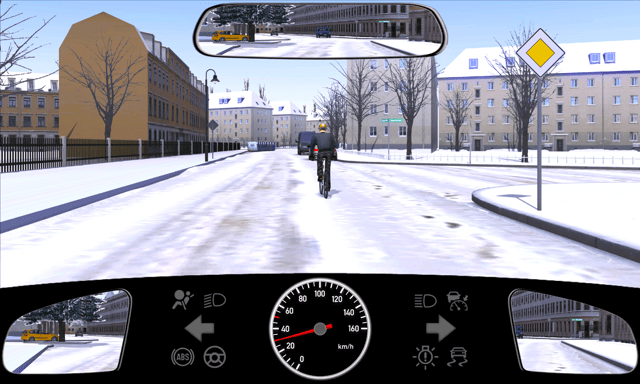
Erklärung
On snow-covered roads, the braking and stopping distance is longer and there is also an increased risk of slipping. Cyclists in particular have difficulty riding safely. Their risk of falling is significantly increased. Keep a greater distance from the cyclist, also because his stopping distance is very long.
-
Frage 9 von 15
Sie möchten in einer schmalen Straße Radfahrer überholen. Wegen der Straßenbreite ist ein Seitenabstand zu ihnen von höchstens 50 cm möglich. Wie verhalten Sie sich?
1.1.06-1245 PunkteErklärung
To avoid danger, as a vehicle driver you must always keep a sufficient safety distance of at least 1.50 metres when overtaking cyclists. If it is not possible to pass the cyclist at such a distance, you must not overtake him under any circumstances.
-
Frage 10 von 15
Wie verhalten Sie sich richtig?
1.1.06-1274 PunkteErklärung
The cyclist will overtake the lorry and pull out to do so. It is too dangerous to overtake him before the bend, as you may not yet be able to see oncoming vehicles. Only overtake the cyclist after the bend. As a general rule, you may only overtake if you can see that there is no danger to or obstruction of oncoming traffic during the entire overtaking process.
-
Frage 11 von 15
In welcher Situation ist das Überholen unzulässig?
1.1.06-1284 PunkteErklärung
Overtaking is prohibited here, because in these situations you greatly increase the risk of an accident as the person overtaking.
-
Frage 12 von 15
Weshalb kann Überholen auch auf übersichtlichen und geraden Fahrbahnen gefährlich sein?
1.1.06-1305 PunkteErklärung
If you misjudge the speed and distance of an oncoming vehicle, your overtaking distance is longer than expected. This can cause accidents.
-
Frage 13 von 15
Wie verhalten Sie sich jetzt richtig?
1.1.06-1315 PunkteErklärung
The vehicle overtaking you has estimated its overtaking path too short. You should reduce your speed so that the overtaking person can re-enter earlier and that the risk of an accident is reduced.
-
Frage 14 von 15
Warum dürfen Sie in dieser Situation nicht überholen?
1.1.06-2014 PunkteErklärung
The overtaking lane is not visible due to the cyclists and the course of the road. If you cannot see the overtaking lane, you must not overtake. As you cannot go much faster than the cyclists, the overtaking lane becomes much longer and therefore more dangerous.
-
Frage 15 von 15
Warum dürfen Sie jetzt nicht überholen?
1.1.06-2024 PunkteErklärung
The cyclist swings to the left and looks over his shoulder. He will probably turn left. Reduce your speed to give the cyclist enough space and ensure that he does not feel pressurised. In this way, you will also avoid endangering the cyclist in the event of an abrupt braking manoeuvre and possible rear-end collisions due to a lack of distance.