
1.1.06 Adelantamiento
Adelantar es una de las maniobras más peligrosas en el tráfico. Conozca las estrictas regulaciones alemanas en materia de visibilidad, velocidad y zonas prohibidas para aprobar su examen teórico.
Si la situación del tráfico no está clara, se permite adelantar. estrictamente prohibido.
check_circle Permitido sólo si:
- Se puede ver claramente todo el tramo de adelantamiento.
- Eres significativamente más rápido que el vehículo al que adelantan.
- Puede volver al carril derecho sin obstaculizar a los demás.
cancel Estrictamente prohibido si:
- La visibilidad está restringida por niebla, lluvia o nieve.
- Acercándose a un paso de peatones.
- El vehículo que va delante ya indica que desea adelantar.
02. Visibilidad y condiciones de la carretera
La geometría de la carretera a menudo dicta si es legal adelantar. Incluso sin una señal, la naturaleza de la vía puede imponer una prohibición.
Curvas y Curvas
Nunca adelantar en una curva. Incluso si la carretera parece despejada al principio, el tráfico que se aproxima rápidamente en sentido contrario es invisible.
Crestas de colinas
La cresta crea un punto ciego. Está prohibido adelantar al acercarse a la cresta. esta permitido después has pasado el punto más alto y puedes ver hacia abajo.
Pasos de peatones
Está estrictamente prohibido adelantar en los pasos de peatones e inmediatamente antes de ellos.
CONSEJO PROFESIONAL
El 80% de los fracasos en los exámenes sobre este tema se deben a malentendidos en "situaciones de tráfico poco claras".
03. Distancia lateral mínima
Alemania tiene leyes precisas sobre cuánto espacio se debe dejar al adelantar a usuarios vulnerables de la vía.
Al adelantar a ciclistas, peatones o patinetes eléctricos dentro de los límites de la ciudad.
Al adelantar a ciclistas o peatones en carreteras rurales (Landstraßen).
04. Tu deber cuando te adelantan
-
arrow_forward
Manténgase a la derecha Conduzca lo más a la derecha posible para dejar espacio al vehículo que adelanta.
-
visibility
Mantener la conciencia Vigile por los espejos el vehículo que adelanta, pero no se fije en él.
-
speed
No acelerar Aumentar la velocidad mientras te adelantan es ilegal y extremadamente peligroso.
-
turn_left
No te desvíes a la izquierda Mantén tu línea. No avance hacia la línea central.
05. Autobuses públicos y autobuses escolares
Si un autobús se acerca a una parada con su luces de advertencia de peligro parpadeando, no podrás adelantarlo mientras esté en movimiento.
Si el autobús se ha detenido y las señales de peligro están parpadeando, puede pasar por velocidad al caminar (4-7 km/h) solo. ¡Esto también se aplica al tráfico que viene en sentido contrario!
Preguntas de práctica (15)
-
Pregunta 1 de 15
¿Es imprudente adelantar a un camión poco antes de una intersección?
1.1.06-0025 puntosExplicación
Under no circumstances should you start an overtaking manoeuvre just before a crossing. There is an increased risk of accidents. This applies especially to overtaking trucks. You may not be able to see cross-traffic or traffic signs.
-
Pregunta 2 de 15
En este momento, ¿por qué no puede adelantar?
1.1.06-0055 puntos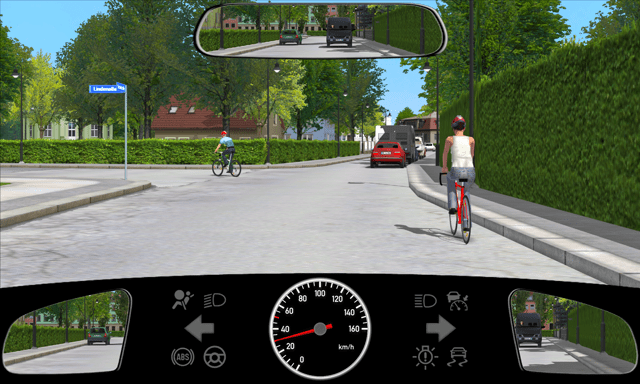
Explicación
You are not allowed to overtake because the cyclist could turn and the oncoming traffic is not detected in time.
-
Pregunta 3 de 15
¿Cuándo está en peligro el que adelanta?
1.1.06-1045 puntosExplicación
If you notice that the vehicle behind you wants to overtake you, do not increase your own speed under any circumstances. This prolongs the overtaking manoeuvre and can lead to dangerous situations. Before you start to overtake, make sure that the vehicle behind you is not about to overtake you. Otherwise they will have to brake heavily.
-
Pregunta 4 de 15
¿En qué circunstancias hay que abandonar el adelantamiento?
1.1.06-1055 puntosExplicación
Sudden oncoming traffic requires that an overtaking manoeuvre be stopped immediately. The same applies if the vehicle to be overtaken accelerates. This means that you can no longer estimate the overtaking distance and endanger oncoming traffic if you continue. If the vehicle being overtaken reduces its speed, there is no danger.
-
Pregunta 5 de 15
¿Cuándo está prohibido adelantar?
1.1.06-1064 puntosExplicación
If you encounter an unclear traffic situation, overtaking is prohibited. This applies in particular: - On bends - On unclear stretches of road - Immediately before and at junctions where the right of way is unclear - When the traffic situation is unclear - If you cannot judge exactly what the vehicle in front is doing. - If it would take you too long to overtake because your vehicle is not fast enough. Before overtaking, make sure that you do not endanger other road users and oncoming traffic.
-
Pregunta 6 de 15
¿Por qué los adelantamientos pueden ser peligrosos incluso en carreteras despejadas y rectas?
1.1.06-1115 puntosExplicación
On a straight stretch of road, you may be able to see oncoming traffic from a distance, but often underestimate their speed. If an overtaking manoeuvre takes too long, dangerous situations can arise. If there is oncoming traffic, it is better to wait until the road is clear before overtaking.
-
Pregunta 7 de 15
¿Qué hace?
1.1.06-1145 puntosExplicación
You just want to start overtaking the cyclist, when the blue car suddenly drives out of its parking space. Apparently, he has not noticed the cyclist yet. It might happen that the cyclist now moves to the left, without looking back. Immediately stop the overtaking maneuver to avoid endangering the cyclist.
-
Pregunta 8 de 15
¿Con qué tiene que contar cuando quiera adelantar?
1.1.06-1224 puntos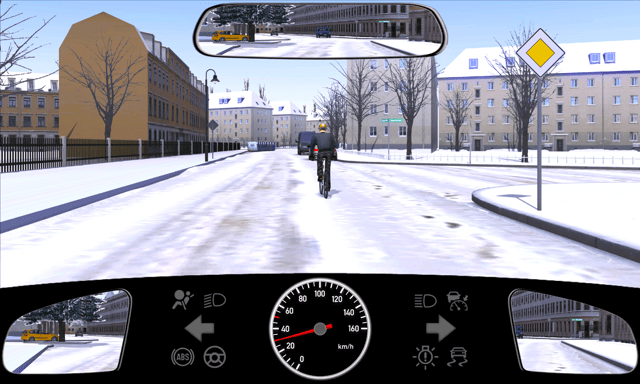
Explicación
On snow-covered roads, the braking and stopping distance is longer and there is also an increased risk of slipping. Cyclists in particular have difficulty riding safely. Their risk of falling is significantly increased. Keep a greater distance from the cyclist, also because his stopping distance is very long.
-
Pregunta 9 de 15
Quiere adelantar a ciclistas en una vía estrecha. Dado el ancho de esta, la distancia lateral máxima a su vehículo es de 50 cm. ¿Qué hace?
1.1.06-1245 puntosExplicación
To avoid danger, as a vehicle driver you must always keep a sufficient safety distance of at least 1.50 metres when overtaking cyclists. If it is not possible to pass the cyclist at such a distance, you must not overtake him under any circumstances.
-
Pregunta 10 de 15
¿Qué es lo correcto?
1.1.06-1274 puntosExplicación
The cyclist will overtake the lorry and pull out to do so. It is too dangerous to overtake him before the bend, as you may not yet be able to see oncoming vehicles. Only overtake the cyclist after the bend. As a general rule, you may only overtake if you can see that there is no danger to or obstruction of oncoming traffic during the entire overtaking process.
-
Pregunta 11 de 15
¿En qué situación no está permitido realizar un adelantamiento?
1.1.06-1284 puntosExplicación
Overtaking is prohibited here, because in these situations you greatly increase the risk of an accident as the person overtaking.
-
Pregunta 12 de 15
¿Por qué puede resultar peligrosa una maniobra de adelantamiento aunque la calzada sea recta y tenga buena visibilidad?
1.1.06-1305 puntosExplicación
If you misjudge the speed and distance of an oncoming vehicle, your overtaking distance is longer than expected. This can cause accidents.
-
Pregunta 13 de 15
¿Qué es correcto hacer en este momento?
1.1.06-1315 puntosExplicación
The vehicle overtaking you has estimated its overtaking path too short. You should reduce your speed so that the overtaking person can re-enter earlier and that the risk of an accident is reduced.
-
Pregunta 14 de 15
En esta situación, ¿por qué no puede adelantar?
1.1.06-2014 puntosExplicación
The overtaking lane is not visible due to the cyclists and the course of the road. If you cannot see the overtaking lane, you must not overtake. As you cannot go much faster than the cyclists, the overtaking lane becomes much longer and therefore more dangerous.
-
Pregunta 15 de 15
En este momento, ¿por qué no puede adelantar?
1.1.06-2024 puntosExplicación
The cyclist swings to the left and looks over his shoulder. He will probably turn left. Reduce your speed to give the cyclist enough space and ensure that he does not feel pressurised. In this way, you will also avoid endangering the cyclist in the event of an abrupt braking manoeuvre and possible rear-end collisions due to a lack of distance.