
1.2.12 Parada y estacionamiento
Aprendamos rápidamente las reglas de parada y estacionamiento más importantes con explicaciones sencillas, trucos de memoria y distancias importantes.
🧠 Reglas de memoria rápida
⏱ Regla de los 3 minutos
Menos de 3 minutos + el conductor permanece dentro = Parada
Más de 3 minutos O saliendo del vehículo = Aparcamiento
🚷 Paso de peatones
No parar ni estacionar: en o 5 metros antes el cruce.
🛑 Paradas de autobús
No estacionar: 15 metros antes y después paradas de autobús/tranvía.
🚦 Cruces
Generalmente conserva:
5 metros distancia.
A veces:
8 metros si la visibilidad se reduce.
🚘 Diferencia entre detenerse y estacionarse
⛔ Detener
- El vehículo se detiene por menos de 3 minutos.
- El conductor permanece dentro del vehículo.
- El motivo NO está relacionado con el tráfico.
- Ejemplo: Recoger a alguien rápidamente
🅿 Estacionamiento
- Más de 3 minutos
- O el conductor abandona el vehículo
- Incluso una salida corta = aparcar
- Ejemplo: Salir del auto para comprar café
📏 Distancias importantes que DEBES recordar
| Lugar | Regla de distancia | Significado |
|---|---|---|
| Paso de peatones | 5 metros antes | No parar ni estacionar |
| Cruce / Intersección | 5 metros | Mantenga la visibilidad clara |
| Grandes cruces | 8 metros | Si existe un carril bici o un problema de visibilidad |
| Paradas de autobús/tranvía | 15 metros antes y después | Permitir el movimiento del transporte público. |
| Cruce de Ferrocarril | 5 metros mínimo | No bloquee la visibilidad del ferrocarril. |
| Área de la Cruz de San Andrés | 50 metros fuera de las ciudades | Mantenga suficiente espacio de espera |
🚫 Donde NO Debes Parar ni Estacionar
🚶 Pasos de peatones
No parar ni estacionar 5 m antes de los cruces.
🚌 Paradas de autobús
No se permite aparcar 15 m antes y después de las paradas de autobús/tranvía.
🚦 Cruces
No estacionar cerca de las intersecciones porque la visibilidad está bloqueada.
🚂 Cruces de ferrocarril
Nunca se detenga ni estacione donde los trenes puedan estar obstruidos.
🛣 Autopistas
Está prohibido detenerse en la autopista o en el arcén, excepto en casos de emergencia.
🚪 Entradas
Nunca estacione frente a bordillos o entradas bajados.
⭐ Reglas especiales de examen
🚕 Estacionamiento en segunda fila
Sólo los taxis pueden parar brevemente en la segunda fila para los pasajeros. En general, otros vehículos están prohibidos.
➡ Dirección de estacionamiento
Generalmente se estaciona en el lado derecho en el sentido de la marcha. Excepción: calles de un solo sentido o vías de tranvía en el lado derecho.
⚠ Luces de peligro
Las luces de emergencia NO permiten esperas o estacionamientos ilegales.
🛣 Hombro duro
Se permite esperar solo en el lado del hombro, NO a la izquierda de la línea blanca continua.
🎯 Consejos sencillos para el examen
- 3 minutos = frontera importante
- 5 metros = cruces/uniones
- 15 metros = paradas de autobús
- Nunca se debe bloquear la visibilidad.
- Aparcamiento antes de los pasos de cebra
- Parando en el arcén de la autopista
- Bloquear bordillos rebajados
- Esperando en segunda fila
Preguntas de práctica (22)
-
Pregunta 1 de 22
¿Dónde está prohibido detenerse?
1.2.12-0013 puntosExplicación
A "stop" is when a vehicle stops for less than 3 minutes for reasons unrelated to traffic without the driver getting out of the vehicle. If the driver stops for a longer time and/or leaves his vehicle, this is called parking. However, drivers are not allowed to stop everywhere so as not to endanger other road users. Exceptions are: - Non-stop zones - Transitions through levels as there is a risk of collision with the train - Narrow and incomprehensible places with a clearance width of less than 3 m blind turns - Hilltops - Pedestrian crossings and the area in front of them (distance not less than 5 m), but not the area behind them.
-
Pregunta 2 de 22
¿Dónde está prohibido estacionar?
1.2.12-0023 puntosExplicación
As soon as you stop or leave your vehicle for more than three minutes without any traffic-related reason, this is called parking. This is not allowed everywhere. You may not park in areas with stopping restrictions or parking prohibition - nor where you impede or obstruct other road users. Parking restrictions also apply to priority roads outside built-up areas. Use side strips or parking bays.
-
Pregunta 3 de 22
¿Dónde está prohibido parar?
1.2.12-1033 puntosExplicación
You may only stop where you do not endanger other road users. This is the case, for example, if there is a hard shoulder separated from the carriageway by a continuous white line. You are not allowed to stop - on marked lanes that are used for getting into the right of way - on the carriageway if there is a hard shoulder - at bus stops or other public transport stops - at taxi ranks, so as not to block the access of taxis - on motorways or motorways, not even on the hard shoulder. Watch out for two-wheelers!
-
Pregunta 4 de 22
¿Dónde está prohibido parar?
1.2.12-1043 puntosExplicación
On and up to five meters in front of a pedestrian crossing, you must not stop because you obstruct the clear view of other drivers on pedestrians. These could then be recognized too late. After a pedestrian crossing you may stop. Waiting is allowed on manhole covers, but not parking.
-
Pregunta 5 de 22
¿Dónde está prohibo aparcar?
1.2.12-1053 puntosExplicación
You are not allowed to park at the edge of the road, where you block marked parking areas and thus hinder other road users. Parking is also prohibited in front of lowered curbs, which are for example located in front of driveways. Lowered curbs should allow wheelchair users to cross the road. Safe and therefore allowed is parking after a pedestrian crossing.
-
Pregunta 6 de 22
¿Dónde puede estacionar a la izquierda en dirección de marcha?
1.2.12-1063 puntosExplicación
You may only park in the direction of travel on the right-hand side of the road. This also applies if all parking spaces are on the left side. You may have to turn if allowed. The only exception are one-way streets, as they are only used in one direction of travel. If there are rails on the right, you must also park on the left, but always observe parking restrictions.
-
Pregunta 7 de 22
¿Quién está estacionado?
1.2.12-1073 puntosExplicación
If the car driver deliberately stops the vehicle and stays there for more than three minutes or leaves the stopped vehicle, this is considered parking. The stopping and waiting in front of a gate is not considered parking, no matter how long it takes, because the break is due to traffic.
-
Pregunta 8 de 22
¿Cuál es la distancia mínima a respetar delante de un paso de peatones para detenerse o aparcar?
1.2.12-1083 puntosCorrecto: 5
Explicación
On a pedestrian crossing and up to 5 m in front no stopping or parking is allowed. So, you can freely view the pedestrian crossing as a car driver and passers-by have a good overview of the traffic.
-
Pregunta 9 de 22
¿Qué distancia hay que mantener al estacionar fuera de poblado ante una cruz de San Andrés?
1.2.12-1102 puntosCorrecto: 50
Explicación
At a railroad crossing with a St. Andrew's Cross sign, the view of the level crossing must not be obstructed with a distance of 50m to have enough space for waiting vehicles.
-
Pregunta 10 de 22
Ud. quiere estacionar dentro de poblado ante una cruz de San Andrés. ¿Qué distancia mínima hay que respetar?
1.2.12-1112 puntosCorrecto: 5
Explicación
At a railroad crossing with St. Andrew's Cross, the rail vehicle has priority. To avoid obscuring the view of the railway line, a safety distance of 5 meters must be maintained.
-
Pregunta 11 de 22
¿Qué distancia hay que mantener cuando se estaciona delante o detrás de una señal de parada?
1.2.12-1122 puntosCorrecto: 15
Explicación
It is not allowed to park 15 meters before and after the stop sign to allow public transports to approach, stop and leave without encumbrance.
-
Pregunta 12 de 22
En paradas, el estacionamiento está sólo permitido si no se molesta a los autobuses. ¿Cuánto tiempo puede estacionar allí como mucho?
1.2.12-1132 puntosCorrecto: 3
Explicación
The stopping time is limited to a maximum of 3 minutes. If a vehicle is stopped for more than 3 minutes, the vehicle is considered as parked. Thus it is only alowed to stop for 3 minutes
-
Pregunta 13 de 22
¿Qué vehículo está incorrectamente estacionado?
1.2.12-1212 puntos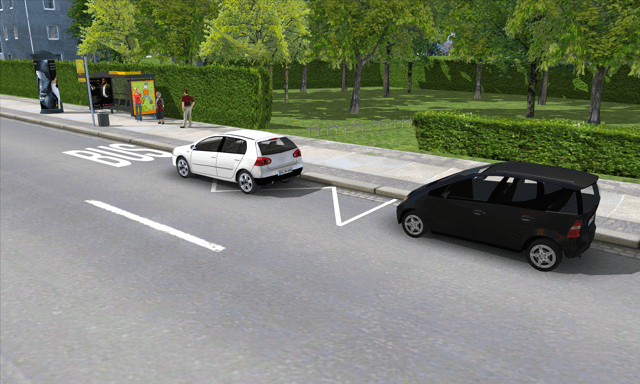
Explicación
The zigzagged line shortens or extends a waiting or parking ban. As far as there is no border marking on the road, a parking ban of up to 15 meters in front of and behind the stop sign applies. In this situation, the white car parked incorrectly because it stands on the marking. The dark car, however, parks properly.
-
Pregunta 14 de 22
¿Cuándo no se le permite estacionar en el carril derecho?
1.2.12-1223 puntosExplicación
In general, parking is prohibited if it could endanger other road users. Visual disability is also included. Therefore, parking is not allowed in all three situations.
-
Pregunta 15 de 22
¿Qué deberá tener en cuenta en esta situación?
1.2.12-1233 puntos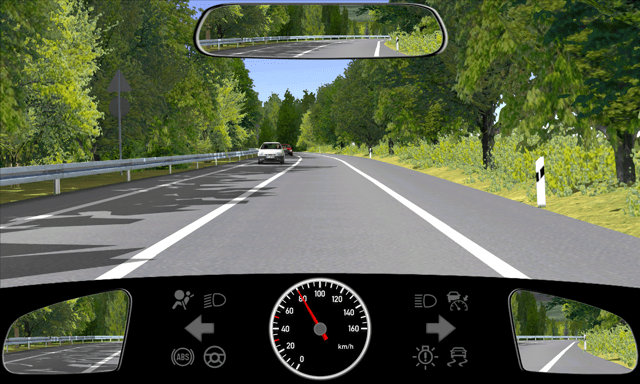
Explicación
Never wait on the left of the lane mark. You would impede or even endanger subsequent vehicles. The side strip is designed for parking, waiting and slow vehicles. As a slow-moving driver you must use such a sufficiently wide and well-fastened strip for driving. In this case, you may drive over the thick solid line with your vehicle representing an official lane boundary.
-
Pregunta 16 de 22
¿Qué vehículos pueden detenerse en segunda fila en la calzada?
1.2.12-1242 puntosExplicación
In exceptional cases, taxis are only allowed to stop in the second row when passengers are getting on or off.
-
Pregunta 17 de 22
¿Dónde está prohibido detener el vehículo?
1.2.12-1253 puntosExplicación
You are not allowed to wait on acceleration or on deceleration lanes. Also, on lanes with directional arrows you must not stop. This does not apply to driveways in front of properties.
-
Pregunta 18 de 22
¿Qué vehículo(s) está(n) parado(s) donde no debería(n)?
1.2.12-1263 puntos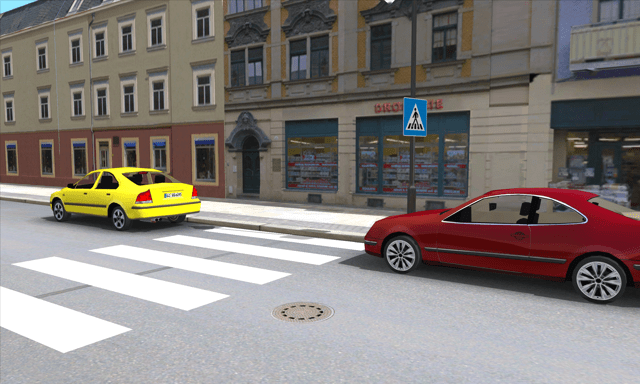
Explicación
On pedestrian crossings and five meters before, waiting is prohibited. The aim of this provision is to ensure a clear view of approaching vehicles and pedestrians who are willing to cross in this traffic situation.
-
Pregunta 19 de 22
¿Dónde puede estacionar aquí?
1.2.12-1283 puntos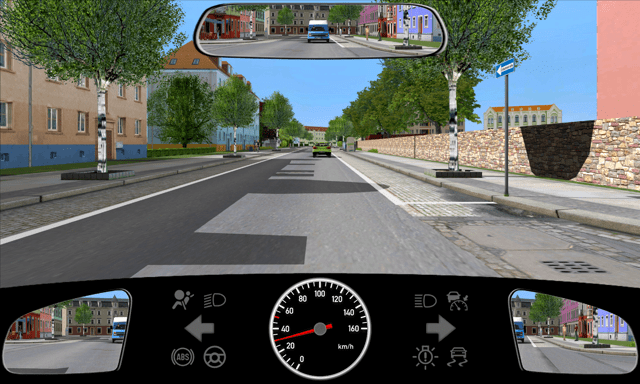
-
Pregunta 20 de 22
Está buscando donde aparcar en el margen derecho de la calle. A la derecha del carril por el que va circulando no hay carril bici. ¿Qué distancia en metros tiene que guardar antes y después de una intersección para aparcar?
1.2.12-1313 puntosCorrecto: 5
Explicación
In order not to limit the view, you are not allowed to park 5 meters before and after an intersection.
-
Pregunta 21 de 22
¿Dónde está prohibido parar?
1.2.12-1323 puntosExplicación
Stopping occurs when a vehicle is stopped for less than 3 minutes for non-traffic reasons while the driver does not leave the vehicle. If the driver stops longer and/or leaves his vehicle, this is referred to as parking. You are not allowed to stop everywhere, for example so as not to endanger other road users. Fire brigade access roads and no-stopping zones, among other things, are excluded; a distinction is made here between parking and stopping. This does not apply to all one-way streets.
-
Pregunta 22 de 22
Está buscando donde aparcar en el margen derecho de la calzada. A la derecha de la calzada hay un carril bici. ¿Qué distancia en metros tiene que guardar antes de una intersección o de una bocacalle para aparcar?
1.2.12-1333 puntosCorrecto: 8
Explicación
To avoid obstructing visibility, you are not allowed to park 8 meters in front of and behind a junction or intersection.