
1.2.12 Zatrzymanie i parkowanie
Nauczmy się szybko najważniejszych zasad zatrzymywania i parkowania dzięki prostym objaśnieniom, sztuczkom pamięciowym i ważnym odległościom.
🧠 Zasady szybkiej pamięci
⏱ Zasada 3 minut
Mniej niż 3 minuty + kierowca zostaje w środku = Zatrzymanie
Ponad 3 minuty LUB opuszczenie pojazdu = Parking
🚷Przejście dla pieszych
Zakaz zatrzymywania i parkowania: NA Lub 5 metrów wcześniej przejście.
🛑Przystanki autobusowe
Nie parkować: 15 metrów przed i po przystanki autobusowe/tramwajowe.
🚦 Skrzyżowania
Zwykle przechowuj:
5 metrów dystans.
Czasami:
8 metrów jeśli widoczność jest ograniczona.
🚘 Różnica między zatrzymywaniem a parkowaniem
⛔ Zatrzymanie
- Pojazd zatrzymuje się na mniej niż 3 minuty
- Kierowca pozostaje w pojeździe
- Powód NIE jest związany z ruchem drogowym
- Przykład: Szybkie odbieranie kogoś
🅿Parking
- Ponad 3 minuty
- LUB kierowca opuszcza pojazd
- Nawet krótki wyjazd = parkowanie
- Przykład: Wyjście z samochodu, aby kupić kawę
📏 Ważne odległości, o których MUSISZ pamiętać
| Miejsce | Zasada odległości | Oznaczający |
|---|---|---|
| Przejście dla pieszych | 5 metrów wcześniej | Żadnego zatrzymywania się i parkowania |
| Skrzyżowanie / skrzyżowanie | 5 metrów | Zadbaj o dobrą widoczność |
| Duże skrzyżowania | 8 metrów | Jeśli występuje problem ze ścieżką rowerową lub widocznością |
| Przystanki autobusowe/tramwajowe | 15 metrów przed i po | Zezwól na ruch środkami transportu publicznego |
| Przejazd kolejowy | Minimum 5 metrów | Nie blokuj widoczności kolei |
| Teren Krzyża Św. Andrzeja | 50 metrów poza miastami | Zachowaj wystarczającą ilość miejsca do oczekiwania |
🚫 Gdzie NIE wolno się zatrzymywać ani parkować
🚶 Przejścia dla pieszych
Zakaz zatrzymywania się i parkowania na skrzyżowaniach lub 5 m przed nimi.
🚌Przystanki autobusowe
Zakaz parkowania 15 m przed i za przystankami autobusowymi/tramwajowymi.
🚦 Skrzyżowania
Zakaz parkowania w pobliżu skrzyżowań ze względu na ograniczoną widoczność.
🚂 Przejazdy kolejowe
Nigdy nie zatrzymuj się ani nie parkuj w miejscu, w którym pociągi mogą być zablokowane.
🛣 Autostrady
Zatrzymywanie się na autostradzie lub poboczu jest zabronione, z wyjątkiem sytuacji awaryjnych.
🚪 Podjazdy
Nigdy nie parkuj przed obniżonymi krawężnikami lub wejściami.
⭐ Specjalne zasady egzaminu
🚕 Parking w drugim rzędzie
Tylko taksówki mogą na chwilę zatrzymać się w drugim rzędzie dla pasażerów. Inne pojazdy są generalnie zabronione.
➡ Kierunek parkowania
Parkuj zazwyczaj po prawej stronie w kierunku jazdy. Wyjątek: Ulice jednokierunkowe lub tory tramwajowe po prawej stronie.
⚠ Światła awaryjne
Światła awaryjne NIE zezwalają na nielegalne czekanie lub parkowanie.
🛣 Twarde ramię
Oczekiwanie dozwolone tylko po stronie barkowej, NIE po lewej stronie ciągłej białej linii.
🎯 Łatwe wskazówki dotyczące egzaminu
- 3 minuty = ważna granica
- 5 metrów = skrzyżowania/skrzyżowania
- 15 metrów = przystanki autobusowe
- Widoczność nie może być nigdy blokowana
- Parkowanie przed przejściami dla pieszych
- Zatrzymanie na poboczu autostrady
- Blokowanie obniżonych krawężników
- Oczekiwanie w drugim rzędzie
Practice Questions (22)
-
Question 1 of 22
Gdzie zabronione jest zatrzymywanie się?
1.2.12-0013 PunktówWyjaśnienie
A "stop" is when a vehicle stops for less than 3 minutes for reasons unrelated to traffic without the driver getting out of the vehicle. If the driver stops for a longer time and/or leaves his vehicle, this is called parking. However, drivers are not allowed to stop everywhere so as not to endanger other road users. Exceptions are: - Non-stop zones - Transitions through levels as there is a risk of collision with the train - Narrow and incomprehensible places with a clearance width of less than 3 m blind turns - Hilltops - Pedestrian crossings and the area in front of them (distance not less than 5 m), but not the area behind them.
-
Question 2 of 22
Gdzie zabronione jest parkowanie?
1.2.12-0023 PunktówWyjaśnienie
As soon as you stop or leave your vehicle for more than three minutes without any traffic-related reason, this is called parking. This is not allowed everywhere. You may not park in areas with stopping restrictions or parking prohibition - nor where you impede or obstruct other road users. Parking restrictions also apply to priority roads outside built-up areas. Use side strips or parking bays.
-
Question 3 of 22
Gdzie zabronione jest zatrzymywanie się?
1.2.12-1033 PunktówWyjaśnienie
You may only stop where you do not endanger other road users. This is the case, for example, if there is a hard shoulder separated from the carriageway by a continuous white line. You are not allowed to stop - on marked lanes that are used for getting into the right of way - on the carriageway if there is a hard shoulder - at bus stops or other public transport stops - at taxi ranks, so as not to block the access of taxis - on motorways or motorways, not even on the hard shoulder. Watch out for two-wheelers!
-
Question 4 of 22
Gdzie zabronione jest zatrzymywanie się?
1.2.12-1043 PunktówWyjaśnienie
On and up to five meters in front of a pedestrian crossing, you must not stop because you obstruct the clear view of other drivers on pedestrians. These could then be recognized too late. After a pedestrian crossing you may stop. Waiting is allowed on manhole covers, but not parking.
-
Question 5 of 22
Gdzie zabronione jest parkowanie?
1.2.12-1053 PunktówWyjaśnienie
You are not allowed to park at the edge of the road, where you block marked parking areas and thus hinder other road users. Parking is also prohibited in front of lowered curbs, which are for example located in front of driveways. Lowered curbs should allow wheelchair users to cross the road. Safe and therefore allowed is parking after a pedestrian crossing.
-
Question 6 of 22
Gdzie można parkować w kierunku jazdy po lewej stronie?
1.2.12-1063 PunktówWyjaśnienie
You may only park in the direction of travel on the right-hand side of the road. This also applies if all parking spaces are on the left side. You may have to turn if allowed. The only exception are one-way streets, as they are only used in one direction of travel. If there are rails on the right, you must also park on the left, but always observe parking restrictions.
-
Question 7 of 22
Kto parkuje?
1.2.12-1073 PunktówWyjaśnienie
If the car driver deliberately stops the vehicle and stays there for more than three minutes or leaves the stopped vehicle, this is considered parking. The stopping and waiting in front of a gate is not considered parking, no matter how long it takes, because the break is due to traffic.
-
Question 8 of 22
Jaki minimalny odstęp należy zachować przy zatrzymywaniu się lub parkowaniu przed przejściem dla pieszych?
1.2.12-1083 PunktówPoprawnie: 5
Wyjaśnienie
On a pedestrian crossing and up to 5 m in front no stopping or parking is allowed. So, you can freely view the pedestrian crossing as a car driver and passers-by have a good overview of the traffic.
-
Question 9 of 22
Przy parkowaniu poza terenem zabudowanym, jak dużą odległość należy utrzymać od krzyża św. Andrzeja?
1.2.12-1102 PunktówPoprawnie: 50
Wyjaśnienie
At a railroad crossing with a St. Andrew's Cross sign, the view of the level crossing must not be obstructed with a distance of 50m to have enough space for waiting vehicles.
-
Question 10 of 22
Na terenie zabudowanym chce Pani/Pan zaparkować przed krzyżem św. Andrzeja. Jaką minimalną odległość należy zachować?
1.2.12-1112 PunktówPoprawnie: 5
Wyjaśnienie
At a railroad crossing with St. Andrew's Cross, the rail vehicle has priority. To avoid obscuring the view of the railway line, a safety distance of 5 meters must be maintained.
-
Question 11 of 22
W jakiej odległości przed i za znakiem przystanku nie wolno parkować?
1.2.12-1122 PunktówPoprawnie: 15
Wyjaśnienie
It is not allowed to park 15 meters before and after the stop sign to allow public transports to approach, stop and leave without encumbrance.
-
Question 12 of 22
Na przystankach można zatrzymywać się tylko wtedy, jeżeli nie przeszkadza to autobusom. Jak długo można tam maksymalnie stać?
1.2.12-1132 PunktówPoprawnie: 3
Wyjaśnienie
The stopping time is limited to a maximum of 3 minutes. If a vehicle is stopped for more than 3 minutes, the vehicle is considered as parked. Thus it is only alowed to stop for 3 minutes
-
Question 13 of 22
Kto parkuje nieprawidłowo?
1.2.12-1212 Punktów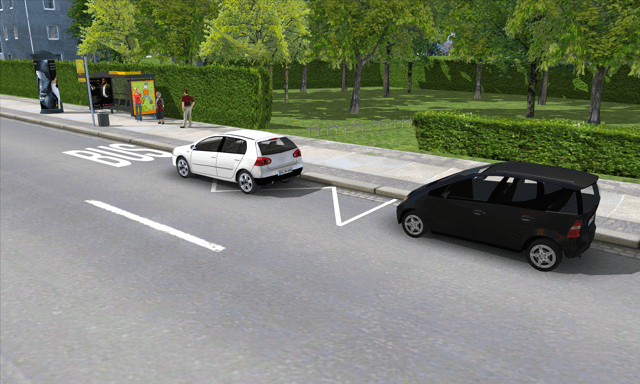
Wyjaśnienie
The zigzagged line shortens or extends a waiting or parking ban. As far as there is no border marking on the road, a parking ban of up to 15 meters in front of and behind the stop sign applies. In this situation, the white car parked incorrectly because it stands on the marking. The dark car, however, parks properly.
-
Question 14 of 22
Kiedy nie mogą Państwo parkować na prawym pasie jezdni?
1.2.12-1223 PunktówWyjaśnienie
In general, parking is prohibited if it could endanger other road users. Visual disability is also included. Therefore, parking is not allowed in all three situations.
-
Question 15 of 22
Czego należy tu przestrzegać?
1.2.12-1233 Punktów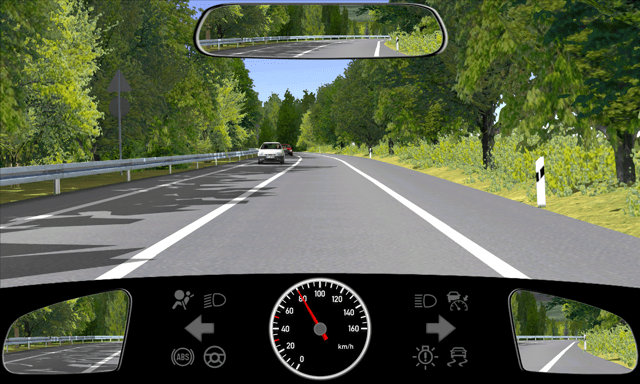
Wyjaśnienie
Never wait on the left of the lane mark. You would impede or even endanger subsequent vehicles. The side strip is designed for parking, waiting and slow vehicles. As a slow-moving driver you must use such a sufficiently wide and well-fastened strip for driving. In this case, you may drive over the thick solid line with your vehicle representing an official lane boundary.
-
Question 16 of 22
Jakie pojazdy mogą zatrzymać się na jezdni w drugim rzędzie?
1.2.12-1242 PunktówWyjaśnienie
In exceptional cases, taxis are only allowed to stop in the second row when passengers are getting on or off.
-
Question 17 of 22
Gdzie zabronione jest zatrzymywanie?
1.2.12-1253 PunktówWyjaśnienie
You are not allowed to wait on acceleration or on deceleration lanes. Also, on lanes with directional arrows you must not stop. This does not apply to driveways in front of properties.
-
Question 18 of 22
Kto zatrzymuje się nieprawidłowo?
1.2.12-1263 Punktów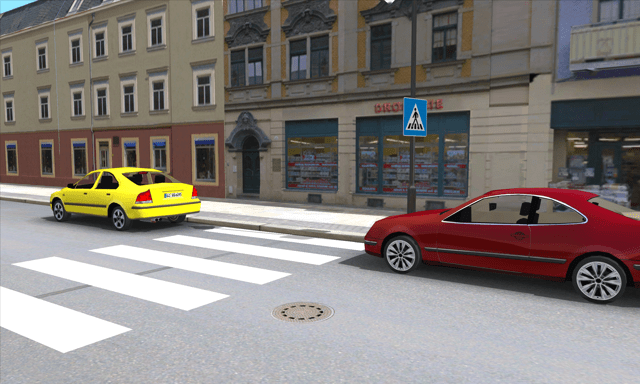
Wyjaśnienie
On pedestrian crossings and five meters before, waiting is prohibited. The aim of this provision is to ensure a clear view of approaching vehicles and pedestrians who are willing to cross in this traffic situation.
-
Question 19 of 22
Gdzie mogą Państwo tutaj zaparkować?
1.2.12-1283 Punktów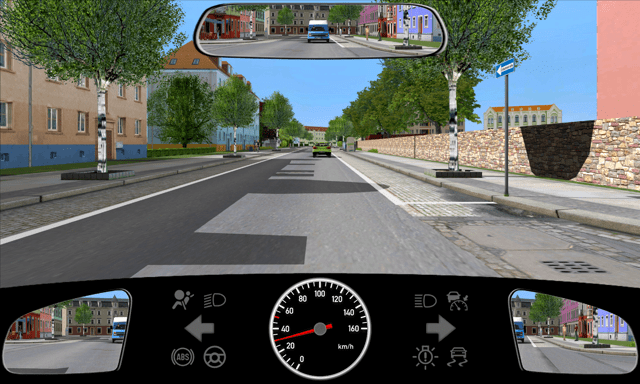
-
Question 20 of 22
Szukają Państwo możliwości zaparkowania przy prawym poboczu. Po prawej stronie obok jezdni nie ma drogi dla rowerów. Ile metrów przed i za skrzyżowaniem nie wolno Państwu parkować?
1.2.12-1313 PunktówPoprawnie: 5
Wyjaśnienie
In order not to limit the view, you are not allowed to park 5 meters before and after an intersection.
-
Question 21 of 22
Gdzie jest zakaz zatrzymywania się?
1.2.12-1323 PunktówWyjaśnienie
Stopping occurs when a vehicle is stopped for less than 3 minutes for non-traffic reasons while the driver does not leave the vehicle. If the driver stops longer and/or leaves his vehicle, this is referred to as parking. You are not allowed to stop everywhere, for example so as not to endanger other road users. Fire brigade access roads and no-stopping zones, among other things, are excluded; a distinction is made here between parking and stopping. This does not apply to all one-way streets.
-
Question 22 of 22
Szukają Państwo miejsca parkingowego po prawej stronie drogi. Na prawo od jezdni znajduje się ścieżka rowerowa. Ile metrów przed skrzyżowaniem lub przed rozjazdem nie mogą Państwo parkować?
1.2.12-1333 PunktówPoprawnie: 8
Wyjaśnienie
To avoid obstructing visibility, you are not allowed to park 8 meters in front of and behind a junction or intersection.