
2.1.06 Wyprzedzanie
Złota zasada:
Wyprzedzaj tylko wtedy, gdy cała droga wyprzedzania jest dobrze widoczna, bezpieczna i można zachować wystarczający odstęp boczny.
🚦 Zasady szybkiej pamięci
✅ MOŻESZ wyprzedzić, kiedy
- Droga przed nami jest w pełni widoczna
- Brak ruchu nadjeżdżającego
- Możesz zachować wystarczającą odległość boczną
- Żadne zakręty ani skrzyżowania nie blokują widoku
- Pojazd poprzedzający nie skręca w lewo
❌ NIGDY nie wyprzedzaj kiedy
- Widoczność jest ograniczona
- Nadjeżdża ruch
- Pojazd z tyłu już zaczął wyprzedzać
- Nie możesz zachować wystarczającej odległości bocznej
- Pojazd poprzedzający sygnalizuje lewo
📏 Ważne odległości
- 🚴 Rowerzyści: 1,5 m w miastach
- 🚴 Poza miastami: Minimalna odległość 2 m
- 🚗 Nigdy nie wyprzedzaj, jeśli droga jest zbyt wąska, aby zachować bezpieczną odległość boczną.
👀 Zasady widoczności
- Nie wyprzedzaj przed zakrętami
- Nie wyprzedzaj w pobliżu skrzyżowań
- Zakręty i drzewa ograniczają widoczność
- Zmiany światła/cienia mogą oszukać ocenę odległości
- Wyprzedzaj tylko wtedy, gdy cała ścieżka jest widoczna
🚛 Konwój i wiele pojazdów
- Pojazdy powinny wyprzedzać jeden po drugim
- Ostatni pojazd ma najdłuższą drogę wyprzedzania
- Nie przerywaj zamkniętego stowarzyszenia
- Nie wyprzedzaj kilku samochodów przed zakrętem
- Zachowaj wystarczająco dużo miejsca, aby móc bezpiecznie wrócić
🛣 Zasady autostrady
- Zwykle wyprzedzanie z prawej strony jest zabronione
- Wyjątek: korek lub wolna kolejka na lewym pasie
- Nie zmieniaj pasów zbyt wcześnie
- Przed zmianą pasa należy dokończyć bezpieczne wyprzedzanie
- Migające reflektory NIE dają pierwszeństwa innym
⚠ Niebezpieczne sytuacje
- Jeżeli ktoś wyprzedza niebezpiecznie – zwolnij
- Jedź jak najdalej w prawo
- Nigdy nie przyspieszaj, gdy jesteś wyprzedzany
- W razie potrzeby ostrożnie korzystaj z trawnika
- Pomóż uniknąć kolizji, tworząc przestrzeń
🚴 Wyprzedzanie rowerzystów
- Zachowaj odległość co najmniej 1,5–2 m
- Nie wyprzedzaj na wąskich drogach
- Roboty drogowe często uniemożliwiają wyprzedzanie
- Słaba widoczność = brak wyprzedzania
- Zwolnij, jeśli nie można zachować bezpiecznej odległości
🚜 Ciągniki i duże pojazdy
- Jeśli ciągnik sygnalizuje lewo → NIGDY nie wyprzedzaj
- Przed skrętem ciągniki mogą skręcić w lewo
- Duże pojazdy blokują widoczność
- Odległość wyprzedzania staje się znacznie dłuższa
- Uważaj na motocykle jadące za tobą
🧠 Sztuczki i porady egzaminacyjne
Typowe pułapki egzaminacyjne
- Ukryty ruch nadjeżdżający
- Motocykle zbliżają się szybko z tyłu
- Pojazdy już wyprzedzają
- Niewystarczająca odległość boczna
- Lewe kierunkowskazy z ciągników
Najlepsza bezpieczna reakcja
- Zmniejsz prędkość
- Zachowaj spokój
- W razie potrzeby przesuń się w prawo
- Wcześnie przerwij wyprzedzanie
- Nigdy nie zmuszaj innych do nagłego hamowania
Practice Questions (23)
-
Question 1 of 23
Chcą Państwo wyprzedzać. Jak zachowają się Państwo teraz właściwie?
2.1.06-0073 PunktówWyjaśnienie
As the vehicle behind you has already started the overtaking process, you should refrain from overtaking.
-
Question 2 of 23
Chcą Państwo wyprzedzać. Czego należy przestrzegać?
2.1.06-0084 PunktówWyjaśnienie
Here you can overtake if you can see over the required distance and if there is no oncoming vehicle (limited visibility).
-
Question 3 of 23
Dlaczego muszą Państwo teraz gwałtownie zahamować?
2.1.06-0114 PunktówWyjaśnienie
Since the blue passenger car will most likely get on your lane, you have to slow down immediately and keep to the right.
-
Question 4 of 23
Jak należy zachować się prawidłowo?
2.1.06-0125 PunktówWyjaśnienie
As the car driver, you do not have to dodge to the middle lane when another car pushes you from behind or uses the flash light. You should overtake the blue car and the red van as usual. To change safely to the middle lane, the overtaking process must be completed. Only then you can change.
-
Question 5 of 23
Chcą Państwo wyprzedzić. Jak należy się właściwie zachować?
2.1.06-0135 PunktówWyjaśnienie
You already indicated and want to overtake the truck. In the rearview mirror you can see a red car approaching on the left lane at high speed. You need to stop the overtaking process immediately and stay behind the truck. If you continue, you force the red car to brake suddenly. He could drive against your car.
-
Question 6 of 23
Jak należy się właściwie zachować?
2.1.06-0145 PunktówWyjaśnienie
While overtaking a truck, you observe a fast approaching car in the rearview mirror. It is too late to complete the overtaking process. Accelerate and complete the overtaking process quickly but safely. Basically, subsequent vehicles do not have priority; even not on the freeway.
-
Question 7 of 23
Jak należy się właściwie zachować?
2.1.06-0155 PunktówWyjaśnienie
A driver drives dangerously close to you on the left-hand lane and signals his/her overtaking intent with his flash light. You should still overtake the transporter on the mid-lane and then get back into the lane in front of it to defuse the situation.
-
Question 8 of 23
Dlaczego muszą Państwo teraz zwolnić?
2.1.06-0173 PunktówWyjaśnienie
The oncoming car overtakes despite opposing traffic about 250 m in front of you. You have to reduce your speed and drive to the far right. So, you defuse the situation and give the overtaking car more time and space to complete the overtaking process. The tractor moves away from the intersection and poses no danger.
-
Question 9 of 23
Jak powinni Państwo się teraz zachować?
2.1.06-0185 PunktówWyjaśnienie
If a car overtakes you despite oncoming traffic, you should delay and try to drive to the right as far as possible. This gives the other vehicle enough space to safely complete the overtaking process.
-
Question 10 of 23
Jak powinni się Państwo teraz zachować?
2.1.06-0205 Punktów -
Question 11 of 23
Chcą Państwo wyprzedzać. Jak zachowają się Państwo teraz właściwie?
2.1.06-0214 PunktówWyjaśnienie
You should not overtake the truck, as you cannot see the distance required for this.
-
Question 12 of 23
Jak zachowają się Państwo teraz właściwie?
2.1.06-0234 PunktówWyjaśnienie
You should not overtake because the tractor will swerve to the left (see indicator).
-
Question 13 of 23
Chcą Państwo wyprzedzać. Jak zachowają się Państwo teraz właściwie?
2.1.06-0244 Punktów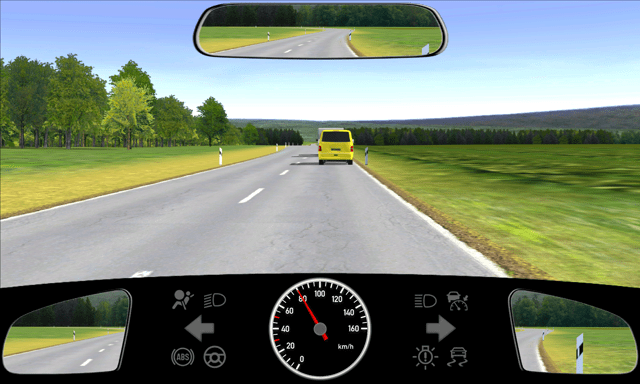
Wyjaśnienie
The correct behavior (proactive) here is not to overtake as the yellow vehicle could overtake and oncoming traffic could appear (restricted view).
-
Question 14 of 23
Dlaczego nie mogą Państwo teraz wyprzedzać?
2.1.06-0265 PunktówWyjaśnienie
Because of the motorcycle (oncoming traffic) and the course of the road and the resulting poor visibility, you are not allowed to overtake the cyclist.
-
Question 15 of 23
Dlaczego teraz nie mogą Państwo wyprzedzać?
2.1.06-0274 PunktówWyjaśnienie
At this moment, a motorcyclist passes the tractor. Wait until you can safely begin the overtaking manoeuvre.
-
Question 16 of 23
Dlaczego tutaj nie wolno Państwu wyprzedzać?
2.1.06-0284 Punktów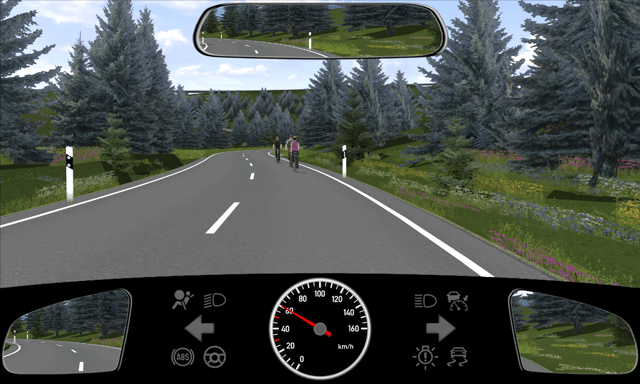
Wyjaśnienie
Due to the curve and the trees, you cannot see the rest of the road sufficiently. Out of town, you must keep a minimum distance of 2 metres to the side of cyclists. In the event of sudden oncoming traffic, you would not be able to maintain this distance when overtaking. Therefore, you must not overtake here.
-
Question 17 of 23
Dlaczego nie wolno tu wyprzedzać?
2.1.06-0294 Punktów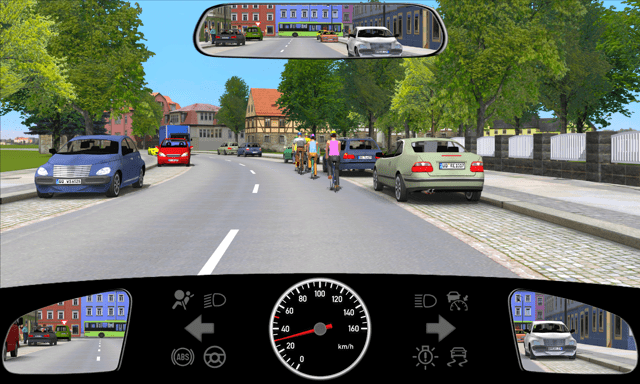
Wyjaśnienie
The road is too small to allow enough side distance to cyclists and oncoming traffic at the same time.
-
Question 18 of 23
Chcą Państwo wyprzedzić na alei. Na jaką szczególną cechę należy zwrócić uwagę?
2.1.06-0304 PunktówWyjaśnienie
The avenue is framed by trees. Therefore, the change of light and shadow often leads to the incorrect estimation of distances. Likewise, it can often lead to trees falling and vehicles with high bodies trying to avoid branches.
-
Question 19 of 23
Dlaczego muszą Państwo teraz przerwać manewr wyprzedzania?
2.1.06-0314 PunktówWyjaśnienie
The tractor starts to turn left. The tractor drives across the left lane of the road. If you overtake now, you would collide with the tractor.
-
Question 20 of 23
Jadą Państwo drogą z pasem w każdym kierunku. Przed Państwem jedzie zamknięty ciąg pojazdów mechanicznych. Dlaczego w celu uniknięcia niebezpiecznych sytuacji powinni Państwo zrezygnować z wyprzedzania?
2.1.06-0323 PunktówWyjaśnienie
A group of pedestrians, cyclists or motor vehicles, which is traveling together in road traffic, is called a closed association. Closed associations must be clearly marked and must not be interrupted. Because a closed association consists of several vehicles, you cannot really understand the traffic situation. When overtaking a closed bandage, you should avoid premature inserting, which makes the overtaking path significantly longer.
-
Question 21 of 23
Dlaczego w tej sytuacji wyprzedzanie jest zbyt niebezpieczne?
2.1.06-0335 PunktówWyjaśnienie
You are driving in a convoy of several cars behind a lorry on a winding road with oncoming traffic. Ideally, the car behind the lorry overtakes first before the vehicles behind move up and start to overtake. On the left-hand bend, you cannot see the overtaking lane sufficiently. You will probably have to cancel the overtaking manoeuvre and pull in between two vehicles. There is a possibility that the distance between the vehicles in front is too small and that you will endanger yourself and other road users by pulling in.
-
Question 22 of 23
Dlaczego w takiej sytuacji nie wolno wyprzedzać?
2.1.06-0344 PunktówWyjaśnienie
You are not allowed to overtake in this situation because the tractor is travelling too fast for you to overtake it at your maximum speed of 50 km/h. The motorbike is also approaching at high speed. It will probably overtake you as there is a long straight ahead and no oncoming traffic in sight.
-
Question 23 of 23
Pojazdy jadące przed Państwem poruszają się z prędkością około 30 km/h. Dlaczego nie wolno wyprzedzać przed zakrętem?
2.1.06-0354 Punktów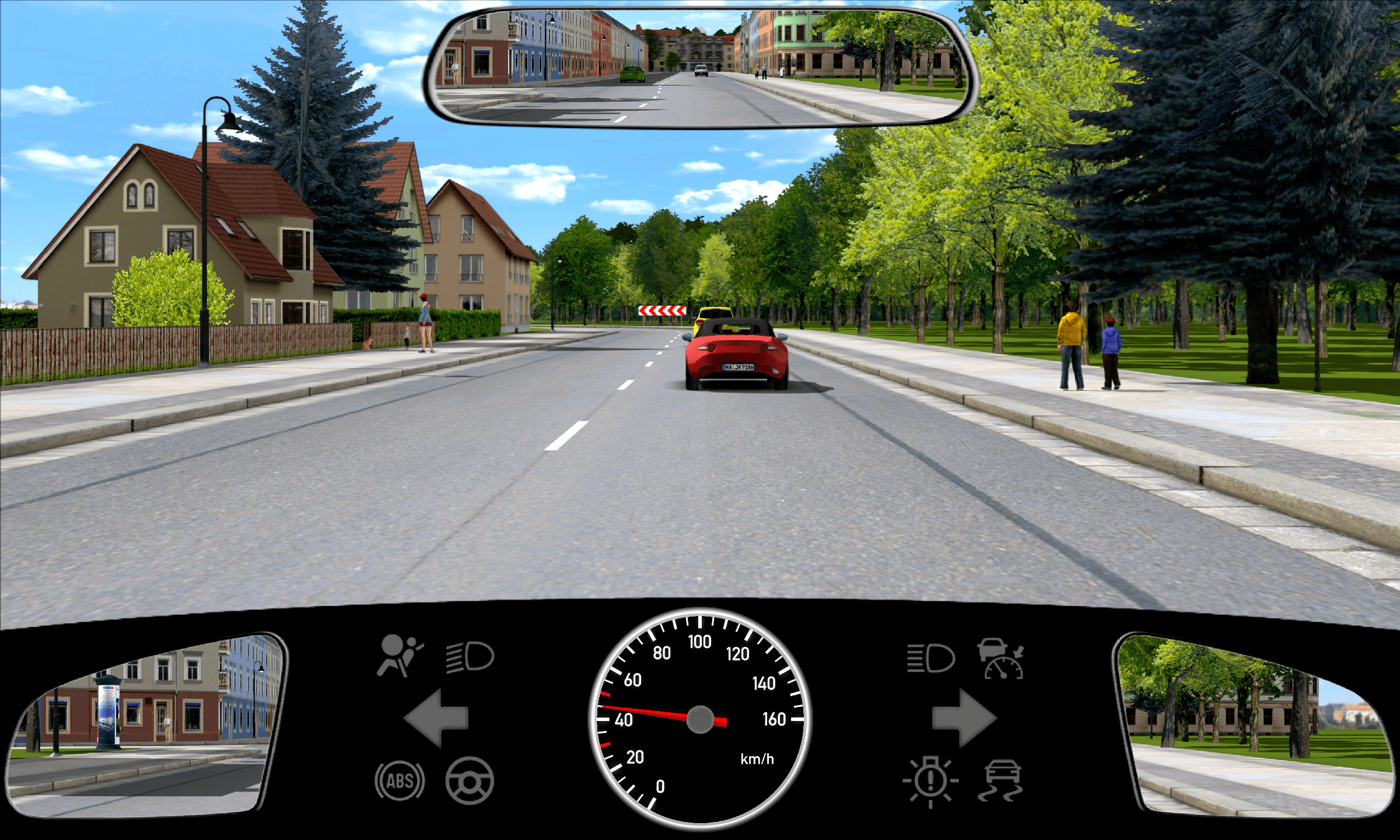
Wyjaśnienie
You are not allowed to overtake before the bend as your overtaking distance is too long to overtake both vehicles before the bend. There is also not enough distance between the two cars for you to pull in. In addition, the red car has the right of way to overtake in front of you; if you both start the overtaking manoeuvre, there is a danger for you and oncoming traffic. As the bend is not visible, you cannot know whether oncoming traffic is coming.