
2.1.07 Specjalne sytuacje ruchu
Specjalne sytuacje drogowe, rozdział 2.1.07 — Dowiedz się, jak postępować w niebezpiecznych, niejasnych lub nietypowych sytuacjach drogowych.
⭐ Główna zasada egzaminu
Gdy sytuacja jest niejasna, niebezpieczna lub inny użytkownik drogi może popełnić błąd: zmniejsz prędkość, zwiększ odległość, jedź ostrożnie i bądź gotowy do hamowania.
🚜 Powolne pojazdy / traktory
Kiedy zobaczysz:
Ciągnik, ciężarówka lub motorower chce zawrócić z pobocza lub skręcić w lewo.
Powinieneś:
Zmniejsz prędkość i pozwól mu bezpiecznie się połączyć.
🚗 Zasada zakończenia pasa / zamka błyskawicznego
Kiedy zobaczysz:
Pas się kończy lub inny kierowca nie może kontynuować jazdy na swoim pasie.
Powinieneś:
Zwolnij i pozwól pojazdowi połączyć się, korzystając z procedury zamka błyskawicznego.
⚠ Uszkodzone pojazdy
Kiedy zobaczysz:
Zatrzymany samochód, osoba na drodze lub zablokowany pas.
Powinieneś:
Zmniejsz prędkość, jedź maksymalnie w prawo, spodziewaj się nagłego ruchu ludzi lub pojazdów.
🦌 Zwierzęta
Kiedy zobaczysz:
Zwierzęta w pobliżu lub na drodze.
Powinieneś:
Zwolnij, obserwuj uważnie, bądź gotowy do hamowania. Nie skręcaj niebezpiecznie.
🚴Rowerzyści
Kiedy zobaczysz:
Rowerzysta zablokowany przez przeszkodę lub jadący pod górę.
Powinieneś:
Spodziewaj się skręcania, zachowuj większy odstęp i wyprzedzaj tylko wtedy, gdy jest to bezpieczne.
🏍 Motocykle
Kiedy zobaczysz:
Motocyklista wyprzedzający, ścinający zakręty lub wjeżdżający na Twój pas.
Powinieneś:
Jedź maksymalnie w prawo, zmniejsz prędkość i utwórz więcej miejsca.
🧠 Schemat egzaminu: Kiedy widzisz X → Wykonaj Y
| Sytuacja | Prawidłowa reakcja | Dlaczego? |
|---|---|---|
| Kierowca jadący pod prąd na autostradzie | Jedź w prawo, hamuj, światła awaryjne | Ostrzegaj innych i unikaj kolizji |
| Tylna klapa za tobą | Zachowaj dozwoloną prędkość | Nie przyspieszaj ani nie hamuj gwałtownie |
| Taksówka zatrzymała się z przodu | Zatrzymaj się za nim, jeśli lewy pas jest zablokowany | Nie jedź po chodniku |
| Ograniczona widoczność w pobliżu drzew/zakrętów | Zwolnij i jedź daleko w prawo | Ukryte zagrożenia mogą ujawnić się późno |
| Pęknięcie opony lub silny boczny wiatr | Zwolnij gaz, skręć w lewo i delikatnie zahamuj | Utrzymuj pojazd stabilny |
| Nieuniknione zderzenie zwierząt | Hamuj mocno, trzymaj kierownicę, pozostań na pasie | Skręcanie może być bardziej niebezpieczne |
📏 Bezpieczna odległość
Poza terenem zabudowanym należy zachować co najmniej:
Połowa prędkości w metrach
Przykład: 100 km/h → odległość 50 m
🛑 Droga hamowania
Jeśli prędkość się podwoi, droga hamowania znacznie się wydłuży.
Podwójna prędkość → 4× droga hamowania
40 km/h = 16 m, 80 km/h = 64 m
🎴 Szybkie fiszki
Pytanie
Co zrobić, jeśli traktor chce się połączyć?
Odpowiedź
Zmniejsz prędkość i pozwól mu się połączyć.
Pytanie
Co zrobić, jeśli na drodze pojawią się zwierzęta?
Odpowiedź
Zwolnij i bądź gotowy do hamowania.
Pytanie
Czy możesz jechać chodnikiem, aby wyprzedzić taksówkę?
Odpowiedź
Nie. Zatrzymaj się i poczekaj, jeśli nie możesz bezpiecznie wyprzedzić.
Pytanie
A co jeśli motocyklista może niebezpiecznie wyprzedzać?
Odpowiedź
Jedź maksymalnie w prawo i zmniejsz prędkość.
Pytanie
Co robisz po trafieniu na dziką zwierzynę?
Odpowiedź
Zatrzymaj się, zabezpiecz miejsce zdarzenia i powiadom policję lub nadleśnictwo.
Pytanie
A co jeśli wjedzie pojazd z leśnej ścieżki?
Odpowiedź
Bądź gotowy do hamowania, nawet jeśli masz pierwszeństwo.
✅ Lista kontrolna ostatecznej wersji
Practice Questions (30)
-
Question 1 of 30
Dlaczego muszą Państwo teraz hamować?
2.1.07-0094 PunktówWyjaśnienie
You should brake because of the green vehicle, as it appears to be driving onto the road behind the tractor.
-
Question 2 of 30
Z czym muszą się Państwo liczyć na tym parkingu?
2.1.07-0103 Punktów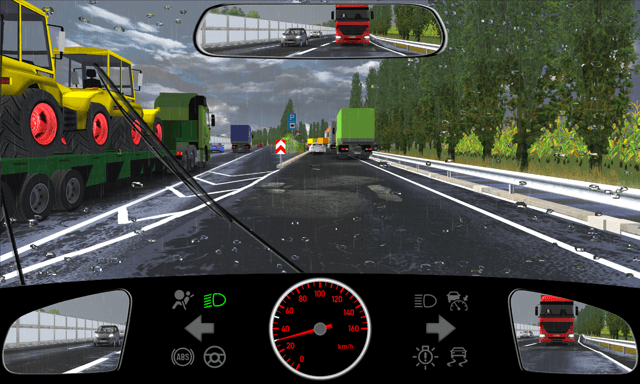
Wyjaśnienie
Vehicles can leave the parking space, watch out for vehicles leaving the parking space. People can walk on the roadway because you are taking a break. Truck drivers often park in car parking spaces.
-
Question 3 of 30
Jak zachowają się Państwo teraz właściwie?
2.1.07-0114 PunktówWyjaśnienie
The car will probably overtake the cyclist. To be on the safe side, slow down and ride as far to the right as possible.
-
Question 4 of 30
Dlaczego w tej sytuacji powinni być Państwo gotowi do hamowania?
2.1.07-0124 Punktów -
Question 5 of 30
Czego należy przestrzegać jadąc w grupie z większą ilością motocykli?
2.1.07-0133 PunktówWyjaśnienie
Drive in a staggered manner to avoid rear-end collisions caused by sudden braking. Group rides are not easy; if one driver makes a mistake, all the others have to react.
-
Question 6 of 30
Z czym powinni się Państwo liczyć w tej sytuacji?
2.1.07-0144 PunktówWyjaśnienie
Because of the turning truck, the van could miss you. Be ready to brake.
-
Question 7 of 30
Dlaczego powinni Państwo tutaj dalej zmniejszać prędkość?
2.1.07-0155 PunktówWyjaśnienie
It's unlikely that the car in the left lane will continue as it appears to have broken down. Even if it did, it wouldn't affect you. However, since there is a person in the lane, extra caution is required here. It's also possible that other people get out of the vehicle and run onto the road. The stationary car may be hidden by the bush or no warning triangle was set up. The following car could therefore recognize too late that the vehicle has stopped in front of it. You should therefore drive with foresight and expect the car behind to swerve into your lane.
-
Question 8 of 30
Jak zachowają się Państwo teraz właściwie?
2.1.07-0164 PunktówWyjaśnienie
The stalled vehicle is blocking the other vehicle's lane and restricting your view. You should reduce your speed and drive as far to the right as possible in your driving.
-
Question 9 of 30
Jaki jest właściwy sposób zachowania się Państwa w tym momencie?
2.1.07-0195 PunktówWyjaśnienie
The motorcyclist is approaching you at high speed. He could overtake you even though the blue truck is already very close. Drive as far to the right as possible to increase the distance to the oncoming lane and reduce your speed so that the motorcyclist can complete the overtaking manoeuvre safely and in good time.
-
Question 10 of 30
Jak należy się teraz zachować?
2.1.07-0204 PunktówWyjaśnienie
The yellow car comes towards you as a wrong-way driver on the highway. Drive to the right as far as possible and brake. To warn other road users, turn on the hazard warning lights.
-
Question 11 of 30
Jakie zachowanie będzie prawidłowe w tej sytuacji?
2.1.07-0223 PunktówWyjaśnienie
Animals on the road are unpredictable. You should continue to reduce your speed and monitor the situation carefully, and be ready to brake in case the animals run across the road. Hazard braking could lead to a rear-end collision if the vehicle behind you cannot react quickly enough.
-
Question 12 of 30
Dlaczego powinni Państwo teraz zmniejszać prędkość?
2.1.07-0234 PunktówWyjaśnienie
Even if you keep to the speed limit of 60 km/h, an animal will run onto the road right in front of you. To avoid an accident, you have to reduce your speed. The oncoming car does not affect your driving style.
-
Question 13 of 30
O czym muszą Państwo pamiętać w tej sytuacji?
2.1.07-0243 Punktów -
Question 14 of 30
Jakie zachowanie będzie teraz właściwe?
2.1.07-0254 PunktówWyjaśnienie
As the blue car will probably be travelling on the road without observing the right of way rules, you must slow down sharply and give up your right of way.
-
Question 15 of 30
Jakie zachowanie będzie teraz właściwe?
2.1.07-0263 PunktówWyjaśnienie
The tractor is signalling by flashing its lights that it wants to move back into the lane. You should therefore reduce your speed and allow the tractor to merge into the lane.
-
Question 16 of 30
Jakie zachowanie będzie teraz właściwe?
2.1.07-0274 PunktówWyjaśnienie
On the narrow country road, it is possible that you and the tractor will not be able to pass each other easily. Be prepared to stop and let the tractor pass.
-
Question 17 of 30
Jakie zachowanie będzie teraz właściwe?
2.1.07-0284 PunktówWyjaśnienie
The yellow car has an unusual driving style. It may be distracted or drunk. The abrupt braking and steering manoeuvres of the car in front are dangerous. Pay attention to how he continues to drive, increase the distance and be ready to brake.
-
Question 18 of 30
O czym muszą Państwo pamiętać podczas jazdy wąskimi alejkami?
2.1.07-0294 PunktówWyjaśnienie
Visibility in avenues is more restricted than in open fields and therefore requires an adapted driving style. On bends, your view of the carriageway may be restricted after the bend. You may therefore only see obstacles very late.
-
Question 19 of 30
Co należy teraz zrobić?
2.1.07-0304 PunktówWyjaśnienie
There is no other option for you in this situation other than to pull over behind the taxi. Because you are not allowed to pass to the right of the taxi as this is a sidewalk. Driving on a sidewalk is generally prohibited. You also can't change to the left lane because there is a motorcycle next to you. If you change lane you risk a collision.
-
Question 20 of 30
Bierzesz udział w grupowej wyprawie kilkoma motocyklami. Jak należy postąpić?
2.1.07-0313 Punktów -
Question 21 of 30
Zwiększasz swoją prędkość z 50 km/h na 100 km/h. Jak zmienia się droga hamowania zgodnie z ogólną zasadą?
2.1.07-1093 PunktówWyjaśnienie
According to the rule of thumb, the braking distance quadruples when the speed doubles. At 40 km/h, for example, it is 16 meters and at 80 km/h 64 meters.
-
Question 22 of 30
Dlaczego muszą Państwo w tej sytuacji być gotowi do hamowania?
2.1.07-1115 PunktówWyjaśnienie
You see that a vehicle wants to drive onto the road from the right. Since it comes from a field or forest path, you have right of way. Due to the forest cover the visibility for the vehicle driver may be limited. It is possible that he/she will continue despite having to wait. For this reason, you must be ready to brake until you clearly recognize that he/she is stopping.
-
Question 23 of 30
Dlaczego powinni Państwo teraz ograniczyć prędkość?
2.1.07-1125 PunktówWyjaśnienie
Basically, you have the right of way, because you are on a priority road. However, to avoid a dangerous situation, you should still reduce your speed and be ready to brake, as the car driver of the car coming from the right-hand side might recognize you too late or miss you altogether. Due to the trees on the roadside his/her view is clearly limited.
-
Question 24 of 30
Jak należy właściwie zachować się w tej sytuacji?
2.1.07-1135 PunktówWyjaśnienie
In this situation, you need to reduce the speed and allow the car driver to go back into lane on the left. If a lane ends on a multi-lane road or if it is not possible for the drivers driving on the other lane to drive through the lane continuously, they must be able to change lanes using the zipper procedure.
-
Question 25 of 30
Z czym muszą się Państwo liczyć w takiej sytuacji?
2.1.07-1145 PunktówWyjaśnienie
Although you are on the priority road, you must always expect dangerous situations to arise. For example, the tractor driver approaching your street at a junction could not fulfill his duty of waiting and force the vehicle in front of you to brake. By driving anticipatory you can help defuse potentially dangerous situations.
-
Question 26 of 30
Jak należy właściwie zachować się w tej sytuacji?
2.1.07-1155 PunktówWyjaśnienie
The maximum speed limit on this road is 80 km/h. You drive 80 km/h. The driver driving behind you harasses you to drive quicker; he/she comes dangerously close and falls below the required safety distance. Keep your speed. If you try to increase the safety margin by accelerating, the driver behind you will probably also accelerate. Braking, even briefly, endangers you and the car behind.
-
Question 27 of 30
O czym muszą Państwo pamiętać podczas skręcania w prawo?
2.1.07-1173 PunktówWyjaśnienie
All drivers driving on the priority road must be given priority. The motorcycle is on the lane where you want to turn right. Before you turn right into the priority road, you have to wait and let the motorcycle pass.
-
Question 28 of 30
Chcieliby Państwo pozostać na drodze z pierwszeństwem. Z czym musieliby się teraz Państwo liczyć?
2.1.07-1183 Punktów -
Question 29 of 30
Jedziesz drogą krajową. Przed tobą utworzył się jadący wąż samochodów składający się z około 15 pojazdów. Jak się zachowasz?
2.1.07-2063 PunktówWyjaśnienie
In such a convoy, it is important to stay calm and to maintain the necessary safety distance. So-called queue, that is the overtaking of individual vehicles, brings no time gain and leads to a high accident risk.
-
Question 30 of 30
Zwiększasz swoją prędkość z 50 km/h na 100 km/h. Jak zmienia czas reakcji zgodnie z ogólną zasadą?
2.1.07-2083 PunktówWyjaśnienie
If the car driver doubles the speed of the vehicle, the braking distance doubles from 15 to 30 meters.