
2.1.07 Situaciones de tráfico especiales
Situaciones de tráfico especiales, Capítulo 2.1.07: aprenda qué hacer en situaciones de tráfico peligrosas, poco claras o inusuales.
⭐ Regla principal del examen
Cuando la situación no está clara, es peligrosa o otro usuario de la vía puede cometer un error: reduzca la velocidad, aumente la distancia, conduzca con cuidado y esté preparado para frenar.
🚜 Vehículos lentos / tractores
Cuando veas:
Un tractor, un camión o un ciclomotor quiere volver desde el arcén o girar a la izquierda.
Debería:
Reduzca la velocidad y permita que se incorpore de forma segura.
🚗 Final de carril / Regla de la cremallera
Cuando veas:
Un carril termina u otro conductor no puede continuar en su carril.
Debería:
Reduzca la velocidad y deje que el vehículo se incorpore mediante el procedimiento de cremallera.
⚠ Vehículos averiados
Cuando veas:
Un automóvil detenido, una persona en la vía o un carril bloqueado.
Debería:
Reduzca la velocidad, conduzca por el extremo derecho y espere que las personas o los vehículos se muevan repentinamente.
🦌 Animales
Cuando veas:
Animales cerca o en la carretera.
Debería:
Reduzca la velocidad, observe con atención y prepárese para frenar. No te desvíes peligrosamente.
🚴 Ciclistas
Cuando veas:
Un ciclista bloqueado por un obstáculo o subiendo una cuesta.
Debería:
Espere desviarse, mantenga una distancia adicional y solo adelante cuando sea seguro.
🏍 Motocicletas
Cuando veas:
Un motociclista adelantando, tomando curvas o inclinándose hacia su carril.
Debería:
Conduce hacia la derecha, reduce la velocidad y crea más espacio.
🧠 Patrón de examen: cuando vea X → haga Y
| Situación | Reacción correcta | ¿Por qué? |
|---|---|---|
| Conductor en sentido contrario en la autopista | Mover a la derecha, freno, luces de emergencia | Advertir a otros y evitar colisiones. |
| El que sigue detrás de ti | Mantenga la velocidad legal | No aceleres ni frenes bruscamente |
| El taxi se detuvo adelante | Deténgase detrás de él si el carril izquierdo está bloqueado. | No conduzcas por la acera |
| Visibilidad limitada cerca de árboles/curvas | Reduzca la velocidad y conduzca por el extremo derecho | Los peligros ocultos pueden aparecer tarde |
| Neumático reventado o viento cruzado fuerte | Soltar el acelerador, contravirar, frenar suavemente | Mantenga el vehículo estable |
| Colisión de animales inevitable | Frene fuerte, sostenga el volante y permanezca en el carril. | Desviarse puede ser más peligroso |
📏 Distancia de seguridad
Fuera de las zonas urbanizadas conservar al menos:
La mitad de tu velocidad en metros
Ejemplo: 100 km/h → 50 m de distancia
🛑 Distancia de frenado
Si su velocidad se duplica, la distancia de frenado se vuelve mucho más larga.
Doble velocidad → 4× distancia de frenado
40 km/h = 16 m, 80 km/h = 64 m
🎴 Tarjetas didácticas rápidas
Pregunta
¿Qué haces si un tractor quiere incorporarse?
Respuesta
Reduce la velocidad y deja que se fusione.
Pregunta
¿Qué haces si hay animales en el camino?
Respuesta
Reduzca la velocidad y prepárese para frenar.
Pregunta
¿Se puede conducir por la acera para pasar un taxi?
Respuesta
No. Deténgase y espere si no puede adelantar con seguridad.
Pregunta
¿Qué pasa si un motociclista puede adelantar peligrosamente?
Respuesta
Conduzca hacia la derecha y reduzca la velocidad.
Pregunta
¿Qué haces después de encontrar caza salvaje?
Respuesta
Deténgase, asegure el lugar e informe a la policía o a la oficina forestal.
Pregunta
¿Qué pasa si puede entrar un vehículo desde un camino forestal?
Respuesta
Prepárate para frenar, incluso si tienes prioridad.
✅ Lista de verificación de revisión final
Preguntas de práctica (30)
-
Pregunta 1 de 30
¿Por qué tiene que frenar en este momento?
2.1.07-0094 puntosExplicación
You should brake because of the green vehicle, as it appears to be driving onto the road behind the tractor.
-
Pregunta 2 de 30
¿Con qué ha de contar en este aparcamiento?
2.1.07-0103 puntos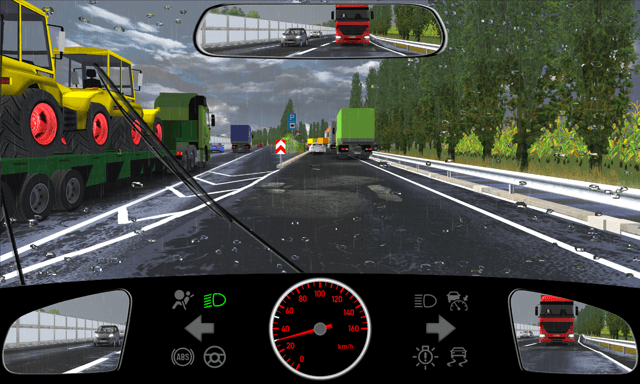
Explicación
Vehicles can leave the parking space, watch out for vehicles leaving the parking space. People can walk on the roadway because you are taking a break. Truck drivers often park in car parking spaces.
-
Pregunta 3 de 30
¿Qué es correcto hacer en este momento?
2.1.07-0114 puntosExplicación
The car will probably overtake the cyclist. To be on the safe side, slow down and ride as far to the right as possible.
-
Pregunta 4 de 30
En esta situación, ¿por qué se recomienda permanecer atento para frenar?
2.1.07-0124 puntos -
Pregunta 5 de 30
En caso de circular en grupo varias motocicletas, ¿qué ha de tenerse en cuenta?
2.1.07-0133 puntosExplicación
Drive in a staggered manner to avoid rear-end collisions caused by sudden braking. Group rides are not easy; if one driver makes a mistake, all the others have to react.
-
Pregunta 6 de 30
¿Con qué debería contar en esta situación?
2.1.07-0144 puntosExplicación
Because of the turning truck, the van could miss you. Be ready to brake.
-
Pregunta 7 de 30
En esta situación, ¿por qué se recomienda continuar reduciendo la velocidad?
2.1.07-0155 puntosExplicación
It's unlikely that the car in the left lane will continue as it appears to have broken down. Even if it did, it wouldn't affect you. However, since there is a person in the lane, extra caution is required here. It's also possible that other people get out of the vehicle and run onto the road. The stationary car may be hidden by the bush or no warning triangle was set up. The following car could therefore recognize too late that the vehicle has stopped in front of it. You should therefore drive with foresight and expect the car behind to swerve into your lane.
-
Pregunta 8 de 30
¿Qué es correcto hacer en este momento?
2.1.07-0164 puntosExplicación
The stalled vehicle is blocking the other vehicle's lane and restricting your view. You should reduce your speed and drive as far to the right as possible in your driving.
-
Pregunta 9 de 30
¿Qué es correcto hacer en esta situación?
2.1.07-0195 puntosExplicación
The motorcyclist is approaching you at high speed. He could overtake you even though the blue truck is already very close. Drive as far to the right as possible to increase the distance to the oncoming lane and reduce your speed so that the motorcyclist can complete the overtaking manoeuvre safely and in good time.
-
Pregunta 10 de 30
¿Qué debería hacer en este momento?
2.1.07-0204 puntosExplicación
The yellow car comes towards you as a wrong-way driver on the highway. Drive to the right as far as possible and brake. To warn other road users, turn on the hazard warning lights.
-
Pregunta 11 de 30
¿Qué es correcto hacer en esta situación?
2.1.07-0223 puntosExplicación
Animals on the road are unpredictable. You should continue to reduce your speed and monitor the situation carefully, and be ready to brake in case the animals run across the road. Hazard braking could lead to a rear-end collision if the vehicle behind you cannot react quickly enough.
-
Pregunta 12 de 30
¿Por qué se recomienda reducir la velocidad en este momento?
2.1.07-0234 puntosExplicación
Even if you keep to the speed limit of 60 km/h, an animal will run onto the road right in front of you. To avoid an accident, you have to reduce your speed. The oncoming car does not affect your driving style.
-
Pregunta 13 de 30
¿A qué tiene que prestar atención en esta situación?
2.1.07-0243 puntos -
Pregunta 14 de 30
¿Qué es correcto hacer en esta situación?
2.1.07-0254 puntosExplicación
As the blue car will probably be travelling on the road without observing the right of way rules, you must slow down sharply and give up your right of way.
-
Pregunta 15 de 30
¿Qué es correcto hacer en esta situación?
2.1.07-0263 puntosExplicación
The tractor is signalling by flashing its lights that it wants to move back into the lane. You should therefore reduce your speed and allow the tractor to merge into the lane.
-
Pregunta 16 de 30
¿Qué es lo correcto en esta situación?
2.1.07-0274 puntosExplicación
On the narrow country road, it is possible that you and the tractor will not be able to pass each other easily. Be prepared to stop and let the tractor pass.
-
Pregunta 17 de 30
¿Qué es correcto hacer en esta situación?
2.1.07-0284 puntosExplicación
The yellow car has an unusual driving style. It may be distracted or drunk. The abrupt braking and steering manoeuvres of the car in front are dangerous. Pay attention to how he continues to drive, increase the distance and be ready to brake.
-
Pregunta 18 de 30
¿Qué ha de tener en cuenta al circular por vías estrechas con árboles a los lados?
2.1.07-0294 puntosExplicación
Visibility in avenues is more restricted than in open fields and therefore requires an adapted driving style. On bends, your view of the carriageway may be restricted after the bend. You may therefore only see obstacles very late.
-
Pregunta 19 de 30
¿Cómo debe comportarse en este caso?
2.1.07-0304 puntosExplicación
There is no other option for you in this situation other than to pull over behind the taxi. Because you are not allowed to pass to the right of the taxi as this is a sidewalk. Driving on a sidewalk is generally prohibited. You also can't change to the left lane because there is a motorcycle next to you. If you change lane you risk a collision.
-
Pregunta 20 de 30
Participa en una salida de grupo con varias motos. ¿Cómo debe comportarse en este caso?
2.1.07-0313 puntos -
Pregunta 21 de 30
Aumenta su velocidad de 50 a 100 km/h. ¿Cómo varía la distancia de frenado según la regla práctica?
2.1.07-1093 puntosExplicación
According to the rule of thumb, the braking distance quadruples when the speed doubles. At 40 km/h, for example, it is 16 meters and at 80 km/h 64 meters.
-
Pregunta 22 de 30
¿Por qué debe estar dispuesto a frenar en esta situación?
2.1.07-1115 puntosExplicación
You see that a vehicle wants to drive onto the road from the right. Since it comes from a field or forest path, you have right of way. Due to the forest cover the visibility for the vehicle driver may be limited. It is possible that he/she will continue despite having to wait. For this reason, you must be ready to brake until you clearly recognize that he/she is stopping.
-
Pregunta 23 de 30
¿Por qué ahora debe reducir su velocidad?
2.1.07-1125 puntosExplicación
Basically, you have the right of way, because you are on a priority road. However, to avoid a dangerous situation, you should still reduce your speed and be ready to brake, as the car driver of the car coming from the right-hand side might recognize you too late or miss you altogether. Due to the trees on the roadside his/her view is clearly limited.
-
Pregunta 24 de 30
¿Cómo reacciona correctamente en esta situación?
2.1.07-1135 puntosExplicación
In this situation, you need to reduce the speed and allow the car driver to go back into lane on the left. If a lane ends on a multi-lane road or if it is not possible for the drivers driving on the other lane to drive through the lane continuously, they must be able to change lanes using the zipper procedure.
-
Pregunta 25 de 30
¿Qué se puede esperar en esta situación?
2.1.07-1145 puntosExplicación
Although you are on the priority road, you must always expect dangerous situations to arise. For example, the tractor driver approaching your street at a junction could not fulfill his duty of waiting and force the vehicle in front of you to brake. By driving anticipatory you can help defuse potentially dangerous situations.
-
Pregunta 26 de 30
¿Cómo se comporta correctamente en esta situación?
2.1.07-1155 puntosExplicación
The maximum speed limit on this road is 80 km/h. You drive 80 km/h. The driver driving behind you harasses you to drive quicker; he/she comes dangerously close and falls below the required safety distance. Keep your speed. If you try to increase the safety margin by accelerating, the driver behind you will probably also accelerate. Braking, even briefly, endangers you and the car behind.
-
Pregunta 27 de 30
¿A qué debe prestarle atención al girar a la derecha?
2.1.07-1173 puntosExplicación
All drivers driving on the priority road must be given priority. The motorcycle is on the lane where you want to turn right. Before you turn right into the priority road, you have to wait and let the motorcycle pass.
-
Pregunta 28 de 30
Quiere permanecer en la carretera principal. ¿Qué se puede esperar en esta situación?
2.1.07-1183 puntos -
Pregunta 29 de 30
Va circulando por una carretera secundaria. Delante de Ud. hay una cola de unos 15 vehículos que circulan lentamente. ¿Qué hace?
2.1.07-2063 puntosExplicación
In such a convoy, it is important to stay calm and to maintain the necessary safety distance. So-called queue, that is the overtaking of individual vehicles, brings no time gain and leads to a high accident risk.
-
Pregunta 30 de 30
Aumenta su velocidad de 50 a 100 km/h. ¿Cómo varía la distancia de reacción según la regla práctica?
2.1.07-2083 puntosExplicación
If the car driver doubles the speed of the vehicle, the braking distance doubles from 15 to 30 meters.