
1.2.05 Adelantamiento
🚗 Adelantamiento y distancia de seguridad
Mantener una distancia de seguridad es una de las normas de seguridad más importantes en la teoría de conducción alemana.
La distancia correcta te ayuda a:
- Evite colisiones por alcance
- Reaccionar con seguridad ante una frenada brusca
- Mejorar la visibilidad hacia delante
- Conduce más suave y tranquilamente
"Más distancia = Más tiempo para reaccionar."
📏 Regla de distancia de seguridad
La distancia de seguridad depende de:
👀 Visibilidad
La niebla, la lluvia, la nieve o la oscuridad requieren una distancia mayor.
🚗 Velocidad
Una velocidad más alta significa una distancia de frenado más larga.
🌧 Superficie de la carretera
Las carreteras mojadas o heladas reducen el agarre de los neumáticos.
Mantenga al menos la mitad de su velocidad en metros.
100 km/h → 50 metros de distancia mínima
80 km/h → 40 metros de distancia mínima
"Distancia = la mitad de tu velocidad".
🚲 Distancia al adelantar bicicletas y scooters
Los ciclistas y usuarios de scooters eléctricos están menos protegidos y pueden moverse repentinamente hacia los lados debido al viento, los baches, los autos estacionados o la pérdida del equilibrio.
Por lo tanto, la legislación de tráfico alemana exige una distancia mínima para adelantar.
🏙 Dentro de áreas urbanizadas
Mantener al menos 1,5 metros distancia al adelantar:
- bicicletas
- patinetes eléctricos
- Vehículos pequeños de dos ruedas.
🛣 Fuera de las zonas urbanizadas
Fuera de las ciudades debes conservar al menos 2 metros distancia.
Las velocidades más altas fuera de las ciudades crean más peligro, por lo que se requiere una brecha de seguridad mayor.
⚠ Regla importante
Si NO hay espacio suficiente para mantener la distancia requerida, NO se permitirá adelantar.
⚠ Acciones Correctas en el Tráfico
Cuando otro vehículo se mueve hacia su carril
Debes crear una distancia segura de inmediato.
Si otro coche entra en su carril, su distancia de seguridad se reduce. Debe reducir la velocidad para restablecer una distancia segura.
Cuando te adelanta otro coche
Nunca aceleres mientras te adelantan.
Reducir la velocidad ayuda al vehículo que adelanta a regresar con seguridad al carril. Acelerar es peligroso e ilegal.
✅ Beneficios de mantener suficiente distancia
👀 Mejor visibilidad
Podrás ver las situaciones del tráfico antes y conducir con mayor fluidez.
🛡 Menor riesgo de accidentes
Más distancia te da más tiempo de reacción.
Respuesta correcta e incorrecta
🧠 Resumen del examen de adelantamiento y distancia
Preguntas de práctica (19)
-
Pregunta 1 de 19
Va circulando fuera de poblado y quiere adelantar a ciclistas o a peatones. ¿Cuál es la distancia lateral mínima que ha de guardar?
1.2.05-0034 puntosCorrecto: 2
Explicación
Outside built-up areas, the minimum distance to be maintained for pedestrians, cyclists and personal transporters is 2 metres.
-
Pregunta 2 de 19
Va circulando por poblado y quiere adelantar a un ciclista. ¿Cuál es la distancia lateral mínima que ha de guardar?
1.2.05-0044 puntosCorrecto: 1,5
Explicación
When overtaking, you must keep a sufficient distance to the side so as not to endanger other road users. In built-up areas, the minimum distance for pedestrians, cyclists and personal transporters is 1.5 metres.
-
Pregunta 3 de 19
Va circulando por poblado y quiere adelantar a un patinete eléctrico. ¿Cuál es la distancia lateral mínima que ha de guardar?
1.2.05-0054 puntosCorrecto: 1,5
Explicación
When overtaking, you must keep a sufficient distance to the side so as not to endanger other road users. In built-up areas, the minimum distance for pedestrians, cyclists and personal transporters is 1.5 metres.
-
Pregunta 4 de 19
¿Dónde está prohibido adelantar?
1.2.05-1014 puntosExplicación
Overtaking is prohibited in the following cases: 1. in the event of an unclear traffic situation; 2. in the event of violation of traffic regulations. In one-way streets, however, there is no general rule of no overtaking. Before you start the overtaking process, look back in the mirror and over your shoulder to make sure you are not hindering or jeopardizing other road users.
-
Pregunta 5 de 19
¿Qué condiciones debe tener Ud. en cuenta para salir de fila con el fin de adelantar?
1.2.05-1034 puntosExplicación
For pulling out when overtaking the following rules apply: You need to convince yourself with a look in the mirror and a glance over the shoulder that your overtaking maneuver will neither jeopardize nor hinder subsequent traffic. Only then you are allowed to indicate and pull out. During the overtaking process you must take care not to hinder oncoming traffic. If the driver in front of you is flashing to the right, you should not be tempted to overtake.
-
Pregunta 6 de 19
¿Cómo debe finalizar el adelantamiento?
1.2.05-1043 puntosExplicación
As an overtaking driver, you must merge right as soon as possible. However, do not go back into the lane as long as you're still too close to the driver you just overtook, as you may obstruct or even endanger him. Use the turn signal in good time before starting to pull out and merging back into the lane again.
-
Pregunta 7 de 19
¿Qué velocidad se prescribe para el adelantamiento?
1.2.05-1054 puntosExplicación
You may only overtake a vehicle in front of you if you are significantly (at least 20 km/h) faster. Also, when overtaking: Do not exceed the maximum speed limit. The one who is being overtaken must not increase its initial speed during the maneuver.
-
Pregunta 8 de 19
¿Cómo se debe comportar si alguien se le adelanta?
1.2.05-1064 puntosExplicación
Drive as far to the right as possible so as not to jeopardize the oncoming traffic and overtaking vehicle. During the entire overtaking process, you, as the one who is being overtaken, must not increase the speed, as otherwise safe overtaking would not be possible.
-
Pregunta 9 de 19
¿Por qué lado puede rebasar un tranvía que circula por el centro de la calzada (no se trata de una calle de dirección única)?
1.2.05-1073 puntosExplicación
Trams must in general be overtaken on the right. If vehicles are parked here, you have to drive behind the tram. If the rails are too far to the right, trams may also be overtaken on the left.
-
Pregunta 10 de 19
¿En qué casos puede Ud. adelantar a un tranvía por la izquierda?
1.2.05-1083 puntosExplicación
Rail vehicles such as trams may basically only be overtaken on the right. For once, you can overtake on the left when the rails are too far to the right or when the rail vehicle is traveling in a one-way street. The right-hand traffic obstructing vehicles are not a sufficient reason to overtake rail vehicles on the left.
-
Pregunta 11 de 19
¿Qué vehículos exigen que se mantenga una distancia lateral especialmente grande al adelantarlos?
1.2.05-1094 puntosExplicación
When overtaking you must always keep sufficient distance to the road users next to you. This must be particularly large with motorcycle and bicycle riders. Single lane vehicles are more unstable and can sway. The lateral minimum distance to two-wheeled vehicles is 1.5 meters.
-
Pregunta 12 de 19
¿En qué casos debe Ud. accionar el intermitente?
1.2.05-1103 puntosExplicación
Whenever you want to make a lane change or turn, you need to indicate. This also applies when following a turning priority road, but not when you leave the priority road straight ahead. Even if the direction indicator is set: always make sure that you do not endanger anyone when pulling out or going back into a lane.
-
Pregunta 13 de 19
Va circulando en un vehículo lento por una carretera secundaria. ¿Cómo puede facilitarle el adelantamiento a otros vehículos más rápidos?
1.2.05-1164 puntosExplicación
To allow faster vehicles to overtake you on a country road, you can dodge on a suitable side stripe, a lay by or in a rest stop. It is also possible to slow down or even stop at a suitable location.
-
Pregunta 14 de 19
¿Cómo se sabe que un coche de caballos quiere cambiar de dirección?
1.2.05-1193 puntosExplicación
When a horse-drawn carriage wants to change its driving direction, it can be recognized by one of the following signs: The horse-drawn carriage indicates; the coachman beckons with his arm or with a signaling disk.
-
Pregunta 15 de 19
Quiere adelantar a un coche de caballos en una carretera secundaria. ¿Qué hace?
1.2.05-1204 puntosExplicación
Drive past the horses at an appropriate speed and with as much distance as possible. The animals may be frightened by sudden and loud noises such as a car horn or high engine speed, and may bolt. Therefore, avoid noise and proximity.
-
Pregunta 16 de 19
Quiere adelantar a un coche de caballos en una carretera secundaria. ¿Qué es correcto hacer?
1.2.05-1234 puntosExplicación
When overtaking a carriage, you must pay attention to hand signals from the coachman, who may give you separate instructions. Carriages should always be overtaken at a safe distance so as not to frighten the horse.
-
Pregunta 17 de 19
¿Qué distancia lateral tiene que guardar al adelantar a peatones y ciclistas?
1.2.05-1244 puntosExplicación
To protect cyclists and pedestrians, you must keep a distance of at least 1.5 metres to the side in built-up areas and at least 2 metres outside built-up areas.
-
Pregunta 18 de 19
En esta situación, ¿qué ha de tener en cuenta a la hora de adelantar a los ciclistas?
1.2.05-1254 puntos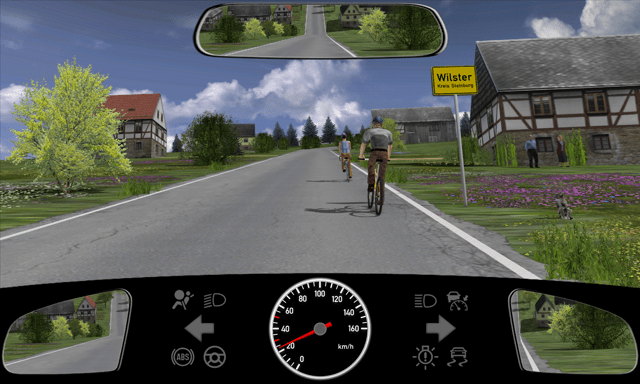
Explicación
When overtaking in built-up areas, you must maintain a distance of at least 1.5 metres to the side of the cyclist. Due to the commuting of cyclists, a larger minimum distance is recommended.
-
Pregunta 19 de 19
¿Qué es correcto hacer en esta situación?
1.2.05-1265 puntosExplicación
The driving lane line is solid. Therefore, overtaking is forbidden here.