
1.1.07 Situaciones de tráfico especiales
Tráfico Especial Situaciones
El tráfico no siempre es fácil. Debes dominar túneles, pasos a nivel, vehículos de emergencia y usuarios vulnerables de la carretera. La regla básica: Conducción defensiva y anticipación.
Entornos desafiantes
En estas zonas se aplican normas específicas para garantizar la seguridad.
Túneles
Los ojos se adaptan lentamente a la oscuridad.
- ● Luces de cruce encendidas
- ● quitarse las gafas de sol
- ● NUNCA gire en U ni retroceda
Pasos a nivel
Los trenes tienen prioridad absoluta.
- ● Espera en la Cruz de San Andrés
- ● Sin zona de adelantamiento
- ● No te detengas en las pistas
Áreas forestales (fauna silvestre)
Alto riesgo de cruce de animales ("Wildwechsel").
- ● Luces de inmersión si aparece un animal.
- ● Frene firmemente, mantenga la dirección recta
- ● NO te desvíes peligrosamente
Sitios de construcción
Rutas de carriles complejas y peligros.
- ● Las líneas amarillas anulan las blancas
- ● Se aplican límites de velocidad estrictos
- ● Evite la conducción tambaleante
Adelantar a ciclistas
Los ciclistas a menudo se balancean o desvían para evitar los baches. Dales espacio.
Evaluar y comprobar
¿Está despejado el tráfico que viene en sentido contrario? Revise los espejos y los hombros (punto ciego).
Distancia lateral
Mantener al menos 1,5 m distancia hacia los lados. Si no puedes, NO adelantes.
Volver a fusionar de forma segura
No intervenga demasiado pronto. Asegúrese de ver al ciclista completamente en su espejo retrovisor.
Emergencias y accidentes: correcto
Formando un corredor de emergencia
En autopistas/autopistas: el carril izquierdo se mueve hacia la IZQUIERDA, todos los demás carriles se mueven hacia la DERECHA.
Llegar a un accidente
1. Luces de emergencia ENCENDIDAS. 2. Chaleco de seguridad ENCENDIDO. 3. Escena segura (Triángulo). 4. Primeros auxilios.
Emergencia: errores peligrosos
"Gaffing" (rudo)
Reducir la velocidad para ver un accidente o tomar fotografías es ilegal e inmoral.
Siguiendo una ambulancia
Nunca utilice el corredor de emergencia para evitar el tráfico. Esto bloquea los vehículos de rescate.
Usuarios vulnerables de la vía
El "principio de confianza" (Vertrauensgrundsatz) dice que se puede asumir que los demás siguen las reglas. Excepción: Niños, ancianos y discapacitados. Debes anticiparte a sus errores.
- check Anciano: Es posible que no le oiga/vea ni calcule la velocidad correctamente.
- check Niños: Impulsivo. Si una pelota rueda por la calle, un niño la sigue.
- check Sillas de ruedas: Mantenga una distancia lateral segura. Ser paciente.
El contacto visual es clave
Si un peatón o un ciclista no lo está mirando, asuma que no lo ha visto. Frene y prepárese para detenerse.
Trampas típicas de los exámenes
Trampa #1: SÓLO luz azul versus luz azul + sirena expand_more
Sólo luz azul: Aviso de accidente o convoy. Conduce con cuidado, haz espacio.
Luz azul + sirena: ¡Derecho de paso inmediato! Despeja el camino al instante. Deténgase si es necesario.
Trampa #2: Derecho de paso versus prevención de accidentes expand_more
Incluso si tiene el derecho de paso (por ejemplo, luz verde o camino prioritario), si otro conductor fuerza su paso, usted DEBE FRENAR. Insistir en su derecho crea un accidente y usted será parcialmente culpable.
Trampa #3: Adelantar a un autobús que se acerca a una parada. expand_more
Si un autobús se dirige hacia una parada con las luces de emergencia parpadeando, usted está PROHIBIDO de adelantarlo. Debes esperar detrás de él hasta que se detenga. Sólo entonces podrás pasar a velocidad de caminata.
Preguntas de práctica (68)
-
Pregunta 1 de 68
¿Qué debe tener Ud. en cuenta si un camión quiere girar a la derecha para entrar en una calle estrecha?
1.1.07-0013 puntosExplicación
Keep a large distance from the lorry and under no circumstances overtake on the right-hand side, even if you would have the opportunity to do so as a two-wheeler driver. The road train must first reduce its speed considerably to turn. For reasons of space, the truck driver may then have to steer the towing vehicle far to the left so that the trailer or semi-trailer does not roll over the kerb when turning.
-
Pregunta 2 de 68
¿A qué debe Ud. prestar especial atención en intersecciones y embocaduras dentro de poblaciones?
1.1.07-0023 puntosExplicación
By driving on a wide and well-developed road, you don't automatically have the right of way. The rule "right before left" does not apply always and everywhere. Instead, signs or traffic lights regulate who has priority. Therefore, pay attention to the signposted right-of-way regulation or the traffic lights at each individual intersection and junction.
-
Pregunta 3 de 68
¿Por qué tiene que prestar atención especial aquí?
1.1.07-0063 puntos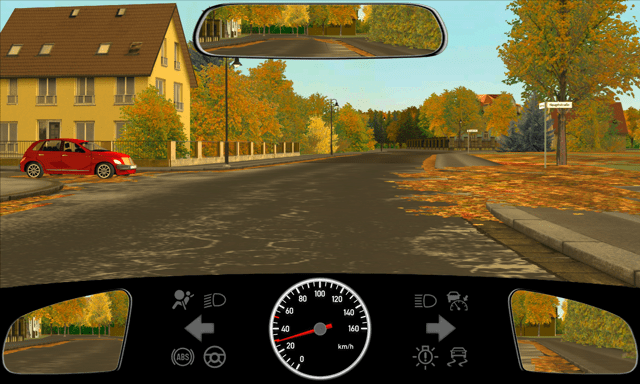
Explicación
The wet leaves on the road result in a longer braking distance and a high risk of slipping. Therefore, reduce your speed and drive carefully before reaching the intersection. A vehicle could be coming from the right and you should give it the right of way. Since there are no signs at the intersection that give you the right of way, the rule here is "right before left".
-
Pregunta 4 de 68
Ud. se acerca a una escuela. Los niños abandonan el recinto escolar. ¿Qué debe tener Ud. en cuenta?
1.1.07-0095 puntosExplicación
In the vicinity of schools, you must always be prepared for children crossing the road abruptly. Children are not yet able to assess themselves and other road users very well and often react impulsively and in a way that is not appropriate for traffic. As a car driver, you must adapt your driving style accordingly in order to exclude any danger to children. In addition to driving at a low speed, you must be particularly attentive and ready to brake at all times.
-
Pregunta 5 de 68
¿Qué puede advertir la luz de emergencia?
1.1.07-0104 puntosExplicación
The use of the hazard warning lights is subject to strict rules. You may only switch on the hazard warning lights to secure your broken-down vehicle or to indicate a traffic jam or a school bus. A school bus with its hazard warning lights on may only be overtaken at walking speed.
-
Pregunta 6 de 68
Delante de Ud. hay una segadora-trilladora que quiere girar a la derecha. ¿Qué es correcto?
1.1.07-0114 puntosExplicación
The combine harvester needs to gain amplitude to turn because the turn is very narrow. To do this, it will greatly reduce his speed. Keep your distance and also drive slowly and be prepared to brake. Especially for cyclists: Never overtake on the right!
-
Pregunta 7 de 68
Ud. está detrás de un tractor agrícola con un remolque muy cargado. ¿Qué debe tener Ud. en cuenta?
1.1.07-0134 puntosExplicación
If you are riding behind an agricultural vehicle with a heavily loaded trailer, you must expect the following: Part of the load could fall onto the roadway when turning or braking. The indicator could be dirty or covered by the load. The braking distance of the vehicle is increased by the weight of the load.
-
Pregunta 8 de 68
¿Con qué tiene que contar?
1.1.07-0143 puntos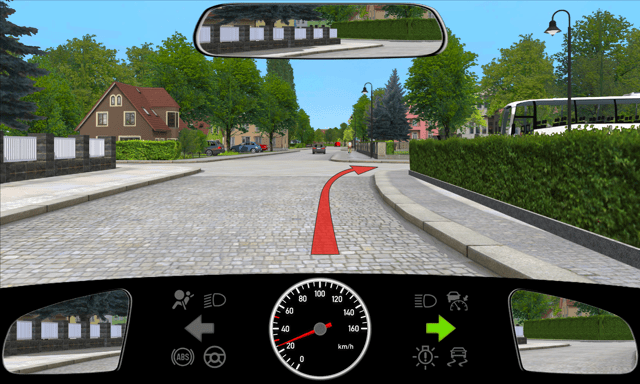
Explicación
You must expect to have to stop before the intersection when turning. For one thing, the view of the bus coming from the right is obstructed. In addition, other vehicles could pass it. In addition, pedestrians may also want to cross the road. You must always show special consideration for them.
-
Pregunta 9 de 68
¿Qué haría en esta situación?
1.1.07-0154 puntos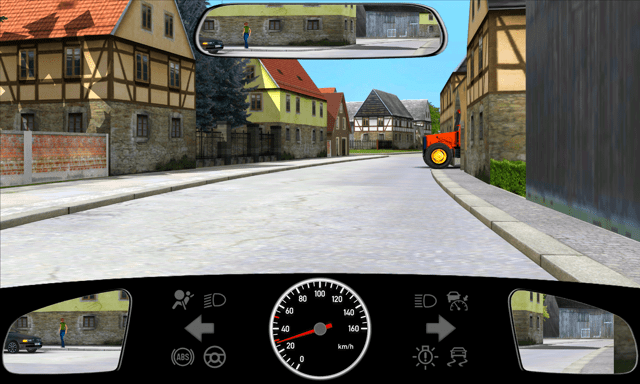
Explicación
The driver of the vehicle coming out of the exit cannot see the cross traffic. He would have to be directed into the traffic. He could drive further ahead and prevent you from continuing your journey. You should reduce your speed, be ready to brake, even stop if necessary.
-
Pregunta 10 de 68
¿Qué espera que ocurra en esta situación?
1.1.07-0175 puntosExplicación
Because the oncoming vehicle is being slowed down by a bicycle, you should expect the vehicle to overtake the bicycle. If this happens, the vehicle could cross into your lane. In the event that the driver does not brake, you should keep as far to the right on the road as possible. Also, be prepared to brake so that you can react to any situation as quickly as possible.
-
Pregunta 11 de 68
Quiere girar a la derecha en la intersección. ¿Qué es lo correcto?
1.1.07-0194 puntos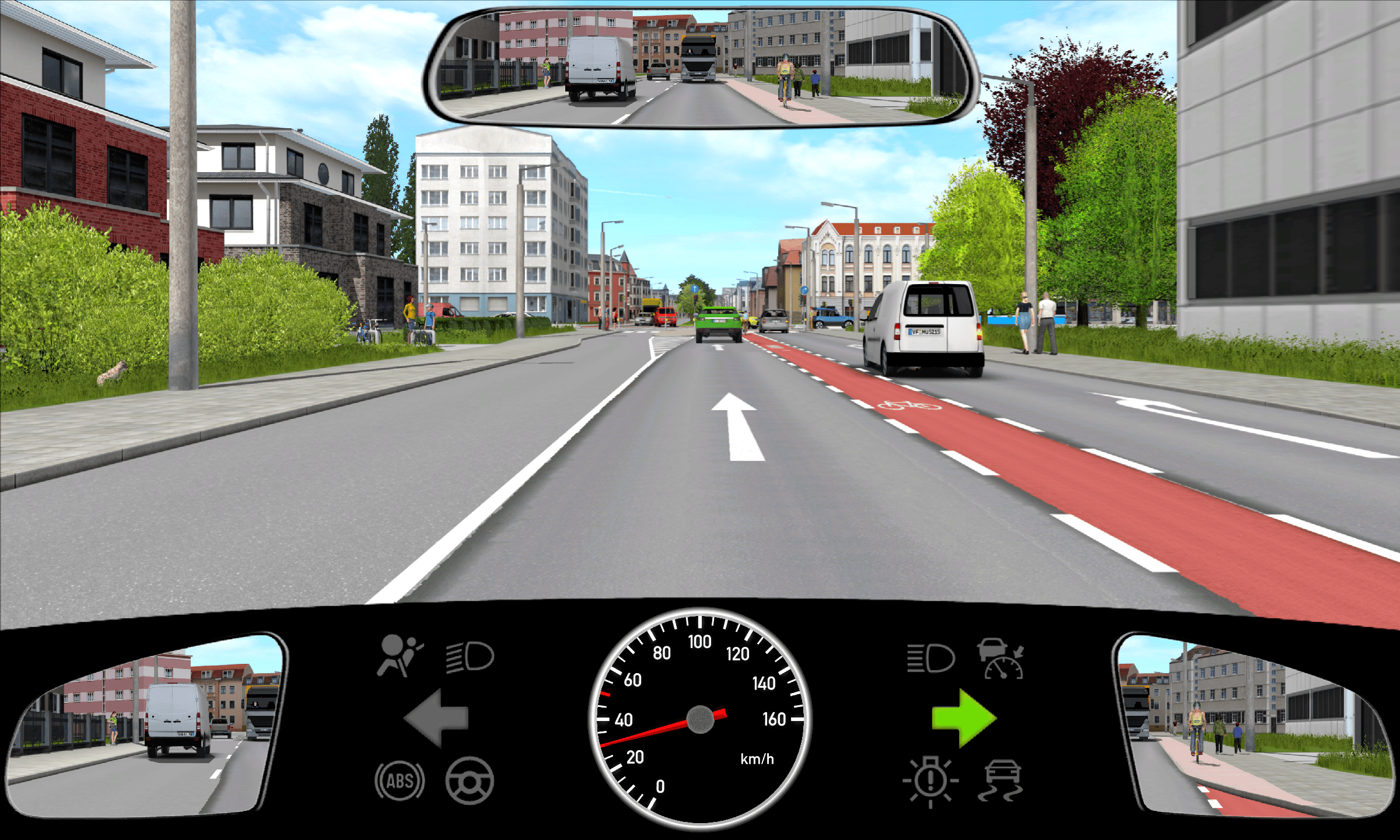
Explicación
There is a protective lane for cyclists between your lane and the turning lane. It is part of the carriageway and is separated by a broken line. You may only use the protective lane to change lanes, swerve or turn. If you use it, you are not allowed to obstruct cyclists or come to a standstill in the protective lane. You should therefore change lanes as early as possible.
-
Pregunta 12 de 68
¿En qué caso podría producirse aquí una situación peligrosa?
1.1.07-0204 puntos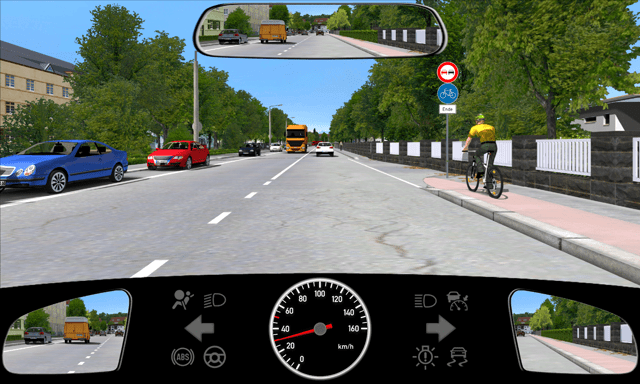
Explicación
You can see that the cycle path ends immediately in front of you. The cyclist would have to stop and wait until she can safely merge into the flowing traffic. However, rather than stopping, expect her to swing into the lane in front of you.
-
Pregunta 13 de 68
¿Qué debe tener en cuenta con las bicicletas eléctricas (e-bikes) en la carretera?
1.1.07-0233 puntosExplicación
E-bikes are just as quiet as classic bikes and are therefore often perceived late. However, they often achieve significantly higher speeds than bicycles without an engine. This is underestimated by many road users, so dangerous situations can occur surprisingly. In general, expect cyclists to gain speed and perform speedy maneuvers.
-
Pregunta 14 de 68
¿Qué es correcto hacer en este momento?
1.1.07-0254 puntos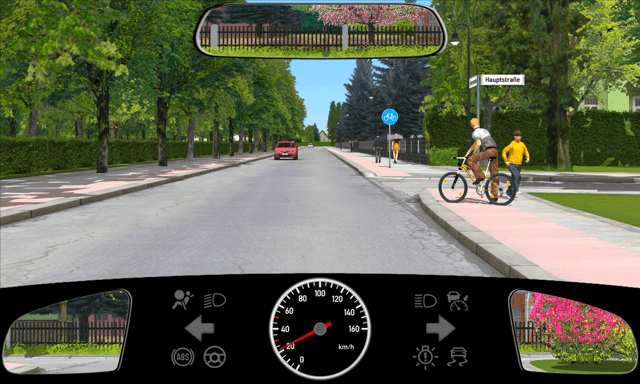
Explicación
You should be ready to brake and watch the cyclist carefully, because the cyclist can suddenly ride onto the road.
-
Pregunta 15 de 68
Ud. quiere adelantar a un tractor con un apero que sobresale por atrás. ¿A qué hay que prestar atención?
1.1.07-1014 puntosExplicación
You should always refrain from an overtaking maneuver when the tractor wants to turn. The reason for this is that the tractor has a large turning circle and is likely to veer, blocking the road. Also keep in mind that the turn signals of such a vehicle are not always visible and that they could be covered by dirt due to the agricultural use.
-
Pregunta 16 de 68
¿Con qué tiene que contar después del cambio de rasante?
1.1.07-1033 puntos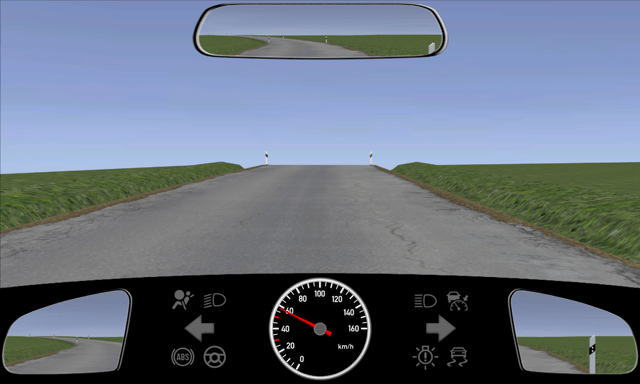
Explicación
Due to the height of the crest, it is not possible to see what is behind it. Expect to encounter obstacles there, such as broken-down or slow-moving motor vehicles. Also be prepared for oncoming trucks sharing your lane. To be able to react to such dangers in time, you should reduce your speed accordingly.
-
Pregunta 17 de 68
¿Qué debe tener Ud. en cuenta?
1.1.07-1073 puntos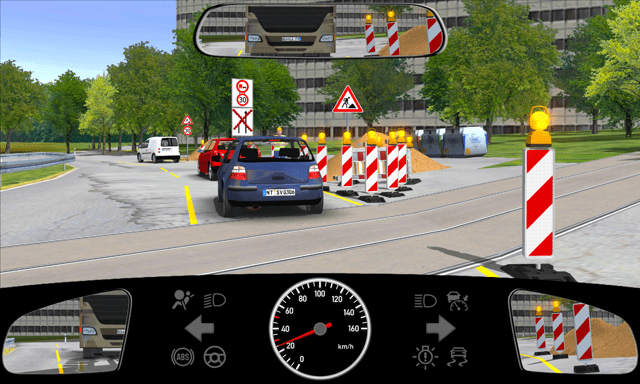
Explicación
In the area of a construction site you have to drive carefully and reduce the speed. For one, the road can be dirty. But it there can also be workers, construction equipment or construction vehicles on the road and obstruct the traffic.
-
Pregunta 18 de 68
Ud. circula por una calle de reciente construcción que pasa por un bosque. ¿Qué debe tener Ud. en cuenta?
1.1.07-1133 puntosExplicación
When roads are newly constructed in forested areas, they often pass through the natural habitat of various wild animals. Therefore, it is possible that their habitual paths cross your roadway. For this reason, you must expect wildlife crossings and obstacles due to frequent wildlife accidents on forest roads.
-
Pregunta 19 de 68
¿Durante qué hora del día hay que contar con el paso frecuente de animales en libertad?
1.1.07-1173 puntosExplicación
Expect more deer crossings during the morning and evening twilight. This transitional period between day and night is characterized by diffuse light conditions.
-
Pregunta 20 de 68
¿Cuáles son los peligros con que debe contar en zonas rurales?
1.1.07-1184 puntosExplicación
Where farming is practised, tractors and other agricultural vehicles travel at slow speeds and/or over width. Often the roadway is also dirty with soil or manure.
-
Pregunta 21 de 68
En la penumbra se acerca en sentido opuesto un tractor con las luces encendidas. ¿Qué debe tener Ud. en cuenta?
1.1.07-1194 puntosExplicación
In agricultural vehicles, the lights are sometimes broken. They can also be covered up by dirt or tarpaulins. The width of the vehicles is not easy to assess. In addition, these vehicles can have up to two trailers.
-
Pregunta 22 de 68
¿Qué debe Ud. tener en cuenta antes de entrar en un túnel?
1.1.07-1204 puntosExplicación
Before entering a tunnel, you must note the following: there is a light obligation in a tunnel. Therefore, turn on the dipped beam to see and be seen better. If you have sunglasses, take them off. You must not switch on the fog lamp in the tunnel.
-
Pregunta 23 de 68
¿Cómo debe comportarse Ud. en caso de retención en un túnel?
1.1.07-1214 puntosExplicación
If there is a traffic jam in a tunnel, stop and turn off the engine. By keeping a safe distance of about five metres, you reduce the risk of poisoning, preserve a manoeuvring option and allow rescue vehicles to pass. Switch on the hazard warning lights to warn following drivers. Only leave your vehicle after an appropriate loudspeaker announcement.
-
Pregunta 24 de 68
¿Qué puede distraer nuestra atención al atravesar un túnel?
1.1.07-1224 puntosExplicación
When passing through a tunnel, the following factors may interfere with your attention: the lack of visual stimulus and the monotony of speed, as well as the lights of oncoming traffic. In this case, an orientation on the right side of the road is helpful; avoid looking directly into the light of oncoming traffic.
-
Pregunta 25 de 68
¿Qué normas de comportamiento básicas debo cumplir dentro del túnel?
1.1.07-1254 puntosExplicación
The following rules of conduct are mandatory in all tunnels: on the entire route no U-turns are allowed. Regardless of the lighting situation, the dim light must always be switched on. The instructions of the tunnel staff must always be followed. Personal protection antecedes the protection of vehicles and their security.
-
Pregunta 26 de 68
¿Qué haría en esta situación?
1.1.07-1365 puntosExplicación
The white reversing lights of the vehicle that turned in front of you indicate that it would probably turn back to its original lane in reverse. Since you cannot tell if you have been noticed by the driver, you should reduce your driving speed and be ready to brake. Refrain from an evasive maneuver due to oncoming traffic.
-
Pregunta 27 de 68
Quiere girar a la derecha. ¿Qué debería hacer?
1.1.07-1374 puntos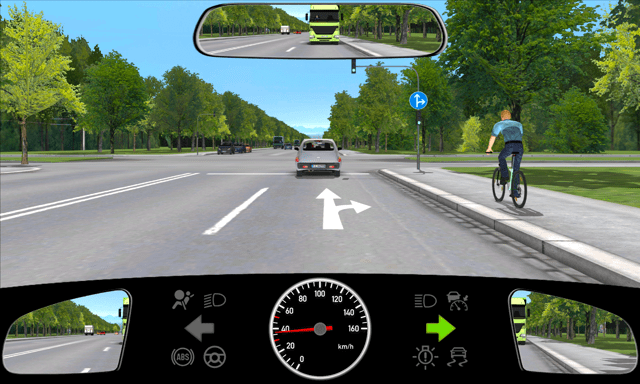
Explicación
Before you can turn, you have to check in the rear-view mirror if the road is clear. It is also advisable to look over your shoulder: this is the only way to be aware of dangerous situations located in the blind spot of the mirror. Keep in mind that other road users - cyclists or pedestrians - whose way you cross, always have priority.
-
Pregunta 28 de 68
¿Con qué tiene que contar?
1.1.07-1384 puntos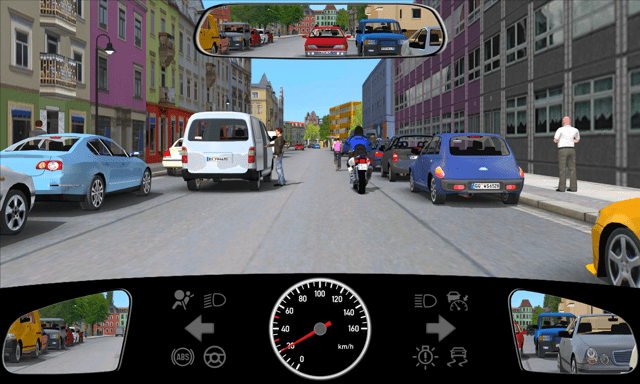
Explicación
The other road users can react to this situation with all the different scenarios described. All are equally dangerous. Therefore, extreme caution and slow driving is required.
-
Pregunta 29 de 68
Delante de la motocicleta hay un turismo que quiere acceder a la calzada marcha atrás. ¿Con qué tiene que contar?
1.1.07-1393 puntos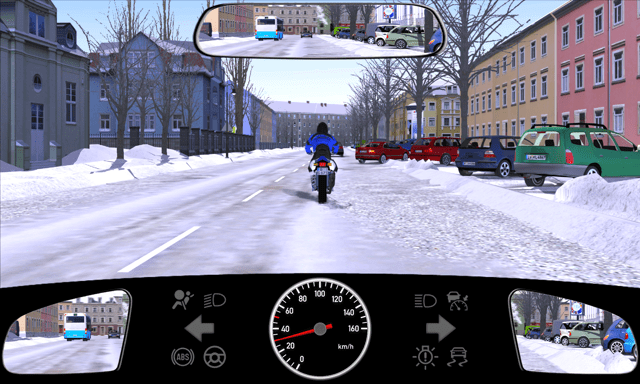
Explicación
Car drivers often underestimate the speed of approaching motorcyclists; the same happens to the driver here while he's pulling out of a parking space. The action alternatives of the motorcyclist - braking or dodging - are both dangerous for him on a snow-slicked road surface. He could fall. Also consider the longer braking distance in this weather.
-
Pregunta 30 de 68
¿Por qué corre un peligro especial al circular en un vehículo de dos ruedas?
1.1.07-1414 puntosExplicación
Especially in restrictive visibility conditions such as fog and darkness, the small silhouette of the two-wheeled driver leads to the fact that he is recognized late or not at all. In addition, the small design makes it difficult to estimate its speed. In the event of a collision, two-wheelers generally offer less protection than most other motor vehicles.
-
Pregunta 31 de 68
En una calle con mucho tráfico y varios carriles, se ha posicionado para girar a la izquierda. No obstante, ahora, quiere girar a la derecha. ¿Qué hace?
1.1.07-1423 puntosExplicación
A lane change or turning right could endanger other road users due to the heavy traffic. You must therefore turn left and take a small detour. Watch out for lane markings that prohibit you from changing lanes.
-
Pregunta 32 de 68
En la ruta por la que circulo hay un túnel. ¿Qué debería saber?
1.1.07-1434 puntosExplicación
If there is a tunnel on your route, you should know the appropriate traffic signs and behavioral measures in the event of a breakdown or an accident: in this case, alert the tunnel monitoring center and follow the next escape route. First, turn off the engine of your vehicle and leave the ignition key in the lock for rescue operations.
-
Pregunta 33 de 68
Iba circulando por un túnel y ha tenido que estacionar su vehículo debido a un fuego dentro del túnel. ¿Qué va a hacer?
1.1.07-1454 puntosExplicación
If you have to park your vehicle in a tunnel due to a fire, you should: stop the engine, leave the key in the ignition switch and quickly trigger the fire alarm at the emergency call station. Leave the tunnel as fast as possible on the next escape route.
-
Pregunta 34 de 68
¿Con qué tiene que contar?
1.1.07-1465 puntosExplicación
You see that the truck wants to turn in front of you. The vehicle obscures the view of the traffic, so you need to adjust your speed. The truck probably swings out to take the curve. He might stop abruptly to let pedestrians or other road users pass.
-
Pregunta 35 de 68
¿A qué tiene que prestar atención ahora?
1.1.07-1474 puntosExplicación
You want to turn right, so does the car driver in front of you. The pedestrian traffic light of the cross street into which you want to turn shows green, and the pedestrian has priority. It is possible that your car in front will pull up and stop soon after to let the pedestrian pass. On the right you can also see a cyclist. The cyclist could drive past your vehicle on the right and circle your turning vehicle on the left. Avoid this danger.
-
Pregunta 36 de 68
En esta situación, ¿por qué tiene que esperar?
1.1.07-1485 puntosExplicación
The cyclist must be given priority because she is on the right-of-way. Wait until the cyclist has passed the vehicles and driven through.
-
Pregunta 37 de 68
En esta situación, ¿por qué tiene que esperar?
1.1.07-1495 puntosExplicación
The traffic on the main road is jammed. The red car drives around the parked vehicles to turn left. You have to wait and let this car pass as it has priority.
-
Pregunta 38 de 68
¿A qué tiene que prestar atención cuando el semáforo se ponga en verde?
1.1.07-1525 puntosExplicación
While you wait at the red light, a motorcyclist pushes past the waiting vehicles. When the traffic light switches to green you should pay attention to the motorcyclist and let him pass before he initiates a risky overtaking maneuver. But you should also let the pedestrian cross the road, which is still on the road despite it being green.
-
Pregunta 39 de 68
¿Con qué ha de contar en esta situación?
1.1.07-1533 puntos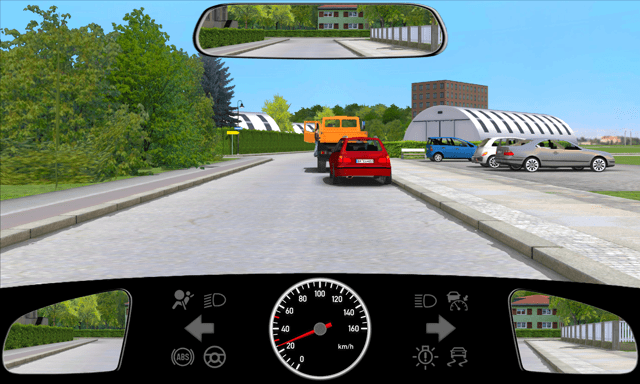
Explicación
The truck blocks your view. You can therefore recognize neither the oncoming traffic nor traffic signs behind the truck. Approach the vehicle at low speed. Look for oncoming traffic (they have priority) and keep your distance to the open driver's door when driving around. The driver of the truck could suddenly get out and jump onto the road.
-
Pregunta 40 de 68
¿Cuál es la conducta correcta al atravesar un túnel?
1.1.07-1544 puntosExplicación
When driving through a tunnel, proceed as follows: Make sure to pay attention to the safety distance and orient yourself on the right-hand side of the road in order to avoid glare from oncoming traffic. Get an overview of safety devices so you know where the nearest emergency exit and emergency telephone are located.
-
Pregunta 41 de 68
¿A qué debe prestarle atención ahora?
1.1.07-1554 puntosExplicación
You intend to turn left. Two cyclists move in the same direction. You must pay particular attention to these, as they could also turn into the street without notice.
-
Pregunta 42 de 68
¿Qué debería hacer en este momento?
1.1.07-1563 puntosExplicación
Since the dog (from the right) seems to be walking into the street, please perform emergency braking and keep the steering wheel straight and steady.
-
Pregunta 43 de 68
¿Qué ha de esperar que ocurra en esta situación?
1.1.07-1574 puntosExplicación
Please be prepared for people behind the bus to enter the lane and for the bus to swerve and briefly enter your lane.
-
Pregunta 44 de 68
¿Con qué tiene que contar cuando haya ciclistas?
1.1.07-1584 puntosExplicación
All 3 answers are correct. Cyclists use one-way streets in both directions, they may not have lights in the dark or they may ride on the wrong side of cycle paths.
-
Pregunta 45 de 68
¿Qué ha de esperar que ocurra en esta situación?
1.1.07-1594 puntos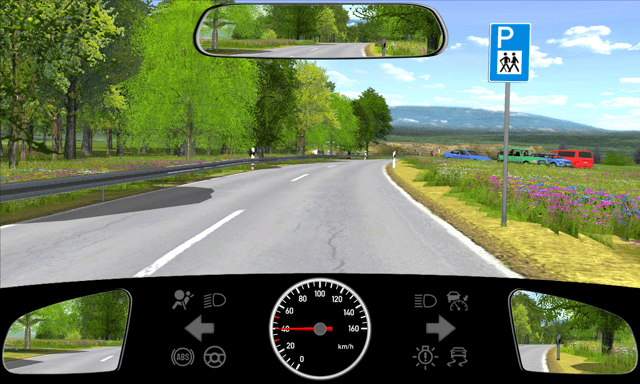
Explicación
The traffic sign indicates a rambler parking area, which means that people can walk across the roadway and vehicles can drive off or onto the parking area at any time.
-
Pregunta 46 de 68
¿Por qué tiene que detenerse en este momento?
1.1.07-1605 puntosExplicación
As you do not have a full view of the traffic situation and must give the cyclist the right of way, you must stop and carefully feel your way in.
-
Pregunta 47 de 68
Quiere seguir todo recto. ¿Qué es correcto hacer en esta situación?
1.1.07-1615 puntosExplicación
You are coming from a priority road first. As there are no other traffic signs, right is before left. The red car is driving on your right and therefore has the right of way. The electric scooter does not have right of way, so to avoid an accident you should let it cross anyway.
-
Pregunta 48 de 68
Quiere desaparcar. ¿Qué apreciación es correcta con respecto a la situación?
1.1.07-1623 puntos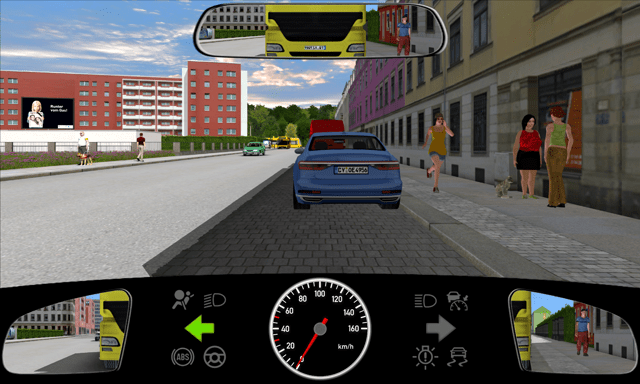
Explicación
As the vehicle parked behind you is very large, you will only see vehicles coming from behind at a late stage and you yourself will only be recognised by other drivers at a late stage.
-
Pregunta 49 de 68
Se ha producido un accidente y esta es la situación. ¿Por qué es peligroso que pase por aquí con su vehículo?
1.1.07-1633 puntos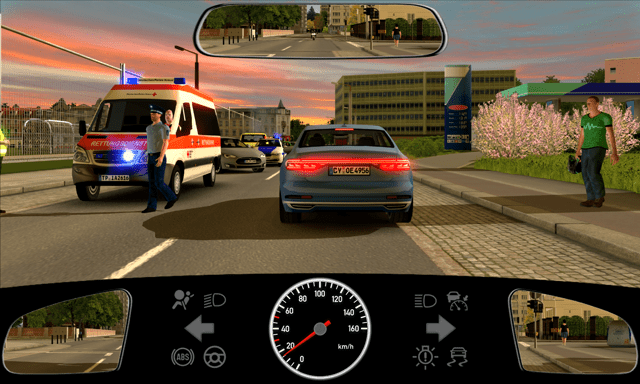
Explicación
The traffic situation is unclear, sudden braking manoeuvres by gawpers and pedestrians crossing the road must be expected.
-
Pregunta 50 de 68
En esta situación, ¿a qué tiene que prestar atención al girar a la derecha?
1.1.07-1645 puntosExplicación
The cyclist has the right of way. When turning right, you must always pay attention to whether pedestrians or cyclists are approaching. They are allowed to cross the street in front of you. Use the rearview mirror and also look over your shoulder to be able to see the blind spot.
-
Pregunta 51 de 68
¿Qué es correcto hacer en este momento?
1.1.07-1655 puntosExplicación
The scooter does not seem to see you coming and takes the right of way. To avoid an accident, you must immediately perform emergency braking.
-
Pregunta 52 de 68
¿Con qué tiene que contar en esta situación?
1.1.07-1664 puntos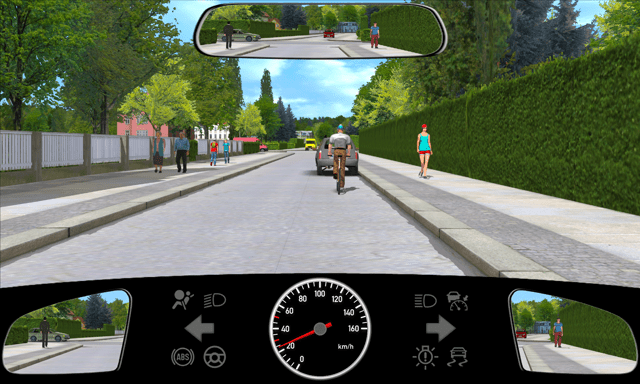
Explicación
Since the obstacle is on your side, you must wait in this case. In addition, the cyclist will overtake the parked car and therefore swerve to the left.
-
Pregunta 53 de 68
Va circulando por un túnel. ¿Qué tiene de particular la situación?
1.1.07-1674 puntosExplicación
In a tunnel, the emergency exits and SOS emergency telephones are clearly signposted and illuminated. In an emergency, you should use the facilities. You can easily be distracted by the different lighting, the lights of other road users and the much louder noises in the tunnel.
-
Pregunta 54 de 68
¿Qué es correcto hacer en este momento?
1.1.07-1684 puntosExplicación
The vehicle that is still parked wants to enter the road and has obviously overlooked you. You should slow down to avoid an accident.
-
Pregunta 55 de 68
¿Con qué tiene que contar en este momento?
1.1.07-1694 puntosExplicación
The [yellow] vehicle will stop, so you must be ready for the driver to open the door. The cyclist will probably move to the left to overtake the yellow vehicle. You must also expect the truck to drive off.
-
Pregunta 56 de 68
Va circulando por un tramo de vía para el cual han avisado de un atasco. ¿Qué es correcto hacer?
1.1.07-1704 puntosExplicación
You should be extra attentive on curves and before hilltops, because the traffic situation is difficult to see. You should also continue to follow the traffic reports.
-
Pregunta 57 de 68
¿Por qué tiene que detenerse en este momento?
1.1.07-1714 puntosExplicación
The "Give way" sign in combination with the additional bicycle sign shows you that you must pay attention to possible cyclists and give them the right of way. Therefore, you must now stop and let the cyclist pass.
-
Pregunta 58 de 68
¿Qué es correcto hacer en esta situación?
1.1.07-1724 puntosExplicación
If a cyclist suddenly comes from the left, you must do an emergency stop.
-
Pregunta 59 de 68
Mientras va conduciendo, por delante de su vehículo atraviesa la calzada un corzo. ¿Qué debería tener en cuenta?
1.1.07-1733 puntosExplicación
A deer is very unpredictable, maybe it runs back into the forest, maybe it will stop in the middle of the street. You should therefore reduce your speed and follow what is happening, as other animals can also step on the road.
-
Pregunta 60 de 68
¿Qué es correcto hacer?
1.1.07-1743 puntosExplicación
As the lorry in front of you is parking in reverse, you must continue to slow down. You can only change lanes when the lane to your left is free. Stay in your lane for the time being and continue braking.
-
Pregunta 61 de 68
¿Qué espera que ocurra en esta situación?
1.1.07-1754 puntosExplicación
You are driving on a turning priority road. Anyone leaving a priority road must give way to vehicles following the priority road. The yellow car flashes and turns left. Although it does not have right of way, at its high speed it will not be able to stop without coming into your lane. You should therefore brake and give up your right of way to avoid a collision. The obligation to avoid accidents takes precedence over all right of way rules.
-
Pregunta 62 de 68
¿Cómo debe comportarse en este caso?
1.1.07-1764 puntosExplicación
In the left side mirror you can see that a car behind you is about to overtake. At the same time, the person on the bike on the right in front of you could move onto the road. A truck is also coming towards you on the opposite lane. All three factors lead to a narrow roadway and thus increase the risk of accidents. In this situation you have to brake to avoid a collision with the overtaking car and the cyclist.
-
Pregunta 63 de 68
¿Por qué tiene que frenar en este momento?
1.1.07-2024 puntosExplicación
Because the cyclist wants to be in your lane, brake because of the cyclist.
-
Pregunta 64 de 68
¿A qué tiene que prestar atención en este momento?
1.1.07-2034 puntos -
Pregunta 65 de 68
¿Con qué debería contar en esta situación?
1.1.07-2044 puntosExplicación
As you are driving behind a large vehicle, it can quickly happen that you are overlooked by oncoming traffic. The danger sign warns of rolling gravel on the road.
-
Pregunta 66 de 68
Va circulando fuera de poblado. ¿Qué es correcto hacer en esta situación?
1.1.07-2055 puntosExplicación
This is not a protected cycle path. You may therefore continue to use the cycle path. When entering another road, you must make sure that the road is clear. There is a "Give way" sign here. This means that the cyclists on the other side of the road have the right of way and you must wait. You should check for yourself that the road is clear. You must still make sure that the road is clear for crossing.
-
Pregunta 67 de 68
En este momento, ¿por qué se recomienda permanecer atento para poder frenar?
1.1.07-2064 puntosExplicación
The brown vehicle has just stopped, there is a high risk that a person will get out hastily and carelessly in the next moment. Therefore, you must be ready to brake.
-
Pregunta 68 de 68
¿Qué es correcto hacer en esta situación?
1.1.07-2074 puntosExplicación
The cyclist is obviously crossing the road without paying attention to the traffic situation and without braking. Use emergency braking to avoid a collision.