
2.1.07 Situazioni di traffico speciali
Situazioni di traffico speciali, Capitolo 2.1.07 - Scopri cosa fare in situazioni di traffico pericolose, poco chiare o insolite.
⭐ Regola principale dell'esame
Quando la situazione non è chiara, è pericolosa o un altro utente della strada potrebbe commettere un errore: ridurre la velocità, aumentare la distanza, guidare con prudenza ed essere pronti a frenare.
🚜 Veicoli/Trattori lenti
Quando vedi:
Un trattore, un camion o un motorino vuole tornare dalla corsia di emergenza o svoltare a sinistra.
Dovresti:
Ridurre la velocità e consentirgli di fondersi in sicurezza.
🚗 Fine corsia/Regola cerniera
Quando vedi:
Una corsia termina o un altro conducente non può proseguire nella propria corsia.
Dovresti:
Rallenta e lascia che il veicolo si unisca usando la procedura della cerniera.
⚠ Veicoli in panne
Quando vedi:
Un'auto ferma, una persona sulla strada o una corsia bloccata.
Dovresti:
Ridurre la velocità, guidare tutto a destra, aspettarsi che persone o veicoli si muovano improvvisamente.
🦌Animali
Quando vedi:
Animali vicini o sulla strada.
Dovresti:
Rallenta, osserva attentamente, sii pronto a frenare. Non sterzare pericolosamente.
🚴 Ciclisti
Quando vedi:
Un ciclista bloccato da un ostacolo o in salita.
Dovresti:
Aspettatevi di sterzare, mantenete una distanza maggiore e sorpassate solo quando siete sicuri.
🏍 Motociclette
Quando vedi:
Un motociclista che sorpassa, taglia curve o sporge nella tua corsia.
Dovresti:
Guida tutto a destra, riduci la velocità e crea più spazio.
🧠 Schema d'esame: Quando vedi X → Fai Y
| Situazione | Reazione corretta | Perché? |
|---|---|---|
| Autista contromano in autostrada | Muoviti a destra, frena, luci di emergenza | Avvertire gli altri ed evitare la collisione |
| Tailgater dietro di te | Mantenere la velocità legale | Non accelerare o frenare improvvisamente |
| Il taxi si è fermato più avanti | Fermati dietro se la corsia di sinistra è bloccata | Non guidare sul marciapiede |
| Visibilità limitata vicino ad alberi/curve | Rallenta e guida tutto a destra | I pericoli nascosti possono apparire tardi |
| Pneumatico scoppiato o forte vento laterale | Rilasciare il gas, controsterzare, frenare dolcemente | Mantenere il veicolo stabile |
| Inevitabile la collisione con gli animali | Frena forte, tieni il volante e resta nella corsia | Sterzare può essere più pericoloso |
📏 Distanza di sicurezza
Fuori dai centri abitati conservare almeno:
Metà della tua velocità in metri
Esempio: 100 km/h → 50 m di distanza
🛑 Spazio di frenata
Se la velocità raddoppia, lo spazio di frenata diventa molto più lungo.
Doppia velocità → 4× spazio di frenata
40 km/h = 16 m, 80 km/h = 64 m
🎴 Flashcard veloci
Domanda
Cosa fare se un trattore vuole fondersi?
Risposta
Ridurre la velocità e lasciarlo unire.
Domanda
Cosa fare se gli animali sono sulla strada?
Risposta
Rallenta e sii pronto a frenare.
Domanda
Puoi guidare sul marciapiede per superare un taxi?
Risposta
No. Fermati e aspetta se non puoi sorpassare in sicurezza.
Domanda
Cosa succede se un motociclista rischia di sorpassare pericolosamente?
Risposta
Guidare tutto a destra e ridurre la velocità.
Domanda
Cosa fai dopo aver colpito la selvaggina?
Risposta
Fermarsi, mettere in sicurezza la scena e informare la polizia o l'ufficio forestale.
Domanda
Cosa succede se può entrare un veicolo proveniente da una strada forestale?
Risposta
Sii pronto a frenare, anche se hai la priorità.
✅ Checklist di revisione finale
Domande di Pratica (30)
-
Domanda 1 di 30
Perché devi frenare proprio adesso?
2.1.07-0094 PuntiSpiegazione
You should brake because of the green vehicle, as it appears to be driving onto the road behind the tractor.
-
Domanda 2 di 30
Cosa ci si deve aspettare in quest'area di parcheggio?
2.1.07-0103 Punti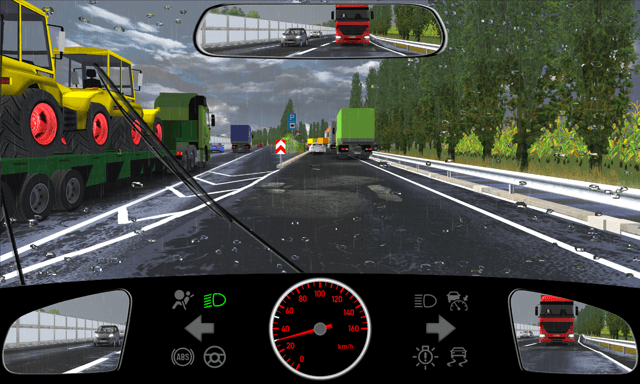
Spiegazione
Vehicles can leave the parking space, watch out for vehicles leaving the parking space. People can walk on the roadway because you are taking a break. Truck drivers often park in car parking spaces.
-
Domanda 3 di 30
Qual è la giusta linea d'azione ora?
2.1.07-0114 PuntiSpiegazione
The car will probably overtake the cyclist. To be on the safe side, slow down and ride as far to the right as possible.
-
Domanda 4 di 30
Perché dovresti essere pronto a frenare in questa situazione?
2.1.07-0124 Punti -
Domanda 5 di 30
Quali precauzioni bisogna osservare quando più motociclette viaggiano insieme in gruppo?
2.1.07-0133 PuntiSpiegazione
Drive in a staggered manner to avoid rear-end collisions caused by sudden braking. Group rides are not easy; if one driver makes a mistake, all the others have to react.
-
Domanda 6 di 30
Cosa dovresti aspettarti in questa situazione?
2.1.07-0144 PuntiSpiegazione
Because of the turning truck, the van could miss you. Be ready to brake.
-
Domanda 7 di 30
Perché dovresti ridurre ulteriormente la velocità qui?
2.1.07-0155 PuntiSpiegazione
It's unlikely that the car in the left lane will continue as it appears to have broken down. Even if it did, it wouldn't affect you. However, since there is a person in the lane, extra caution is required here. It's also possible that other people get out of the vehicle and run onto the road. The stationary car may be hidden by the bush or no warning triangle was set up. The following car could therefore recognize too late that the vehicle has stopped in front of it. You should therefore drive with foresight and expect the car behind to swerve into your lane.
-
Domanda 8 di 30
Qual è la giusta linea d'azione ora?
2.1.07-0164 PuntiSpiegazione
The stalled vehicle is blocking the other vehicle's lane and restricting your view. You should reduce your speed and drive as far to the right as possible in your driving.
-
Domanda 9 di 30
Qual è la giusta linea d'azione ora?
2.1.07-0195 PuntiSpiegazione
The motorcyclist is approaching you at high speed. He could overtake you even though the blue truck is already very close. Drive as far to the right as possible to increase the distance to the oncoming lane and reduce your speed so that the motorcyclist can complete the overtaking manoeuvre safely and in good time.
-
Domanda 10 di 30
Cosa dovresti fare ora?
2.1.07-0204 PuntiSpiegazione
The yellow car comes towards you as a wrong-way driver on the highway. Drive to the right as far as possible and brake. To warn other road users, turn on the hazard warning lights.
-
Domanda 11 di 30
Qual è la procedura corretta da seguire in questa situazione?
2.1.07-0223 PuntiSpiegazione
Animals on the road are unpredictable. You should continue to reduce your speed and monitor the situation carefully, and be ready to brake in case the animals run across the road. Hazard braking could lead to a rear-end collision if the vehicle behind you cannot react quickly enough.
-
Domanda 12 di 30
Perché dovresti ridurre la velocità proprio ora?
2.1.07-0234 PuntiSpiegazione
Even if you keep to the speed limit of 60 km/h, an animal will run onto the road right in front of you. To avoid an accident, you have to reduce your speed. The oncoming car does not affect your driving style.
-
Domanda 13 di 30
Di cosa bisogna tenere conto in questa situazione?
2.1.07-0243 Punti -
Domanda 14 di 30
Qual è la giusta linea d'azione ora?
2.1.07-0254 PuntiSpiegazione
As the blue car will probably be travelling on the road without observing the right of way rules, you must slow down sharply and give up your right of way.
-
Domanda 15 di 30
Qual è la giusta linea d'azione ora?
2.1.07-0263 PuntiSpiegazione
The tractor is signalling by flashing its lights that it wants to move back into the lane. You should therefore reduce your speed and allow the tractor to merge into the lane.
-
Domanda 16 di 30
Qual è la cosa giusta da fare in questa situazione?
2.1.07-0274 PuntiSpiegazione
On the narrow country road, it is possible that you and the tractor will not be able to pass each other easily. Be prepared to stop and let the tractor pass.
-
Domanda 17 di 30
Qual è la giusta linea d'azione ora?
2.1.07-0284 PuntiSpiegazione
The yellow car has an unusual driving style. It may be distracted or drunk. The abrupt braking and steering manoeuvres of the car in front are dangerous. Pay attention to how he continues to drive, increase the distance and be ready to brake.
-
Domanda 18 di 30
A cosa bisogna prestare attenzione quando si guida lungo strade strette?
2.1.07-0294 PuntiSpiegazione
Visibility in avenues is more restricted than in open fields and therefore requires an adapted driving style. On bends, your view of the carriageway may be restricted after the bend. You may therefore only see obstacles very late.
-
Domanda 19 di 30
Qual è il comportamento corretto ora?
2.1.07-0304 PuntiSpiegazione
There is no other option for you in this situation other than to pull over behind the taxi. Because you are not allowed to pass to the right of the taxi as this is a sidewalk. Driving on a sidewalk is generally prohibited. You also can't change to the left lane because there is a motorcycle next to you. If you change lane you risk a collision.
-
Domanda 20 di 30
State partecipando a un tour di gruppo con diverse motociclette. Qual è il comportamento corretto?
2.1.07-0313 Punti -
Domanda 21 di 30
Aumenti la velocità da 50 km/h a 100 km/h. Come cambia la distanza di frenata secondo la regola empirica?
2.1.07-1093 PuntiSpiegazione
According to the rule of thumb, the braking distance quadruples when the speed doubles. At 40 km/h, for example, it is 16 meters and at 80 km/h 64 meters.
-
Domanda 22 di 30
Perché devi essere pronto a frenare in questa situazione?
2.1.07-1115 PuntiSpiegazione
You see that a vehicle wants to drive onto the road from the right. Since it comes from a field or forest path, you have right of way. Due to the forest cover the visibility for the vehicle driver may be limited. It is possible that he/she will continue despite having to wait. For this reason, you must be ready to brake until you clearly recognize that he/she is stopping.
-
Domanda 23 di 30
Perché dovresti ridurre la velocità proprio ora?
2.1.07-1125 PuntiSpiegazione
Basically, you have the right of way, because you are on a priority road. However, to avoid a dangerous situation, you should still reduce your speed and be ready to brake, as the car driver of the car coming from the right-hand side might recognize you too late or miss you altogether. Due to the trees on the roadside his/her view is clearly limited.
-
Domanda 24 di 30
Qual è la giusta linea d'azione in questa situazione?
2.1.07-1135 PuntiSpiegazione
In this situation, you need to reduce the speed and allow the car driver to go back into lane on the left. If a lane ends on a multi-lane road or if it is not possible for the drivers driving on the other lane to drive through the lane continuously, they must be able to change lanes using the zipper procedure.
-
Domanda 25 di 30
Cosa dovresti aspettarti in questa situazione?
2.1.07-1145 PuntiSpiegazione
Although you are on the priority road, you must always expect dangerous situations to arise. For example, the tractor driver approaching your street at a junction could not fulfill his duty of waiting and force the vehicle in front of you to brake. By driving anticipatory you can help defuse potentially dangerous situations.
-
Domanda 26 di 30
Qual è la giusta linea d'azione in questa situazione?
2.1.07-1155 PuntiSpiegazione
The maximum speed limit on this road is 80 km/h. You drive 80 km/h. The driver driving behind you harasses you to drive quicker; he/she comes dangerously close and falls below the required safety distance. Keep your speed. If you try to increase the safety margin by accelerating, the driver behind you will probably also accelerate. Braking, even briefly, endangers you and the car behind.
-
Domanda 27 di 30
A cosa bisogna prestare attenzione quando si svolta a destra?
2.1.07-1173 PuntiSpiegazione
All drivers driving on the priority road must be given priority. The motorcycle is on the lane where you want to turn right. Before you turn right into the priority road, you have to wait and let the motorcycle pass.
-
Domanda 28 di 30
Vuoi rimanere sulla strada prioritaria. Cosa devi prevedere ora?
2.1.07-1183 Punti -
Domanda 29 di 30
Stai guidando su una strada rurale. Davanti a te si trova una fila di circa 15 veicoli che procedono lentamente. Cosa dovresti fare?
2.1.07-2063 PuntiSpiegazione
In such a convoy, it is important to stay calm and to maintain the necessary safety distance. So-called queue, that is the overtaking of individual vehicles, brings no time gain and leads to a high accident risk.
-
Domanda 30 di 30
Aumenti la velocità da 50 km/h a 100 km/h. Come cambia la distanza di reazione secondo la regola empirica?
2.1.07-2083 PuntiSpiegazione
If the car driver doubles the speed of the vehicle, the braking distance doubles from 15 to 30 meters.