
1.1.06 Sorpasso
Il sorpasso è una delle manovre più pericolose nel traffico. Impara le rigide normative tedesche relative a visibilità, velocità e zone vietate per superare il tuo esame di teoria.
Se la situazione del traffico non è chiara, il sorpasso lo è severamente vietato.
check_circle Consentito solo se:
- Si vede chiaramente tutto il tratto di sorpasso.
- Sei molto più veloce del veicolo sorpassato.
- Puoi tornare sulla corsia di destra senza ostacolare gli altri.
cancel È severamente vietato se:
- La visibilità è limitata da nebbia, pioggia o neve.
- Avvicinamento ad un passaggio pedonale.
- Il veicolo che precede sta già indicando di sorpassare.
02. Visibilità e condizioni stradali
La geometria della strada spesso determina se il sorpasso è legale. Anche senza segnaletica, la natura della strada può imporre un divieto.
Piegature e curve
Non sorpassare mai in curva. Anche se inizialmente la strada sembra libera, il traffico in avvicinamento rapido è invisibile.
Creste collinari
La cresta crea un punto cieco. È vietato sorpassare avvicinandosi alla cresta. È permesso Dopo hai superato il punto più alto e puoi vedere in basso.
Attraversamenti pedonali
È severamente vietato il sorpasso in corrispondenza e immediatamente prima degli attraversamenti pedonali.
SUGGERIMENTO PROFESSIONALE
L'80% dei fallimenti agli esami su questo argomento è dovuto a un'incomprensione di "situazioni di traffico poco chiare".
03. Distanza laterale minima
La Germania ha leggi precise su quanto spazio bisogna lasciare quando si sorpassano utenti stradali vulnerabili.
Quando si sorpassano ciclisti, pedoni o scooter elettrici all'interno dei confini della città.
In caso di sorpasso di ciclisti o pedoni su strade di campagna (Landstraßen).
04. Il tuo dovere quando vieni sorpassato
-
arrow_forward
tenere a destra Guidare il più a destra possibile per dare spazio al veicolo che sorpassa.
-
visibility
Mantenere la consapevolezza Controlla il veicolo in sorpasso negli specchietti ma non fissarlo.
-
speed
Non accelerare Aumentare la velocità mentre si viene sorpassati è illegale ed estremamente pericoloso.
-
turn_left
Non sterzare a sinistra Mantieni la tua linea. Non spostarsi verso la linea centrale.
05. Autobus pubblici e scuolabus
Se un autobus si avvicina ad una fermata con il suo luci di emergenza lampeggianti, non puoi sorpassarlo mentre è in movimento.
Se l'autobus si è fermato e lampeggiano i segnali di pericolo, puoi passare velocità di camminata (4-7 km/h) soltanto. Questo vale anche per il traffico in arrivo!
Domande di Pratica (15)
-
Domanda 1 di 15
È irresponsabile sorpassare un camion con rimorchio poco prima di un incrocio?
1.1.06-0025 PuntiSpiegazione
Under no circumstances should you start an overtaking manoeuvre just before a crossing. There is an increased risk of accidents. This applies especially to overtaking trucks. You may not be able to see cross-traffic or traffic signs.
-
Domanda 2 di 15
Perché ora non ti è permesso sorpassare?
1.1.06-0055 Punti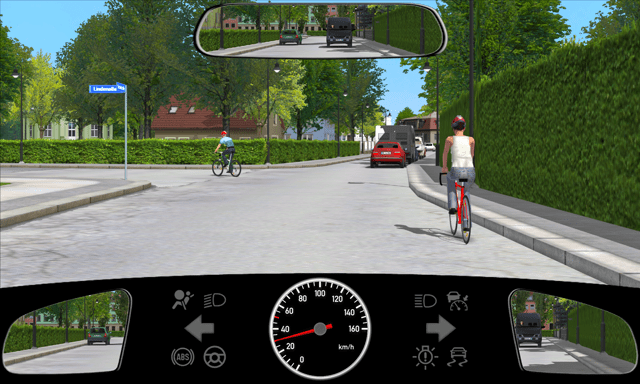
Spiegazione
You are not allowed to overtake because the cyclist could turn and the oncoming traffic is not detected in time.
-
Domanda 3 di 15
In quali situazioni si corre un rischio durante un sorpasso?
1.1.06-1045 PuntiSpiegazione
If you notice that the vehicle behind you wants to overtake you, do not increase your own speed under any circumstances. This prolongs the overtaking manoeuvre and can lead to dangerous situations. Before you start to overtake, make sure that the vehicle behind you is not about to overtake you. Otherwise they will have to brake heavily.
-
Domanda 4 di 15
In quali casi è necessario rinunciare al sorpasso?
1.1.06-1055 PuntiSpiegazione
Sudden oncoming traffic requires that an overtaking manoeuvre be stopped immediately. The same applies if the vehicle to be overtaken accelerates. This means that you can no longer estimate the overtaking distance and endanger oncoming traffic if you continue. If the vehicle being overtaken reduces its speed, there is no danger.
-
Domanda 5 di 15
Quando è vietato sorpassare?
1.1.06-1064 PuntiSpiegazione
If you encounter an unclear traffic situation, overtaking is prohibited. This applies in particular: - On bends - On unclear stretches of road - Immediately before and at junctions where the right of way is unclear - When the traffic situation is unclear - If you cannot judge exactly what the vehicle in front is doing. - If it would take you too long to overtake because your vehicle is not fast enough. Before overtaking, make sure that you do not endanger other road users and oncoming traffic.
-
Domanda 6 di 15
Perché sorpassare può essere pericoloso anche su strade rettilinee e ben visibili?
1.1.06-1115 PuntiSpiegazione
On a straight stretch of road, you may be able to see oncoming traffic from a distance, but often underestimate their speed. If an overtaking manoeuvre takes too long, dangerous situations can arise. If there is oncoming traffic, it is better to wait until the road is clear before overtaking.
-
Domanda 7 di 15
Cosa dovresti fare?
1.1.06-1145 PuntiSpiegazione
You just want to start overtaking the cyclist, when the blue car suddenly drives out of its parking space. Apparently, he has not noticed the cyclist yet. It might happen that the cyclist now moves to the left, without looking back. Immediately stop the overtaking maneuver to avoid endangering the cyclist.
-
Domanda 8 di 15
Cosa bisogna prevedere se si vuole effettuare un sorpasso?
1.1.06-1224 Punti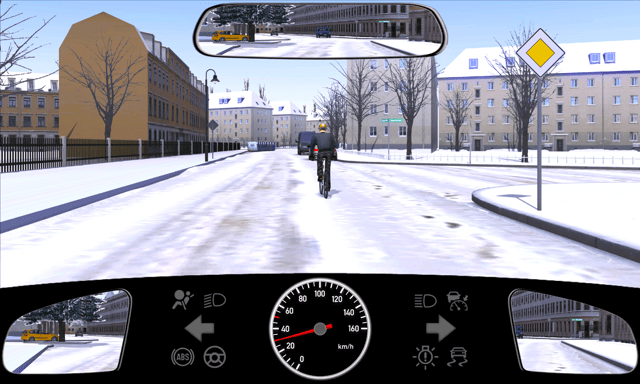
Spiegazione
On snow-covered roads, the braking and stopping distance is longer and there is also an increased risk of slipping. Cyclists in particular have difficulty riding safely. Their risk of falling is significantly increased. Keep a greater distance from the cyclist, also because his stopping distance is very long.
-
Domanda 9 di 15
Vuoi sorpassare dei ciclisti su una strada stretta. La larghezza della strada fa sì che lo spazio massimo possibile tra loro e l'auto sia di 50 cm. Cosa dovresti fare?
1.1.06-1245 PuntiSpiegazione
To avoid danger, as a vehicle driver you must always keep a sufficient safety distance of at least 1.50 metres when overtaking cyclists. If it is not possible to pass the cyclist at such a distance, you must not overtake him under any circumstances.
-
Domanda 10 di 15
Qual è la linea d'azione corretta?
1.1.06-1274 PuntiSpiegazione
The cyclist will overtake the lorry and pull out to do so. It is too dangerous to overtake him before the bend, as you may not yet be able to see oncoming vehicles. Only overtake the cyclist after the bend. As a general rule, you may only overtake if you can see that there is no danger to or obstruction of oncoming traffic during the entire overtaking process.
-
Domanda 11 di 15
In quale situazione è vietato il sorpasso?
1.1.06-1284 PuntiSpiegazione
Overtaking is prohibited here, because in these situations you greatly increase the risk of an accident as the person overtaking.
-
Domanda 12 di 15
Perché sorpassare su una strada rettilinea e senza ostacoli può essere pericoloso?
1.1.06-1305 PuntiSpiegazione
If you misjudge the speed and distance of an oncoming vehicle, your overtaking distance is longer than expected. This can cause accidents.
-
Domanda 13 di 15
Qual è la giusta linea d'azione ora?
1.1.06-1315 PuntiSpiegazione
The vehicle overtaking you has estimated its overtaking path too short. You should reduce your speed so that the overtaking person can re-enter earlier and that the risk of an accident is reduced.
-
Domanda 14 di 15
Perché in questa situazione non si dovrebbe sorpassare?
1.1.06-2014 PuntiSpiegazione
The overtaking lane is not visible due to the cyclists and the course of the road. If you cannot see the overtaking lane, you must not overtake. As you cannot go much faster than the cyclists, the overtaking lane becomes much longer and therefore more dangerous.
-
Domanda 15 di 15
Perché ora non ti è permesso sorpassare?
1.1.06-2024 PuntiSpiegazione
The cyclist swings to the left and looks over his shoulder. He will probably turn left. Reduce your speed to give the cyclist enough space and ensure that he does not feel pressurised. In this way, you will also avoid endangering the cyclist in the event of an abrupt braking manoeuvre and possible rear-end collisions due to a lack of distance.