
2.2.22 Carregar
Aprenda as regras mais importantes de segurança e transporte de carga de forma simples. Concentre-se na segurança, equilíbrio, visibilidade e estabilidade do veículo.
🚗 Carga de telhado e caixas de telhado
Efeitos importantes
- Centro de gravidade move-se para cima
- Veículo fica instável nas curvas
- Mais sensível a ventos cruzados
- A distância de frenagem aumenta
- A aceleração fica mais lenta
- O consumo de combustível aumenta
Lembre-se sempre
- Nunca exceda o limite de carga do telhado
- Proteja a bagagem com cuidado
- Evite alta velocidade
- Verifique as fixações durante as pausas
- A estabilidade de direção piora nas curvas
🏍 Carregamento de motocicleta
Erros perigosos
- Muito peso traseiro → oscilação
- Carga lateral irregular → manuseio instável
- Bagagem alta → efeito de vento cruzado mais forte
- Carregamento ruim → vibração e balanço
Comportamento Correto
- Distribua a bagagem uniformemente
- Aumente a pressão dos pneus, se necessário
- Ajustar suspensão/chassis
- Siga os limites de velocidade do fabricante
- Itens pesados baixos, itens leves altos
📦 Proteção de carga
Ferramentas de segurança corretas
- Correias tensoras
- Redes de segurança
- Tapetes antiderrapantes
Você deve garantir
- A carga não pode escorregar ou cair
- Nenhum ruído evitável
- Segurança do veículo não afetada
- A direção permanece controlável
Se a pulseira estiver danificada
- Substitua imediatamente
- Continue apenas com proteção segura
- O motorista é responsável
🚨 Regras de carga pendente
| Regra | Exigência |
|---|---|
| Saliência traseira ≤ 100 km | Máximo 3 metros |
| Saliência traseira > 100 km | Máximo 1,5 metros |
| Saliência frontal | Máx. 50 cm acima de 2,50 m de altura |
| Marcação Noturna | Luz branca dianteira, luz vermelha traseira |
| Projeção Lateral | Marque se > 40 cm de luzes externas |
🚛 Caminhões, vans e reboques
Fatos importantes
- Carga pesada nas costas causa movimento do pêndulo
- Carga irregular afeta a frenagem e a direção
- Observe os limites de carga por eixo
- Use plano de distribuição de carga
- Comprimento total máximo do trem: 20,75 m
Regras Especiais
- Mercadorias perigosas precisam de certificado ADR
- Caminhão que transporta lixo usa placa preta com “A”
- Motorista e titular são responsáveis
- Carga segura durante frenagens e curvas
🧠 Truques fáceis de memória
Carga alta = alto perigo → Centro de gravidade mais alto = menos estabilidade.
Itens pesados baixos → Melhor equilíbrio e travagem mais segura.
Carga solta mata → Prenda sempre com cintos, redes ou tapetes antiderrapantes.
Carga no telhado = mais vento → Dirija mais devagar em curvas e ventos laterais.
❓ Teste rápido
1. O que acontece com a bagagem de teto?
✔ O centro de gravidade aumenta e a condução torna-se instável.
2. Quais ferramentas protegem a carga?
✔ Cintos tensores, redes, tapetes antiderrapantes.
3. Quais cores de luzes marcam a carga saliente?
✔ Frente branca, traseira vermelha.
4. O que acontece com o carregamento pesado na parte traseira da motocicleta?
✔ Direção oscilante e instável.
Perguntas de Prática (18)
-
Pergunta 1 de 18
What do you have to observe when getting a load ready for safe road transportation?
2.2.22-1163 PontosExplicação
A distribution of the charge and the fixing of the selfsame and a backup of the device for securing the load you should be aware so that security is guaranteed. All three answers are correct.
-
Pergunta 2 de 18
What should be noted when loading vehicles?
2.2.22-1173 PontosExplicação
Cargo may protrude above a height of 2.50 m forward up to 50 cm above the vehicle. If the load protrudes more than 1 m beyond the rear reflectors of the vehicle, the end must be visually marked. Cargo needs to be secured carefully. Back-heavy loading causes dangerous pendular movements when driving faster. For motorcycles, ensure that the load is evenly distributed on the sides.
-
Pergunta 3 de 18
When is a centrifugal force exerted on the load of a truck?
2.2.22-1203 PontosExplicação
The centrifugal force affects your truck when cornering. go straight brakes or have no circular motion and are therefore not decisive.
-
Pergunta 4 de 18
How far may a labelled load protrude beyond the rear of your vehicle if your journey is more than 100 km?
2.2.22-1292 PontosCorreto: 1
Explicação
For distances up to 100 Kilometers, the load is allowed to overhang up to 3 meters. For distances over 100 Kilometers, the load is allowed to overhang up to 1.50 meters to the rear.
-
Pergunta 5 de 18
Which warning plate is correctly mounted?
2.2.22-2012 Pontos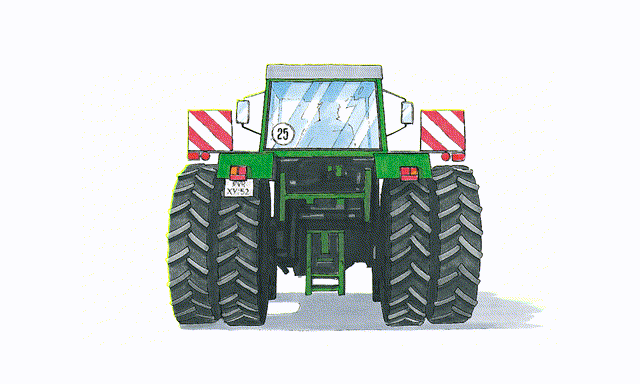
Explicação
As we need an A for (attention) the right warning sign is in place.
-
Pergunta 6 de 18
How can you determine that a truck is overloaded?
2.2.22-2033 PontosExplicação
To determine an overload, you can weigh again your loaded vehicle or by built-axle load measuring devices.
-
Pergunta 7 de 18
A truck for exchangeable load carriers (interchangeable containers) has a permissable total mass of 6,000 kg. The interchangeable container has an empty mass of 1,500 kg. Which mass are you allowed to stow in this interchangeable container?
2.2.22-2043 PontosExplicação
Empty weight (1500 kg) plus loading (4,500 kg) = payload (6000 kg) 4,500 kg is correct. In other words, payload (6000 kg) minus the empty weight (1500 kg) of the interchangeable container gives the load (4500 kg)
-
Pergunta 8 de 18
What do you understand by form-fit securing of the load?
2.2.22-2103 PontosExplicação
The positive load securing means that free spaces are closed between the cargo items by means of suitable filler, and the load is located directly on the end and side wall.
-
Pergunta 9 de 18
What do you have to consider when tipping bulk goods?
2.2.22-2163 PontosExplicação
When dumping of materials, please make sure that the vehicle is on sufficiently solid ground, and protective must be released so that the dumping body can be fully tilted.
-
Pergunta 10 de 18
Why is it necessary to observe the load distribution plan?
2.2.22-2173 PontosExplicação
In order to avoid exceeding the axle load, it is necessary to adhere to the load distribution plan. So you can also ensure the steering ability.
-
Pergunta 11 de 18
What is the purpose of a load distribution plan?
2.2.22-2183 PontosExplicação
The load distribution plan shows how the vehicle must be loaded. If the distribution is uneven, the braking behaviour changes greatly.
-
Pergunta 12 de 18
What could happen if your vehicle is not loaded according to the load distribution plan?
2.2.22-2193 PontosExplicação
The load distribution plan shows how the vehicle must be loaded. If the load is unevenly distributed, the braking behaviour will change considerably. Damage to tyres occurs and steering ability is also impaired.
-
Pergunta 13 de 18
What specific information can you find in a load distribution plan?
2.2.22-2203 PontosExplicação
The load distribution plan gives information on the load centre of gravity with the maximum permissible load.
-
Pergunta 14 de 18
Who is responsible for securing the load on the vehicle?
2.2.22-2213 Pontos -
Pergunta 15 de 18
What can help with friction-locked load securing?
2.2.22-2223 Pontos -
Pergunta 16 de 18
What should be taken into consideration when selecting load-securing lashing equipment?
2.2.22-2233 PontosExplicação
Among other things, the face and shape of the load are decisive for the selection of suitable and necessary lashing equipment. Equally important are the requirements of the vehicle, such as the permissible payload and the attachment points.
-
Pergunta 17 de 18
You want to secure your load by lashing it down. What should you bear in mind?
2.2.22-2243 PontosExplicação
When lashing down, the load is pressed onto the loading area using lashing devices to increase the friction force and prevent slipping. It is important to check the tension of the lashing devices, as the necessary contact force and thus the required friction can only be achieved with sufficient tension. In addition, this method is only suitable for dimensionally stable loads; flexible goods can deform under the tension, which means that the pre-tensioning force is lost and load securing is no longer guaranteed.
-
Pergunta 18 de 18
When must attached working equipment be marked with red-white warning plates?
2.2.22-3033 PontosExplicação
A red and white warning board is then to mount when it protrudes rearward more than 1 m on the rear lamps of the tractor if it has traffic hazardous parts and also when it laterally by more than 40 cm beyond the boundary or rear lamps of the tractor protrudes. All three are correct.