
2.2.22 Load
Learn the most important load securing and transport rules in a simple way. Focus on safety, balance, visibility, and vehicle stability.
🚗 Roof Load & Roof Boxes
Important Effects
- Center of gravity moves upwards
- Vehicle becomes unstable in curves
- More sensitive to crosswinds
- Braking distance increases
- Acceleration becomes slower
- Fuel consumption increases
Always Remember
- Never exceed roof load limit
- Secure luggage carefully
- Avoid high speed
- Check fastenings during breaks
- Driving stability becomes worse in curves
🏍 Motorcycle Loading
Dangerous Mistakes
- Too much rear weight → wobbling
- Uneven side loading → unstable handling
- High luggage → stronger crosswind effect
- Bad loading → vibration and swinging
Correct Behavior
- Distribute luggage evenly
- Increase tire pressure if necessary
- Adjust suspension/chassis
- Follow manufacturer speed limits
- Heavy items low, light items high
📦 Cargo Securing
Correct Securing Tools
- Tension belts
- Safety nets
- Anti-slip mats
You Must Ensure
- Load cannot slip or fall
- No avoidable noise
- Vehicle safety not affected
- Steering remains controllable
If Strap is Damaged
- Replace immediately
- Continue only with safe securing
- Driver is responsible
🚨 Overhanging Load Rules
| Rule | Requirement |
|---|---|
| Rear Overhang ≤ 100 km | Max 3 meters |
| Rear Overhang > 100 km | Max 1.5 meters |
| Front Overhang | Max 50 cm above 2.50 m height |
| Night Marking | White light front, red light rear |
| Lateral Projection | Mark if > 40 cm outside lights |
🚛 Trucks, Vans & Trailers
Important Facts
- Back-heavy loading causes pendulum movement
- Uneven load affects braking and steering
- Observe axle load limits
- Use load distribution plan
- Total train length max: 20.75 m
Special Rules
- Dangerous goods need ADR certificate
- Truck carrying litter uses black "A" sign
- Driver and holder are responsible
- Secure cargo during braking and curves
🧠 Easy Memory Tricks
High load = High danger → Higher center of gravity = less stability.
Heavy items low → Better balance and safer braking.
Loose cargo kills → Always secure with belts, nets, or anti-slip mats.
Roof load = more wind → Drive slower in curves and crosswinds.
❓ Quick Quiz
1. What happens with roof luggage?
✔ Center of gravity rises and driving becomes unstable.
2. Which tools secure cargo?
✔ Tension belts, nets, anti-slip mats.
3. What color lights mark protruding cargo?
✔ White front, red rear.
4. What happens with rear-heavy motorcycle loading?
✔ Wobbling and unstable steering.
Practice Questions (18)
-
Question 1 of 18
What do you have to observe when getting a load ready for safe road transportation?
2.2.22-1163 PointsExplanation
A distribution of the charge and the fixing of the selfsame and a backup of the device for securing the load you should be aware so that security is guaranteed. All three answers are correct.
-
Question 2 of 18
What should be noted when loading vehicles?
2.2.22-1173 PointsExplanation
Cargo may protrude above a height of 2.50 m forward up to 50 cm above the vehicle. If the load protrudes more than 1 m beyond the rear reflectors of the vehicle, the end must be visually marked. Cargo needs to be secured carefully. Back-heavy loading causes dangerous pendular movements when driving faster. For motorcycles, ensure that the load is evenly distributed on the sides.
-
Question 3 of 18
When is a centrifugal force exerted on the load of a truck?
2.2.22-1203 PointsExplanation
The centrifugal force affects your truck when cornering. go straight brakes or have no circular motion and are therefore not decisive.
-
Question 4 of 18
How far may a labelled load protrude beyond the rear of your vehicle if your journey is more than 100 km?
2.2.22-1292 PointsCorrect: 1
Explanation
For distances up to 100 Kilometers, the load is allowed to overhang up to 3 meters. For distances over 100 Kilometers, the load is allowed to overhang up to 1.50 meters to the rear.
-
Question 5 of 18
Which warning plate is correctly mounted?
2.2.22-2012 Points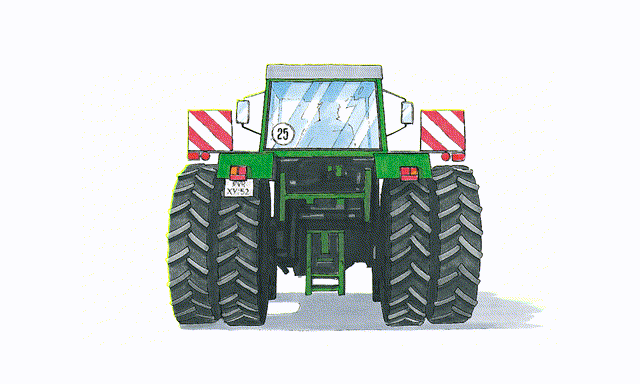
Explanation
As we need an A for (attention) the right warning sign is in place.
-
Question 6 of 18
How can you determine that a truck is overloaded?
2.2.22-2033 PointsExplanation
To determine an overload, you can weigh again your loaded vehicle or by built-axle load measuring devices.
-
Question 7 of 18
A truck for exchangeable load carriers (interchangeable containers) has a permissable total mass of 6,000 kg. The interchangeable container has an empty mass of 1,500 kg. Which mass are you allowed to stow in this interchangeable container?
2.2.22-2043 PointsExplanation
Empty weight (1500 kg) plus loading (4,500 kg) = payload (6000 kg) 4,500 kg is correct. In other words, payload (6000 kg) minus the empty weight (1500 kg) of the interchangeable container gives the load (4500 kg)
-
Question 8 of 18
What do you understand by form-fit securing of the load?
2.2.22-2103 PointsExplanation
The positive load securing means that free spaces are closed between the cargo items by means of suitable filler, and the load is located directly on the end and side wall.
-
Question 9 of 18
What do you have to consider when tipping bulk goods?
2.2.22-2163 PointsExplanation
When dumping of materials, please make sure that the vehicle is on sufficiently solid ground, and protective must be released so that the dumping body can be fully tilted.
-
Question 10 of 18
Why is it necessary to observe the load distribution plan?
2.2.22-2173 PointsExplanation
In order to avoid exceeding the axle load, it is necessary to adhere to the load distribution plan. So you can also ensure the steering ability.
-
Question 11 of 18
What is the purpose of a load distribution plan?
2.2.22-2183 PointsExplanation
The load distribution plan shows how the vehicle must be loaded. If the distribution is uneven, the braking behaviour changes greatly.
-
Question 12 of 18
What could happen if your vehicle is not loaded according to the load distribution plan?
2.2.22-2193 PointsExplanation
The load distribution plan shows how the vehicle must be loaded. If the load is unevenly distributed, the braking behaviour will change considerably. Damage to tyres occurs and steering ability is also impaired.
-
Question 13 of 18
What specific information can you find in a load distribution plan?
2.2.22-2203 PointsExplanation
The load distribution plan gives information on the load centre of gravity with the maximum permissible load.
-
Question 14 of 18
Who is responsible for securing the load on the vehicle?
2.2.22-2213 Points -
Question 15 of 18
What can help with friction-locked load securing?
2.2.22-2223 Points -
Question 16 of 18
What should be taken into consideration when selecting load-securing lashing equipment?
2.2.22-2233 PointsExplanation
Among other things, the face and shape of the load are decisive for the selection of suitable and necessary lashing equipment. Equally important are the requirements of the vehicle, such as the permissible payload and the attachment points.
-
Question 17 of 18
You want to secure your load by lashing it down. What should you bear in mind?
2.2.22-2243 PointsExplanation
When lashing down, the load is pressed onto the loading area using lashing devices to increase the friction force and prevent slipping. It is important to check the tension of the lashing devices, as the necessary contact force and thus the required friction can only be achieved with sufficient tension. In addition, this method is only suitable for dimensionally stable loads; flexible goods can deform under the tension, which means that the pre-tensioning force is lost and load securing is no longer guaranteed.
-
Question 18 of 18
When must attached working equipment be marked with red-white warning plates?
2.2.22-3033 PointsExplanation
A red and white warning board is then to mount when it protrudes rearward more than 1 m on the rear lamps of the tractor if it has traffic hazardous parts and also when it laterally by more than 40 cm beyond the boundary or rear lamps of the tractor protrudes. All three are correct.